
Publication in Russian on the Zen blog
https://dzen.ru/a/ZuFpBDSrbXogHwAl
The Real Problem with the Russian Economy. Economic theory provides clues to Russia's future; I argue that Russia's economic decline is not simply the result of demographic problems, but is rooted in a failure to embrace the division of labor and free trade advocated by Adam Smith. By examining Russia's markets, centralized control, and limited economic freedoms, I argue that without these fundamental economic principles, the Russian economy will struggle to thrive, regardless of demographic trends.
I INVITE YOU TO THE TELEGRAM CHANNEL
UNCENSORED
https://t.me/shipshard

In this post I want to talk about the demographic decline in Russia and its economic impact on Russia. Will this demographic decline lead to an economic collapse in the Russian system and what are the prospects for Russia in the next 20 years in the short term because of this demographic decline. In the previous post I discussed Ukraine and argued that this will not affect the economic success of Ukraine, Ukraine will prosper and I still stand by this claim and back it up by providing a lot of evidence related to Russia. What is the fate of Russia, if Ukraine can mitigate its demographic decline, can Russia too? The demographic decline argument comes up here, it is a Malthusian argument that was reinterpreted by Harvard economist Alvin Hansen in the 1930s in the context of the Great Depression and by Larry Summers in 2013 with the Secular Stagnation of Negative Real Interest Rates theory. It is a Kenyan argument and it does not correspond to reality now. In my publication "Demographic Decline and Economic Prosperity in Ukraine" I cited many historical examples of how this argument failed to materialize. So when you look at data and logic, you look at two things: either you want to look at the population data, as a scientist who studies human populations, like from a flying start, or you look at certain phenomena, say, diseases, and what are the effects of the disease; or you look at it from a logical-methodical approach, which is an empirical approach, which is actually not entirely logical, believe it or not, but logic is usually more powerful when it comes to economics. Because aggregate data cannot be fully trusted. We can see that demographics do not matter by using historical experience, historical data I gave in the previous article about Ukraine. For example, the potato famine in Ireland in the 19th century, when the country lost 30% of the population, and yet Ireland subsequently prospered economically. I am not saying that demographic decline is a good thing, and I definitely do not agree with the "golden billion" theory (read the previous publication "Demographic Decline and Economic Prosperity of Ukraine"). In addition to population data, we should look at other economic data. For example, Iceland, New Zealand, Canada, Denmark, Finland, Norway, Sweden are not in a worse economic situation than, say, India, the Philippines or Nigeria, so simply saying let's increase the population to achieve significant economic growth is wrong. Let's look at Russia and this idea that Russia can mitigate its economic decline, or maybe it cannot. I made the argument that demographics do not affect the economy. But what really affects the economy? Let's turn to Adam Smith in his "Wealth of Nations" of 1776, where two propositions are put forward that determine the wealth of a nation, the wealth of a country. The first proposition is specialization, the division of labor. And the second, most important, comparative advantage of free trade. His quote that the most any prudent family owner can do is never to try to make at home anything that costs him more than it costs to buy. What is prudent behavior for any private family can be applied to a great nation. So Adam Smith is refuting the idea of home production, which is currently being pursued by the Russian government. Adam Smith is saying that if you want to increase the efficiency of production, buy from abroad at a lower price. And now this may shock populists, but I use this argument. Look at this example: I live in Sochi and grow oranges. And my friend lives in Magadan, he grows apples and hearty garlic. And he sells them to me, and I sell him oranges. Theoretically, I could also grow the same apples and garlic, but it would not be as productive and not as tasty. He could also grow oranges, but he would have to build a greenhouse and so on, that is, growing oranges in Magadan would not be as productive as in Sochi. This is the comparative advantage of trade. And if Russia conducts aggressive conflict activities with everyone, then it deprives itself of the comparative advantages of free trade. And in the economic future for Russia, this will not lead to a good result, and will have echoes for the next 10 years, 20 years, 50 years. When a country is under global sanctions and when the country says that sanctions do not matter, but the country is trying to get around them, and this is a fact and proof that sanctions do matter for the Russian economy, which will shrink and collapse. Because the idea of the wealth of nations is that comparative advantage is achieved through free trade with countries, free movement of labor and capital. And the main point is related to the division of labor - the greatest improvement in the productivity of labor power, skill and labor skills. So how does this apply in modern Russia in relation to the Russian economy? I am not talking about some innate characteristics of the Russian people, but I am talking about the culture - this is the most passive and apathetic culture on Earth, it is not only sanctioned, which violates the comparative advantage of free trade, but also the most brutal. And if you look at Abraham Maslow's hierarchy of needs, Erik Erikson's psychology or Viktor Frankl, where it comes to human psychology, the search for meaning and the desire to realize oneself, the desire for self-improvement. When everybody does what they want, the world works most efficiently. But in an economy like Russia, people are treated like cattle. People don't want to do something just because they're motivated, because they really enjoy it, because they're not who they are. We all have a purpose in this world, but a command-and-control economy like Russia's, which is oppressive and unproductive with a passive and apathetic population, people don't use themselves to their full potential, they don't self-actualize. It sounds abstract, but think about it. In Russia, square pegs are hammered into round holes because the population thinks and says, "Oh, nothing else matters because I get paid a little more here." Earning a lot of rubles is not the way to become a winner, a winner is thinking outside the box, being creative, doing what you were meant to do in this life. The most effective way is the division of labor, when all people strive for their self-realization and creativity, this is the essence of civilized countries with a free economy. Therefore, demography will not affect Russia, this is not an effect, it is a symptom. Countries with a small population live quite well. But Russia does not have the infrastructure to support the prosperity of the population, and it does not have the necessary resources. The idea is that capitalism is a free market, transparent government, the triumph of justice and the rule of law. A country that fights for freedom and fights for it with all its might, like sparks or embers that catch fire and cannot be extinguished, such a country has a chance to develop. And such a country can and should be invested in. Russia cannot boast of such a future, and I would not invest in this country. Invest all your savings in the Russian economy, and see where it leads. In any case, no matter what you do, specialists - the best and brightest - leave Russia. Apathetic and passive, which will affect future generations of the cultural community, remain in Russia and in the Russian economy, which is collapsing and is about to collapse, because the country violated the laws of the Wealth of the Nation - specialization and free trade. That's all, this is the immediate history of Russia in perspective.
Демографический спад и экономическое процветание Украины
Томас Мальтус – английский ученый, демограф и экономист. Он – автор теории, согласно которой рост народонаселения приводит к снижению благосостояния и массовому голоду. Отсюда Мальтус считал войны и эпидемии подлинным благом для человечества, поскольку они помогают сократить количество народа на Земле, чтобы оставшиеся жили лучше.
В целом, надо понимать, что по всей видимости он и его последователи были провозвестниками будущей теории "золотого миллиарда" .
Адам Смит - шотландский экономист и философ-этик, один из основоположников экономической теории как науки. Считается основателем классической политэкономии.
Главный труд "отца" классической политической экономии Адама Смита, завершенный им более 230 лет назад, "Исследование о природе и причинах богатства народов".
Теория невидимой руки рынка, государство как ночной сторож - все это "Богатство народов".
Абрахам Маслоу - американский психолог, основатель гуманистической психологии.
Широко известна "пирамида Маслоу" - диаграмма, иерархически представляющая человеческие потребности.
Уникальные и увлекательные теории, формулы жизни идеи опережающие время.
Эрик Хомбургер Эриксон - психолог в сфере психологии развития и психоаналитик.
Известен прежде всего своей теорией стадий психосоциального развития, а также как автор термина "кризис идентичности".
Виктор Эмиль Франкл - австрийский психиатр, психолог, философ и невролог.
Известен как создатель логотерапии (исцеление смыслом) - направления в экзистенциальной психологии и психотерапии и как основатель третьей венской школы (после психоанализа Фрейда и индивидуальной психологии Адлера).
Это тот человек, который попытался вдохнуть человечность, духовность в свет психиатрии и это у него получилось.
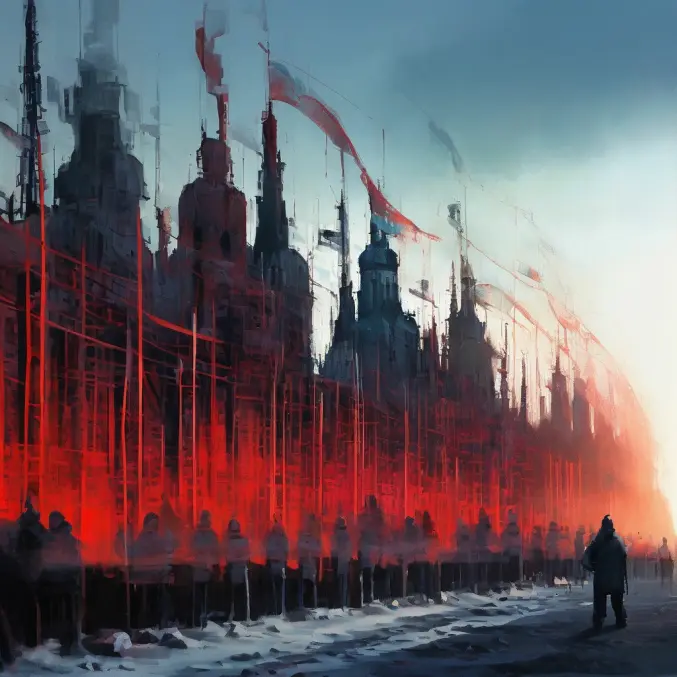
As my father used to say, don't let today ruin your tomorrow.
Unfortunately, war is when you spend today on something you will have to spend tomorrow to destroy what was created yesterday.
Peace and security allow people to focus on other things.
No innovation, no consumption, international trade only at low discount prices, but - demographic decline, currency collapse and, in the long term, debt, crumbling infrastructure on land, water and in the sky... This is Russia.
I suppose that the reason for the culture in the Moscow territories is that the state has always been ruled by an imperialist elite (whatever the superficial position in the simple political spectrum and whatever the method of selection of this elite). The simple, short-term interests of whoever forms the elite at any given time are to extract wealth from the imperial territories for use by the center (Moscow and St. Petersburg, as well as the security forces and the armed forces). Before industrialization, wealth was the product of the land, and that required at least a rural population (static and controlled by serfdom). Now, wealth is natural resources - a "dig and sell" economy requires few people. It is pointless and dangerous for the elite to educate the masses, improve their living conditions, or allow them to develop. The masses of poor, ignorant people are useful to the Moscow elite as a resource for expanding the empire. An educated, prosperous, individualistic middle class would be dangerous. Moscow brainwashes its population to regard collectivism and membership in a collective mind as a virtue and a unique culture, so that the population builds its own mental prison and is afraid to leave Moscow's embrace.
Countries trying to move their economies away from this type of model will face an uphill battle to move to a more egalitarian economy with distributed wealth. In Russia, no effort seems to be made to do so. All government actions only strengthen the existing model and do not provide or even allow the survival of an alternative socio-economic model. They protect the existing order using outdated stereotypes: "we are not the best, but everyone hates us."
One of the founders of Google (now Alphabet) Sergey Brin is Russian. Sergey was born on August 21, 1973 in Moscow, Russia. The best and the brightest leave and contribute to more dynamic economies, such as the United States.
Corruption is a tax on productivity, which significantly reduces production capacity, as well as innovation.
The most important thing in the economy is legal certainty, in Russia there is none.
In Russia, many do not understand the meaning of the term "capitalism". Capitalism is a free economy and free enterprise, free trade, free movement of labor and capital. And not the capitalism with its parasitic greed, where loyalty to the tsar is more important than freedom. The term oligarchic capitalism is more applicable to Russia. The wealth of nations is determined by freedom.
Author's video content.
In collaboration with CMCproduction & SmartREC video studios
https://www.youtube.com/c/ViolettaWennman
https://ok.ru/shipshard1
https://vk.com/shipshardvk
https://www.pinterest.ca/omegagirs/
https://dzen.ru/shipshard
https://t.me/shipshard
Publication in Russian on the Zen blog
https://dzen.ru/a/ZuFpBDSrbXogHwAl






