
Publication in Russian on the Zen blog
https://dzen.ru/a/afZ7XO8_N2It3mZY
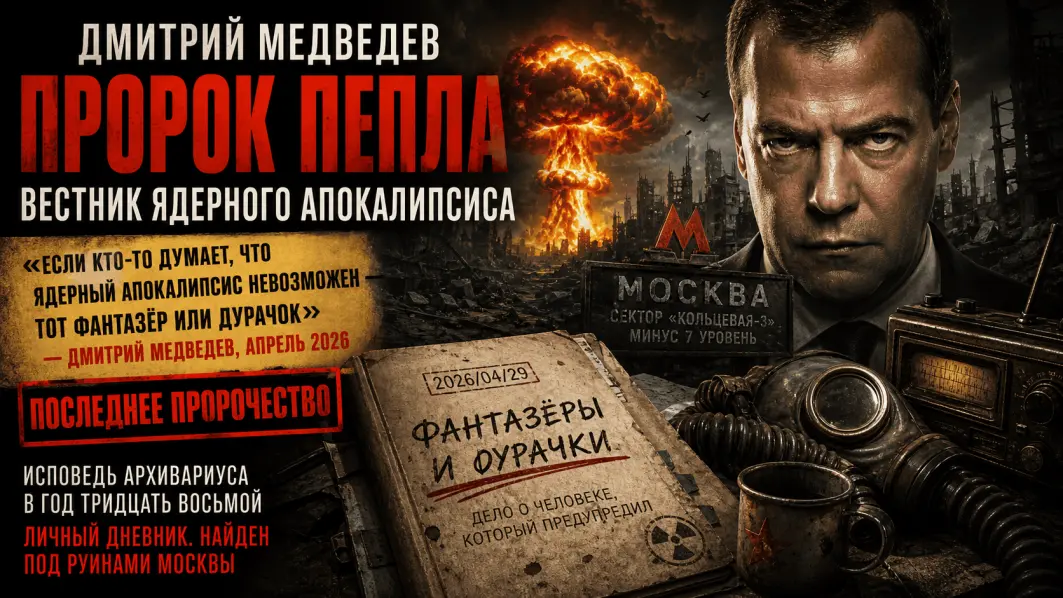
"If someone thinks that a nuclear apocalypse is impossible, he's a fantasist or a fool."
— Dmitry Medvedev, April 2026. The Last Prophecy
The confession of an archivist in the year thirty-eight.
Post-apocalyptic noir. "Confessions of an archivist." A personal diary. It was found in a lead container under the ruins of a library in a sector that used to be called Moscow.
Prologue: About those who stayed below.
They say it's minus forty degrees and grey snow on the surface now. They say it's because none of those who got up came back. And those who did not get up, sit in their holes, listen to the hum of ventilation and remember how once the sun did not require a dosimeter.
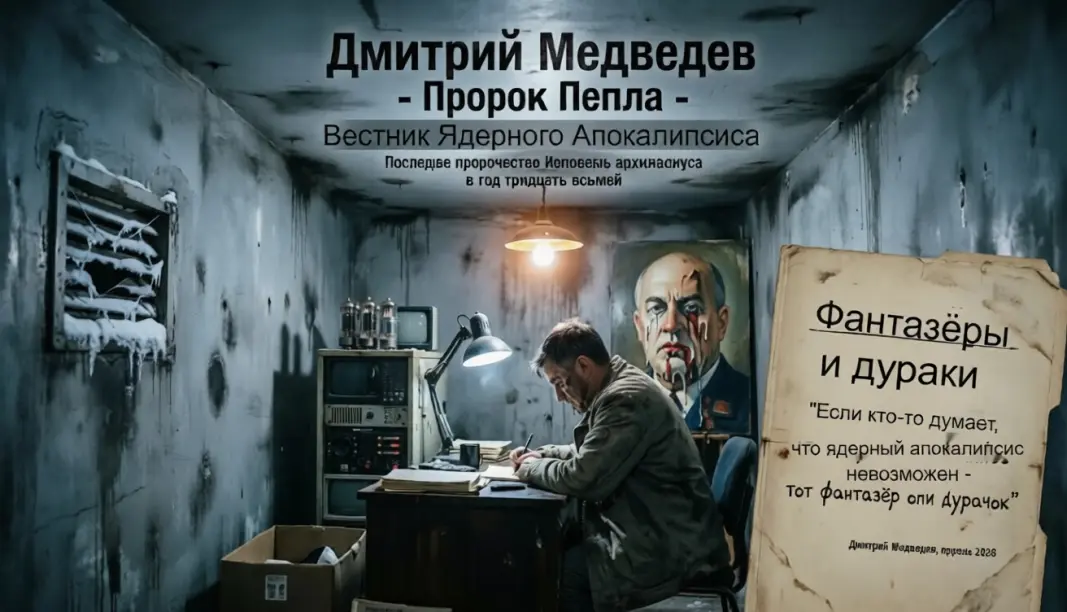
My name is Arkady. There is no last name anymore — the last names are left at the top, along with mailboxes, tax returns and the illusion that the state remembers you. Here, on the minus seventh level of the former subway, I have only a service number, a cough and a position: archivist of the Ministry of Memory.
It sounds solid. In fact, I'm sitting in a three—by-four room, between a buzzing lamp logic server and a portrait of the Great Guarantor, whose paint has leaked from radiation so that he looks like a crying Pierrot. My job is to catalog the "pre—war information noise." That is, to read the news of those years when there was still a difference between news and reality. When the word "apocalypse" wasn't the headline for a morning collection of memes.
Today I have folder number 2026/04/29 on my desk. From above, by hand, in pencil, fountain pens have long since run out.:
"Dreamers and fools." The case of the person who warned.
Outside there is grey snow and silence.
Inside is a sixty—watt lamp and me.
Go.
Chapter One: The voice that we stopped noticing.
There's a digitized recording from that marathon in my headphones. The sound floats, hisses, like an old radio in a thunderstorm. In the frame is a man in a suit. Still quite alive. I'm still pretty confident. He speaks calmly, like a man who orders coffee in a Vienna coffee shop, where the cup costs like lunch in a good restaurant. Says:
"If someone thinks that a nuclear apocalypse is impossible, he is a fantasist or a fool. It is really possible, although I would really hate for that to happen."
I'm pausing it. I'm rewinding it. I'm listening again. And again.
Then I pour myself some muddy water from a canteen — they give me clean water on coupons, and the coupons were cut last year— and I think: Here it is, the moment. A shot that was supposed to be a worldwide scandal. The frame that became background noise.
I have a separate drawer in my filing cabinet, a metal one with rivets that rust faster than I can wipe them. It says in marker: "Reactions of the world, April 2026." I'm opening it.
— Daily Express: "A frightening warning." Two days later, a crossword puzzle and a story about a princess will be on the front page.
— Russian state media: "Sober realism". Two days later, an Easter cake recipe and tips on gardening in the countryside. Radioactive ash is an excellent fertilizer, according to the comments.
— Telegram: Memes, A wave of images. "The Triad will save you." "Nuclear Winter as a service — subscription starting from 299 rubles per month." "Medvedev-apocalypse, new DLC, fire graphics, singleplayer, waiting for the patch."
I close the drawer. There is dust and a thin crack on the lid. Just like everything else in this world. The crack goes from edge to edge, and if you look at it from a certain angle, it looks like the lid is about to fall apart in two halves. Like this world. Like our attention. Like the promises we were given before it became possible not to make promises.
Do you know what I've learned over the years? Shock is a resource. And we've exhausted it. Completely. Below zero. There wasn't even enough left on the bottom to dip your finger and draw a line.
Chapter two: Dossier: A former liberal and a future prophet, or Two photographs of one soul.
In the lower safe, a heavy one with a combination lock that has been beeping on its last battery for three years, there is a dossier on the main character of our story. The Ministry of Memory loves these files. Especially now that the defendants themselves are no longer there. Not them, not their offices, not their chairs, not their Telegram channels with tens of thousands of subscribers. The servers burned down in the first forty minutes after the sky turned orange. But paper, as you know, survives even where chips fail.
I open the heavy folder. There are two photos inside. Two epochs. Two people in one body.
The first one, 2010. Silicon Valley. The sun. Smiles. The young man is clean—shaven, in a perfect suit that fits as if it was sewn specifically for this picture. He shakes hands with the man who was then called the President of the United States. On the table is a mock—up of the first iPhone. The glass glitters. The future is shining. In the caption under the photo: "He starts a Twitter account. Discusses START III. He talks about modernization and innovation." The word "Skolkovo" does not sound like an expletive yet. The word "reboot" is not yet ironic.
The second one, 2026. The same person. Completely different. The eyes are like two drilled holes in a concrete wall. Smiles — no, disappeared, like childhood memories disappear after the first serious injury. On the background is a stylized map of Europe highlighted in red. Fire. Ash. Dark. There's a microphone in his hand. Not an iPhone. Microphone.
I look at these two photos and realize that there are not fifteen years between them. There is a whole geological epoch between them. The era in which the man who discussed reducing nuclear arsenals became the world's foremost speaker on their use. An era in which the words "security" and "triad" have been reversed. The era in which we stopped asking the question "why" and started just nodding.
How did this happen? And that's where the fun begins. And the scariest part.
Chapter three: Chronology of ordinary madness (a tutorial for posterity).
The archivists have a professional joke. We repeat it in quiet moments when the ventilation is quiet and radioactive water is not dripping from the ceiling. It sounds like this:
"Escalation is when yesterday's madness becomes today's headline and tomorrow's educational material."
In the case of the 2026/04/29 folder, this is no joke. This is a tutorial. This is a detailed summary of how insanity is normalized.
I put the cards on the table. Each is a verified statement. Each is a small step towards a big abyss. I've memorized them over the years, but I still reread them every time, just like the first time. Because if you stop rereading, you'll stop being surprised. And if you stop being surprised, it means you're already dead. You're just still breathing.
September 2022.
"Russia has the right to use nuclear weapons to defend 'new territories.'"
It was a shock then. I remember sitting in my old apartment, up there, where there's only ash and wind now, and looking at the screen. His mouth was open. The coffee was freezing in the mug. I thought: "This is the end." No, that was the beginning. We just didn't know then.
January 2023.
"The defeat of a nuclear power in a conventional war inevitably leads to a nuclear war."
Simple arithmetic. Addition. Subtraction. On which all other arithmetic is reset. That was the first time someone said the word "escalation" out loud. And we all nodded together — yes, escalation, it's scary, but what can we do?
May 2023.
"A nuclear apocalypse is likely, but not a foregone conclusion."
What an elegant word — "not a foregone conclusion." It's like it's about the Academy Award or whether your favorite football team will win. As if you can place a bet in a bookmaker's office. Odds: apocalypse — 2.5, peaceful sky — 1.8. Place your bets, gentlemen.
2023–2024.
Threats to London. Berlin. To Washington. Regularly. Every two weeks. Like washing. Like going to the supermarket on Saturdays. Like brushing your teeth in the morning.
May 2024.
Publication of a map of Europe with nuclear mushrooms. Not white. Atomic. At that time, the first meme appeared in the chats: "New DLC, graphics are on fire, optimization is lame, we are waiting for a patch: developers fix the "destroy the whole world" button."
November 2024.
The new nuclear doctrine. Triggers are expanded. What was a Telegram post yesterday has now become a paragraph in an official document. Attention, users: The Prophet of Ashes works as a test server. First, he rolls out the update through himself, looks at the reaction of the community — who is stalling, who will remain silent, who will start arguing. And then the patch goes to the prod. And everyone pretends that it was like that.
February 2026.
START III is about to expire. They don't extend it. No one comes to the funeral. The legal framework is destroyed, like old asphalt under the wheels of a tank. And no one calls to say, "Can we sit down and talk?" No. Everyone is silent.
April 2026.
"Dreamers and fools." The final compilation. The apotheosis. Top.
I look at this series — from 2022 to 2026 — and I don't see chaos. I can see the train schedule. Only everyone has one destination. And you can't be late. And the tickets have already been bought. And we all sit in the carriage, look out the window at the ashes floating by and pretend that it's just a landscape.
Chapter Four: Three versions of the same ending (instructions for analysis).
The Ministry of Memory has an internal instruction. It was also written by my mentor, Comrade Vershinin, the one who taught me to distinguish signal from noise, and noise from nonsense. The instruction says: when analyzing the pre-war period, one cannot limit oneself to one reason. It's always three. Always in parallel. They always reinforce each other. Like three nails in one board. Like three engines on one bomber.
In the case of the Prophet of Ashes, this scheme works flawlessly. It's been tested for years. Tested by sleepless nights.
The first version. Personal survival.
The man lost real power in 2020. His chair is an honorable one, but without wires in the socket. In a system where voice volume is directly proportional to loyalty, a quiet official is a dead official. He will be forgotten. They'll erase it. They'll replace it with a new one, the same one, but louder.
He chose the niche of "chief hawk". And she fed him. Speaking of the apocalypse, he was escaping from his own political oblivion. Every radioactive post was his little resurrection. Every threat is a small reminder.: "I'm here. I'm still alive. I can't be deleted."
Ironically, in order to stay in the system, he had to scare everyone with the end of this very system. It's as if the captain of a sinking ship started shouting, "We're sinking!"—not to save the passengers, but to be heard at headquarters and promoted to admiral.
The second version. The "Bad Cop" algorithm.
The first person always spoke more softly. Hints. Pauses. Philosophical digressions. Ellipsis, for which everyone was thinking their own way. Medvedev took on the dirty work.
He formulates the "red lines" as rigidly as possible. No hints. Without pauses. Without philosophy. If the West flinches, great, the goal has been achieved. If the West is outraged, the system can always roll back: "This is just a personal opinion of the deputy. Have you read the official doctrine? Everything is balanced there."
Comfortable. As an emergency exit. It's like a second door in a dentist's office: one for patients in ties, the other for an ambulance.
The fact that I have checked in all available archives is that the Kremlin has never officially distanced itself from his words. Not once. The press secretary, like a good firewall, always confirmed: "The position has been agreed with the management." This is not a solo. It's a duet. It's just that one sings the part of the first violin, and the other sings the part of the fire siren.
The third version. A psycho-viral attack.
Constant spam about nuclear weapons is a DDoS attack on the brains of the Western man in the street. The goal is simple and cynical: to get a voter in Ohio or Bavaria to ask their politician the question: "Is supporting Ukraine worth the risk of World War III?"
Fear is irrational. Fear votes. Fear pushes through decisions that rational calculation cannot push through. It is enough to sow one grain of doubt, and the political will cracks. And if you sow every week, the crack turns into a rift. And the rift turns into a chasm.
Pre-war studies (I keep them in a separate folder) showed a direct correlation: the more often nuclear rhetoric was heard, the more votes those who promised "caution" and "peace at any cost" received in the elections. Fear worked as a vaccine against courage.
All three versions worked simultaneously. Like three engines of one bomber. And do you know what the funniest thing is? The bomber flew. To the point. Until the finish line. Until the very button that was talked about so much. Not the button you thought of, no. The button that was pressed was neither red nor nuclear. It was the mute button.
Chapter Five: A footnote that I'm rereading with bated breath (about submarines and Telegram).
There is a separate sheet in the folder. Yellowed. With streaks — either from water, or from time, or from the fact that someone was crying right over him, realizing the absurdity of what was happening. At the top is a note — "extremely strange", written in pencil, which has long been worn down to a tiny stump.
On the sheet is an excerpt from the American press. April 2026. The title is in large letters. I am translating it for those who have forgotten English along with the hope of a peaceful sky.:
"The US president ordered the relocation of two nuclear submarines closer to the Russian borders. The reason is "provocative statements by Medvedev." At the end, the president added a phrase that I underlined in red: "Words matter."
I often reread this piece of paper. It's the same picture in my head every time. Somewhere in the Atlantic, at a depth of two hundred meters, the commander of a submarine with nuclear missiles on board receives an order to change course. Not because of the missile launch. Not because of the maneuvers of the troops. Not because of the early warning signal.
Because of the Telegram post.
Think about it. A nuclear submarine. Two hundred meters of water. Thirty knots of travel. Twenty-four ballistic missiles. And the commander changes the route because some person - important, very important, but still some person — wrote in his channel about "dreamers and fools."
This moment is the whole essence of our pre—war civilization. We have spent half a century building strategic stability. Contracts. Communication lines. Hotlines. Verification systems. Inspections. All of this turned out to be more fragile than a smartphone screen.
And when I think about it, I start coughing. But not from dust.
Chapter Six: Night whispering to yourself (a counterargument that keeps you awake).
Sometimes, when the lights are turned off (and they are often turned off — the system is old, the lamps are half on, and the generators are working intermittently), I lie on my cot and stare at the ceiling. There's a crack in the ceiling. Like everything else. I count her curves, just as I once counted sheep.
And at some point in the silence, when the ventilation stops humming and only my breathing remains, I think: what if he was right?
What if it wasn't a performance? What if it was a real warning? What if he really knew something we didn't? Suddenly, he saw graphs, intelligence, analytics that did not reach the townsfolk? Suddenly, behind all this rhetoric, there was not a desire to scare, but the desperation of a person who understands that no one is listening?
And then I remember the wording. "Dreamers." "Fools." I remember the memes that the defendants themselves liked. I recall the context in which all this was said — not at a secret meeting, not at closed-door negotiations, but at an educational marathon. Between the performances of the folklore ensemble and the lecture on healthy eating.
A serious person who warns of a real threat does not speak the language of an anonymous channel. He's calling on a secure line. He sits down at the table with his opponents. Requires negotiations.
A serious warning is a silent one. It doesn't need stands. It doesn't need hashtags. It doesn't need memes.
And when it's loud, with effects, with quotes for headlines, with repetitions like a spell, it's no longer a warning. It's a scene. And the main problem with the scene is that sooner or later it gets confused with reality. First— the audience. Then the actors.
And when an actor starts to believe in his role, it's already a diagnosis. And this diagnosis is called "installment apocalypse."
Chapter seven: The Economics of Fear, or a conversation with Lev Markovich.
In the next sector, through two corridors and one door, the old man Lev Markovich works. Before the war, he was a Doctor of Economics. After that, the watchman of radiation sensors. The salary is a ration and the right to charge the phone from an outlet in the control room sometimes.
Lev Markovich does not like to talk about the past. He says that the past is like fresh bread: those who live upstairs have it, but we only have breadcrumbs. But he repeats one phrase often. Almost every time we meet in the hallway.
"Arkasha, remember the law of attention preservation. It works flawlessly. Tested on crises, wars and defaults. When the bread situation in the country starts to suck, the end of the world appears in the news. It's like a thermometer. If the thermometer shows a high temperature, do not look at the thermometer, look for inflammation."
I wrote this phrase down in my notebook. And, going through the folders for 2022-2026, I discovered that Lev Markovich was right. Accurate to the week.
The worse things went "on earth", the louder the talk about "heaven" became.
Is inflation reaching double digits? The Triad saves the Fatherland.
Is the budget deficit growing by leaps and bounds? The nuclear doctrine expands the triggers.
Are defeats at the front becoming too frequent to cover up? A map of Europe in radioactive ash is immediately published.
It's just like the notes. As per the textbook. As ordered.
This is not a conspiracy theory. Conspiracy theory suggests the existence of a conspiracy — that is, a secret group of people who came up with all this and implements it according to plan. I do not know about the secret group. Maybe there is one. Maybe it doesn't exist. But even if it doesn't exist, the mechanism works by itself. Because the apocalypse has always been the best way to write off any losses with the stroke of a pen. Write off, but not cancel.
And it worked. For the time being. Until that glass hour when everyone stopped shaking.
Chapter Eight: The Lieutenant Colonel who is No More (the story of one rescue).
In my file cabinet, under an iron lid, in a separate folder marked "Heroes about whom textbooks are silent", there is one name. Stanislav Petrov.
If you've forgotten who it is, I'll remind you. The year is 1983. The Cold War is in full swing. The Soviet Union's early warning system records the launch of American intercontinental ballistic missiles. The screen turns red. The sirens start wailing. The algorithm prescribes: report to the command immediately.
Petrov, a lieutenant colonel in the rocket forces who was on duty that night, decided not to report. He didn't believe the car. He thought: "The system made a mistake." And I was really mistaken — the sun's glare on the upper atmosphere was mistaken for a launch.
If Petrov had pressed the alarm button, other buttons would have been pressed. Lots of buttons. And we wouldn't be here. Not you, not me, not this basement, not our conversations. Nothing. Emptiness.
Petrov saved the world. Just without clicking the button. Just by doubting. Just keeping my cool at a time when everything was screaming: "War!".
I often think: what would have happened if an operator from the twenties had been in Petrov's place? A cameraman who has been reading the word "apocalypse" on the news every day for the past four years? An operator whose alarm threshold has been erased like a coin in a tramp's pocket? A cameraman who has seen hundreds of memes about the nuclear winter and thousands of posts about radioactive ash?
Will he be able to distinguish another performance from a real threat in this information noise?
Will he be able to keep his cool when the system shows the launch, and yesterday's phrase about "dreamers and fools" is still ringing in his ears?
I do not know the answer. And that scares me more than any of the words of the Prophet of Ashes. Because composure is a resource. It, like oil, can be exhausted. Just talking. Drop by drop. Post after post. Threat after threat.
I think we've exhausted it.
Chapter nine: About the last yawn (a lesson from Comrade Vershinin).
When I was a young intern at the Ministry of Memory — young, naive, with burning eyes and the belief that the truth is somewhere nearby, you just have to dig into the archives — my first mentor, Comrade Vershinin, told me a phrase.
We were sitting in his office. He was smoking. I didn't smoke. Through the blue smoke, he stared somewhere at the wall, on which hung an old map of the world - the one on which there were no gray areas and radioactive spots yet.
He said:
"Arkasha, remember this for the rest of your life. A civilization does not fall from a blow. Civilization is falling because it takes too long to discuss the impact. At first, with horror. Then — with fear. Then — with the hope that it will pass. Then — with irony. Then with a laugh. And then — with a yawn. And everything ends with a yawn."
I didn't understand it then. I thought it was a beautiful aphorism, but no more. Now, after years spent poring over folders filled with other people's fears, I understand. I understood everything.
Folder 2026/04/29 is a yawn document.
There was not a single shocking statement in this story that would have changed anything. There was not a single phrase after which the world would wake up differently. There was no point of no return—the wrong day, the wrong month, the wrong year.
It was a long, methodical process of getting used to it.
At first, people froze. Then they twisted their finger at the temple. Then they laughed. Then they made memes. Then they wrote in the comments: "Our prophet turned on the siren again." Then they stopped commenting. Then they stopped reading to the end. Then they scrolled through it without even opening it.
And one day, we scrolled through the last post.
And a few months later, they scrolled through reality.
Chapter ten: A note that I won't send (an appeal to those who are still upstairs).
I am closing the folder 2026/04/29. I cough like an old man, even though I'm only thirty—eight. I turn out the lamp. The room gets dark. Only the control diode on the server glows dimly — green, like a hope that has nothing to cling to.
A siren is wailing somewhere above.
But this is no longer the siren that warns of radiation or an air raid. It's just a background sound. Familiar. Just like you, upstairs, before the war — the sound of notifications in the messenger. Are you awake? Turned it off? Have you turned down the volume? Have you clicked "do not disturb"?
If anyone ever finds this diary, I want them to know one thing.
The man in the suit with the microphone, he didn't press the button. He didn't press the button. It was our indifference that pushed the button. Gradually. Over the years. One like click at a time. By silent scrolling. Tired, "he's at it again."
Was he a fantasist or a fool? No.
He was a megaphone.
And the megaphone, as you know, is silent by itself. The sound in it appears only when it is spoken. And only when there is someone to listen to.
We listened. And they applauded. Until the last second. And then they stopped listening. But they continued to applaud. Because applauding is a reflex. How to dodge the siren. How to frantically check the dosimeter. How to search for a familiar face and familiar words in the news feed — "triad", "ashes", "dreamers and fools".
Instead of an epilogue: a request from a man who will no longer go upstairs.
So if you, the one who is reading these lines, are you, the reader, if you still live upstairs in a world where there is sun, coffee, Internet, the opportunity to go outside without a dosimeter and buy bread that does not smell of iodine, I have a request for you.
One. Small.
The next time someone says the word "apocalypse" from the podium, don't make a meme.
Don't scroll through it. Don't shrug your shoulders. Don't write "uncle, you're tired, go get some rest" in the comments. Do not like for the sake of laughter and repost for the sake of karma.
Just stop.
Just for a second.
Turn off the sound in your head. Move the phone away. Take a deep breath. And ask yourself — softly, slowly, as if you are talking to someone who can no longer answer.:
"Who's talking?"
"To whom?"
"And why now?"
Maybe that one second is enough to not miss the moment when the joke stops being a joke. When the performance becomes a reality. When the meme turns into an order.
Maybe this one second will be enough for you not to have your own archivist Arkady. Coughing on the minus seventh floor over a folder with your name on it. Sorting through yellowed sheets. Questioner: Did you scroll through the last warning or did you stop?
An afterword from the patrol group (found on the spot).
The diary was discovered by a patrol group of the Koltsevaya-3 sector during a planned bypass of underground utilities. The detection time is 03:47 local time. The condition of the room is that the door is open, the lamp is on, and the ventilation is working. There were no signs of a struggle or intrusion.
The author of the diary, presumably archivist Arkady (the service number has not been established, the accounts of the Ministry of Memory for 2038 have not been preserved), was absent at the time of the group's arrival. Personal items are in place. The water flask is half full. The 2026/04/29 folder was not found in place. Disappeared. She disappeared. Like a lot of things in this world.
According to the patrol group, the author most likely died of radiation sickness shortly after the last recording. The lamp on his desk was still on when the patrolmen entered. The food is of unknown origin. There has been no voltage in the outlets for three years now.
Recommendation: send the diary to the central repository of the Ministry of Memory, the "Certificates" sector. Vulture: "For official use. Read with the lights off."
End of recording.
Grey snow falls on the surface. The siren wails, fades away, wails again. Someone up in the old world, where there is still sunshine and hope, is scrolling through the news feed. He sees a familiar face. He hears familiar words. He thinks, "Again." And clicks "next".
And below, on the minus seventh level, the lamp goes out. Past. The one that burned for sixty-three hours without a break. It went out.
Dark.
And in this darkness there is only a voice. Taped, digitized, overwritten, compressed, lost, and found again. The voice that says:
"If someone thinks that a nuclear apocalypse is impossible..."
The recording stops here.
The very last footnote, already from the future (or what's left of it).
Forty years after the events described in the diary, another lead container was found in the Koltsevaya-3 sector. Inside is a notebook. Another. Not Arkady. Someone who came after.
The first page:
"Comrade archivist, if you are reading this, it means that the lamps are still on. So you're alive. So, there is someone to remember. It's quiet upstairs now. The Prophet of Ashes no longer broadcasts. They say his channel was deleted for violating the rules. Or he left on his own. Or it was deleted along with the channel. Or along with the city where he lived. It doesn't matter.
Something else is important. We've learned not to scroll. Gradually. Difficult. But we've learned. Now, when someone says the word "apocalypse," we listen. Until the end. And we ask your questions: who? To whom? why?
Thanks for the folder 2026/04/29. She helped. Not for everyone. But I helped those who survived.
P.S. Your lamp is still on. We took her away. They put it on a memorial. Next to the photo of Lieutenant Colonel Petrov. Two lamps — two hopes. Enough for another civil war. And then we'll see.
P.P.S. We have restored the last name. By the service number. Your name was Arkady Vershinin. In honor of your mentor. You've never told us about this. We figured it out for ourselves.
Sleep well. The siren is gone.
We turned it off.
The next time someone tries to turn it on, we won't scroll through it. Let's stop. Let's ask.
On the word of an archivist.
Of which there are two now.
We're counting."
end.
The document is based on a diary found in the Koltsevaya-3 sector. The version is for public review. The original is stored in a lead container under seven locks.
Archive of the Ministry of Memory. The forty-fifth year after the sky turned orange. The "Certificates" sector. Shelf number seven. Shelf number three.
The lamp is on.
If you've read this far, you haven't scrolled through. Thank you.
Now, please don't forget. Tell others. Not a meme. Not a repost. In words. Gradually. Calmly. Like Arkady.
Honestly. It helps sometimes.
Even when it seems that nothing will help anymore.
The Dark Art of Dystopia by Violetta Wennman
PARSING, SYMBOLS, MEANINGS.
WE ANALYZE, COMPARE, AND UNDERSTAND.
Welcome to a world where the future is already written.
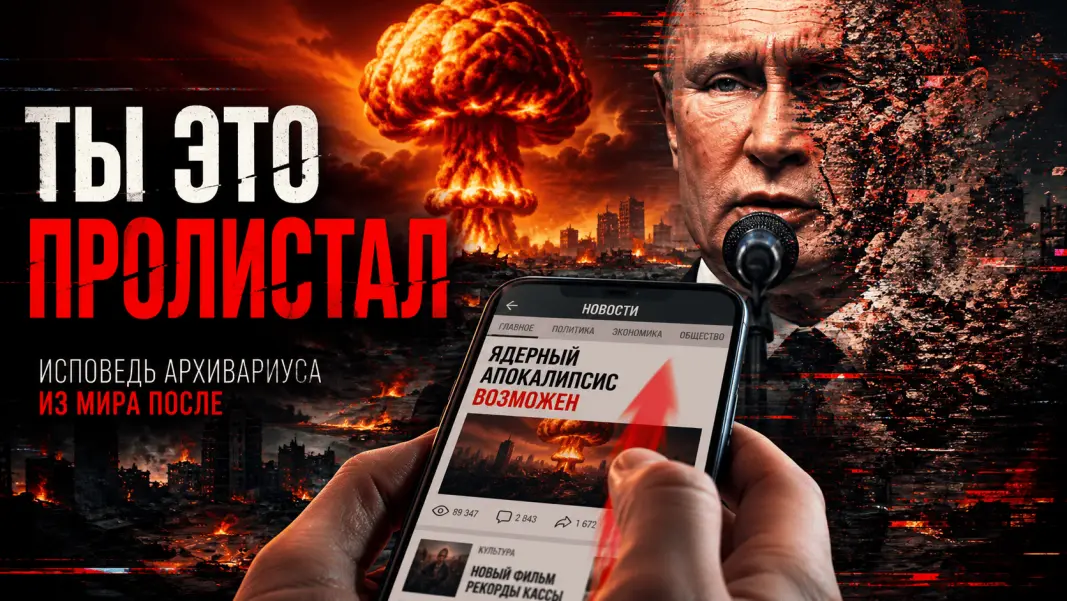
I write and shoot. Join me
Author's video content
https://www.youtube.com/c/ViolettaWennman
Political trash
https://www.youtube.com/@Ship-Shard
I invite you to the telegram channel
https://t.me/shipshard
Highly Social on Zen
https://dzen.ru/shipshard
To buy caramels to ruin your teeth
https://dzen.ru/shipshard?donate=true
My hobbies are history, philosophy, psychology, music, economics, politics, and sociology. I write about this and much more. Professional model. She has performed at international music festivals (vocals, dancing, imitation of vocalists). I am studying at the Academy of Arts - the film and art industry, I am a producer and the owner of a video studio.
I am glad to see all of you in my blogs.
Violetta Wennman (archive) (the surface of the Earth before the Nuclear Apocalypse)
I'm waiting for you here so I don't get lost. https://t.me/shipshard





