
World War II lasted from 1939 to 1945 and involved over 30 countries including the world’s largest and most powerful countries. The implications of this battle are still felt today as it was by far the deadliest conflict the world has ever seen that resulted in close to 85 million people dying. Warfare has been consumed by technology that led to tanks, airplanes, huge naval ships, improved weaponry, and ammo causing more death than had ever been believed possible. Previously shut down industrial centers like Detroit and Chicago were brought out of the Great Depression and were now at full capacity. The political, social, and economic change illustrated unprecedented shifts in the power that continued to see Money Changers starve off the population from normalcy. We will discuss what led to the conflict, the important politicians and Money Changers involved, important events that took place during this period, and the important statistics that will boggle your mind.
Let’s remember how in Germany, the Treaty of Versailles, created by Money Changers in the United States blamed Germany for starting World War I and led to severe territorial losses, economic downturns, hyperinflation, and political instability. The government that ran Germany at the time of the signing and through the Great Depression was the Weimer Republic. However, the suffering of the lower and middle classes for the reasons we just discussed led to the Weimer Republic being on the hot seat and the citizens of Germany looking for a new leader to run their country. Enter Adolf Hitler.
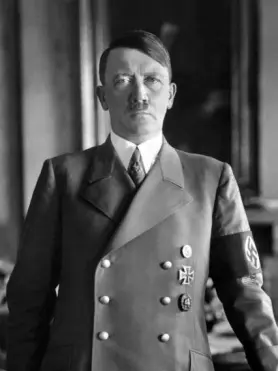
(Portrait of Adolf Hitler, 1938)
Adolf Hitler was a decorated war Veteran from World War I who led the National Socialists German Workers Party or National Socialists, which would eventually be known as the Nazis. Hitler and his faction continued to gain support and allegiance from people throughout the region by provoking racist and explosive discharge in his speeches. They began in the 1920s as one of the many parties that were involved with German politics at the time. They didn’t have much support at first until Hitler attended the first meeting and his enthusiasm and passion for public speaking became apparent to his peers. Hitler was originally sent to the National Socialists gathering in order to gather political intel for the Weimer republic military to use against their opposition, but after listening to their anti-sematic beliefs and rationales for why Germany was losing power, he was swayed to join their small organization and eventually, Hitler became the leader of the National Socialists and started to gather support from his robust and blunt attitude and dialogues.
He put the blame for the loss of German Power on anyone who wasn’t deemed to be a “Pure German”, Jews, Marxists, and anyone who supported the opposition party in Germany at the time, known as Liberals, who signed the Treaty of Versailles and put German in an irrational amount of debt which was a major contributor to their hyperinflation occurrence which led to destruction in their economy. The party still had trouble gaining prominence in other parts of Germany besides Bavaria. The economy was recovering and politics became less hostile as a result.
There was one action that Hitler took that really was the turning point for his popularity within the region and that was the Beer Hall Putsch in 1923. Because the Nazis weren’t gaining popularity in politics across Germany, Hitler decided to do something drastic, storm a public meeting in Munich that was being held and viewed by people across the political spectrum. Hitler declared a revolution and the genesis of a new government. This display was quickly dispersed over the next 24 hours and 20 people were reportedly killed during the entire instance. Hitler was arrested and convicted of Treason and was sentenced to 5 years in prison which he only served a little over a year.
Hitler may not have known it at the time, but this failed attempt to overthrow the government is perhaps the most important factor that led to him being the eventual takeover of Germany for two reasons. The first reason is that he gained massive publicity from newspapers, media, politicians, and business people across the country from the failed revolution. His speeches in the courtroom were being heard across the country and people were hearing rumblings of this decorated war veteran from Austria trying to become the ultimate power in Germany and submit a new ideology to their culture, even if they didn’t know it yet. The second reason is that it gave him time to write his autobiography which spewed his rhetoric, increased his popularity, and established his fame. The autobiography titled, “Mein Kampf,” or “My Struggle” was eventually published and sold over 1,000,000 copies through two volumes from 1925-1933.
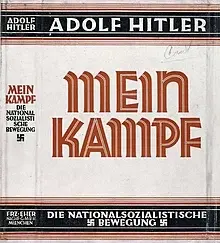
(Dust jacket of the book Mein Kampf, written by Adolf Hitler. Courtesy of the New York Public Library Digital Collection.)
After Hitler was released from jail, he was eventually barred from public speaking in Bavaria. In response, Hitler appointed some of his closest followers to spread the word of this new movement throughout Germany and it was beginning to gather more and more traction. Then perhaps one of the most catastrophic economic events in the world took place, which allowed Hitler and his party to catapult to higher power and influence throughout the region. This event happened on October 24th, 1929 when the United States stock market crashed and caused the Great Depression which had waves felt throughout the world. In Germany, like other countries in the world, major banks collapsed, jobs were lost and the cycle of hunger, homelessness, and poverty began all over again.
One of the banks collapsed with the Creditanstalt that was being managed by the Rothschilds since 1855. After Austria lost in the first World War, the country faced financial difficulties and some of its largest manufacturing companies had to shut down. In October 1929 the Austrian government passed on its debts and liabilities to the bank, to try and stabilize its balance sheet, which led to disaster. Some historians believe this bank failure was the event that caused the Great Depression in the United States. Creditanstalt had to declare bankruptcy in 1931, which sent even further shock waves throughout the world, however, it was eventually saved by Chancellor Otto Ender and he distributed shares of the company to the Weimer Republic, the Rothschild family, and the Australian Central Bank. This failure of the bank, led by the Rothschild Jews, allowed Hitler to extend his message and allowed him to compel millions of Germans that Jews were responsible for the economic disaster that was infecting Germany. The Nazi party was on the rise and went from hardly being recognized as a political party to earning over 18% of the seats in the lower house of the German government.
In April 1932 Hitler ran for President but lost to the incumbent. Even though Hitler lost, his campaign solidified the legitimacy of the Nazi party and himself as a representative of the party, who continued to give violent public speeches and secretly plan to take over all of Europe. Meanwhile, incumbents in government were fighting over who should have power and trying to recreate the entire voting system. Nazis and communists continued to have violent clashes in the streets, which usually led to death. The internal turmoil in the country led to the German Chancellor Franz von Papen making a compromise with Hitler that he would recommend to the 84-year-old President Von Hindenburg to appoint Hitler as Chancellor to calm the public, which now made up a plurality of Nazis, as long as Franz Von Papen could remain vice-chancellor. In January 1933, Von Hindenburg made Hitler Chancellor, and Papen was made vice-chancellor. Political figures like Papen and Von Hindenburg were under the false assumption they could contain the spread of Hitler's influence and were overall powerful, but they would soon realize they would make the worst mistake in their lives and actually be empowering a single-party dictator to run Germany.
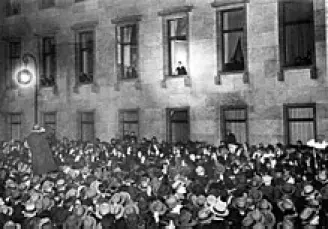
(Hitler, at the window of the Reich Chancellery, receives an ovation on the evening of his inauguration as chancellor, 30 January 1933.)
An arson attack on the Reichstag building in February 1933 caused the Nazi party to quickly suppress the communists, who Nazis believed carried out the act in response to Hitler being made Chancellor, by refusing to allow communist participation in elections and convinced the Reichstag to give him powers that could be used without the consent of parliament, the constitution or the president (Bullock 1991, pp. 147–148). Initially, this act was intended to be temporary, and last only four years. Hitler would be able to rule without any restraints, even while President Hindenburg remained in office. Hitler continued his suppression of opposing parties and gathered supporters by force and persuasive public speaking. Then, in August 1934, Hindenburg died, and Hitler combined the power of the Chancellor and President followed by forcing the German military to take a Hitler Oath, that would swear “unconditional obedience to Hitler Personally, not to the office or nation” and a formal law would be put in place less than 3 weeks after President Hindenburg’s death solidifying the Nazi ruler (Hoffmann 1977, pp. 27–28). Hitler was now the dictator of Germany only one year after the election of President Franklin Roosevelt in the United States. The Weimer Republic was replaced by the Nazi party and now his secret plans would have the potential to be carried out in the real world. Meanwhile, nations around Europe had all of their eyes on Germany.
Hitler quickly began to take legal and political control over the German military and paramilitary who supported him. He would fire, replace and strip over 70 Generals in four years (Kershaw 2008, pp. 397–398). In August 1934, Hitler appointed a new minister of Economics whose sole purpose was to prepare the economy for war (McNab 2009, p. 54.). New infrastructure projects were created that would create new highways, railroads, damns and other important developments that mimicked the United States New Deal, except it was Hitler’s New Order. Hitler would withdraw from the League of Nations and disobey the Treaty of Versailles by beginning the mobilizing of a military force by increasing the size of his standing soldiers to 600,000, building up his Air Force and Navy. Although Hitler was breaking the rules of the Treaty, foreign nations stood by idle, allowing it to happen (Messerschmidt 1990, pp. 601–602.).
In 1935 Italy, led by Mussolini, invaded Ethiopia to take control of the African territory and expand their colonialism ideals. Ethiopia was nowhere near as industrially advanced as Italy at the time and was ill-prepared for the air raids, tanks, and advanced machine guns the modern Italian military was using at the time. Throughout the war, the Italian military would deploy mustard gas against Ethiopian civilians and troops, attack the Red Cross indiscriminately, use expanding bullets, castrate the enemy military and carry out mass genocide. During this time, Italy was part of the League of Nations and Ethiopia was making desperate calls to the League to intervene on their behalf. Nothing was done.
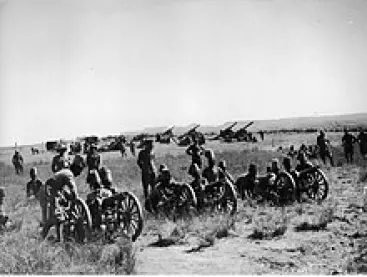
(Italian Artillery in March 1936)
From 1936 to 1939 the Spanish Civil War was fought between Republicans and Nationalists. Mussolini and Hitler would support the Nationalists by giving them soldiers, weapons, equipment, and resources for the goal of creating a Europe that was led by powerful fascists who led by force and fear. The Nationalist party would end up winning, putting former General and now dictator Francisco Franco in power as their supreme leader. Franco would create internment camps for the political opposition which housed nearly 500,000 people in over 50 different prisons across Spain. Throughout the years, Spain would be a country with extreme tension surrounding its leaders and democracy and involved important controversy that we may get to in future sections. But for now, Hitler could carry out without the threat of intervening in Spain. The Spanish government still hides a great deal of information from the public regarding the event because of the massive horrors that occurred.
In June 1936, Hitler began sending troops to the Rhineland, which at the time was demilitarized and in violation of the Treaty of Versailles. In the same year, Hitler formed an alliance with Benito Mussolini in Italy. While partnering with Japan in 1938 by recognizing Manchukuo, the Japanese State after Japan invaded Chinese Manchuria. This triple alliance formed the spine of the Axis Powers. Also, in 1938 Hitler threw out his Minister of War, and gave himself the position, showing that his ultimate goals were military conflict to gain territory, power, and international influence that he believed rightfully belonged to Germans.
Hitler was now a full-fledged military dictator that had his goals set on expanding his territorial control over Europe while surrounding superpowers like Great Britain and France stood idle while they dealt with recovery from World War I and the depression. Hitler’s first target to extend his territory was to take back land that previously belong to Germany before World War I, Austria, and Czechoslovakia. Austria consisted of many ethnic Germans, nearly the entire country spoke German and supported the Nazi's views. Therefore, the Austrian population welcomed an absorption of Austria into the German Nazi regime with open arms when troops began storming their largest cities in 1938. This was a relatively peaceful change.
Czechoslovakia was a country that was created after World War I and the Treaty of Versailles. It was broken up into two major ethnic populations the Czechs to the west and the Slovakians to the East. The Czechs in the west, and especially the Northwest sympathized with Nazi views and were happy to be adopted by Germany. The formal adoption of this area of German support, called the Sudetenland, was formally made part of Germany during the Munich Agreement that was signed in October 1938. This agreement allowed Hitler to take over the Sudetenland in agreement that he would not seek any more territorial gains in Europe. This compromise caused him to be on the cover of Time Magazine’s Man of the Year award in 1938 because it was celebrated across the globe as preventing another continental conflict (Time, January 1939). Great Britain’s Prime Minister Neville Chamberlain celebrated this agreement as a symbol that Europe would remain peaceful. He was dreadfully wrong. In March 1939, Slovakia would declare independence from Czechoslovakia with German protection and would become a satellite state for the Nazis. The next day, Hitler would invade the rest of the Czech region, which violated the Munich agreement, and took control over the territory (Shirer 1960, p. 448). Meanwhile, Great Britain and France remained watching on the sideline as Hitler gained more land, population, and resources to support his regime, even though Chamberlain swore the Munich Agreement, which Hitler just violated, was the ultimatum of sworn European peace.
Germany's next target was Poland, which he saw as vital to take control of the continent. In 1939, Joseph Stalin was becoming fearful of Hitler’s power and asked for support from Great Britain and France, which was once again fatally ignored. As a result of the Ignorance, Stalin negotiated a non-aggression pact with Hitler, which was beneficial to Russia’s survival. It was also beneficial to Hitler, as it was an important goal of his to take control of the territory. The agreement stipulated that Russia would get the Eastern part of Poland, while German would get the Western half. On the first day of September in 1939, the Nazis ordered their troops to invade Poland and took over with little resistance. Two days later, Great Britain and France had enough and declared war on Hitler’s Germany.
The wars began and now it was up to the military and financial might of the Allies and the Axis powers to determine who would emerge victorious. To extend his reign and power, Hitler invaded Denmark and Norway in 1940 and had a swift victory. His next target was France, which he invaded in May 1940. Also in May 1940, British Prime Minister Chamberlin stepped down and was replaced by Winston Churchill, who had an uphill battle to face in the coming years. France was also easily defeated because of the lack of resources France had produced leading up to the war. Their main strategy had been defense, and Germany’s military strategy of Blitzkrieg was much more effective in surprising the allied forces.
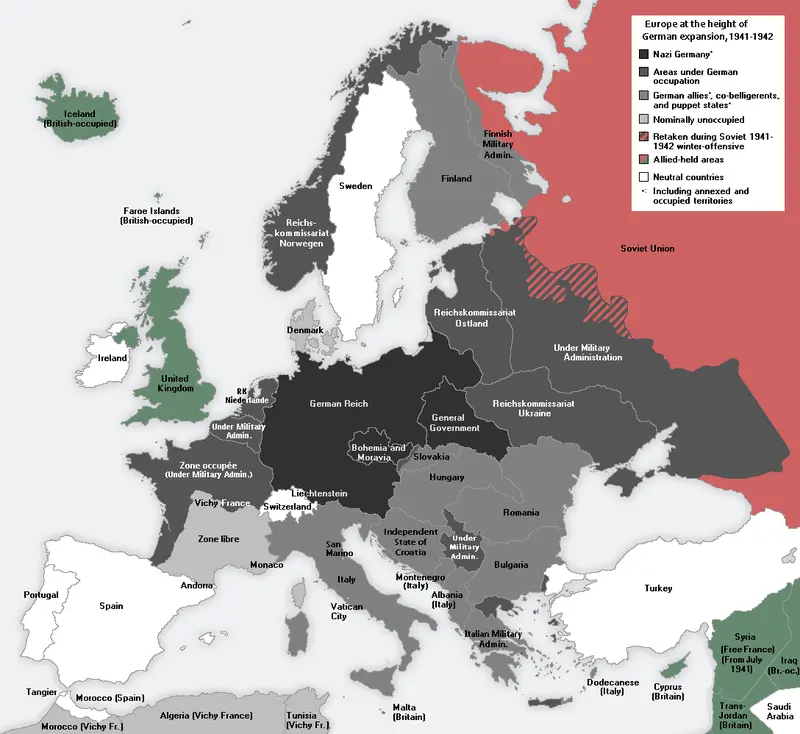
(Europe at the height of German military expansion in 1942)
338,000 British troops who were supporting France were forced to leave the country during operation Dunkirk, where German air raids would bomb troops waiting to be taken to safety and lead to 17,000 dead soldiers. Later in 1940, the Tripartite Pact would be signed by Italy, Japan and Germany, officially recognizing the cooperation between the nations. Hungary, Romania, and Bulgaria would also join at a later date (Roberts 2006, pp. 58–60.).
Throughout World War II, Hitler was carrying out the systematic genocide of over 6,000,000 Jews, nearly 2/3 of the ethnic group’s European population through mass shootings, gas chambers, and incineration. Hitler’s plan began immediately after he became chancellor in 1933 with the segregation of opposing political parties and religions. Anyone who opposed Hitler's vision would be segregated from the general public and blamed for the economic crisis that was occurring throughout Europe during the Great Depression. In 1935 the Nuremberg Laws were enacted that made it illegal for German to have sex with or marry Jews. This law also sought to make pure Germans by only allowing people to gain citizenship if they had German in their bloodline. During the Holocaust, doctors and scientists would experiment on Jewish men, women, and children. One of the most prominent German doctors was named Josef Mengele, nicknamed the ‘Angel of Death’.
In 1943 Mengele was transferred to the Auschwitz concentration camp where he would perform numerous inhumane experiments that would usually lead to the participant's death. They would test subjects’ ability to withstand poisonous gas, be injected with deadly diseases, freeze them, give them head injuries, be forced to have blood clots, and starve. Mengele was especially interested in twins. From 1943-1944 Mengele experimented on over 1500 sets of twins while only 100 pairs survived (Josef Mengele and Experimentation on Human Twins at Auschwitz). In some instances, Mengele tried to create conjoined twins by cutting off their body parts and sewing them together. All of these experiments failed, resulting in the patient’s death (Black, Edwin (2004). War Against the Weak). His favorite subjects to carry out this unethical and inhumane treatment involved twins, pregnant women, disabled individuals, and little people. Most of the subjects would be subject to mass shootings, incineration, or gas chambers after the doctors were done experimenting, or they were done dissecting their remains.
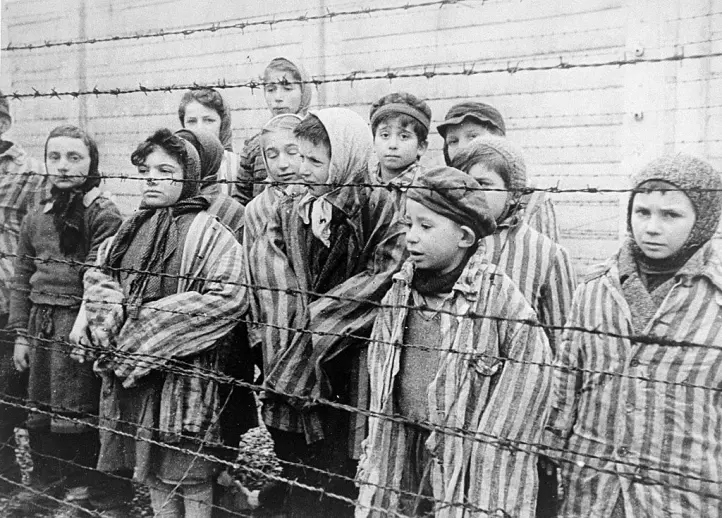
(Jewish twins kept alive in Auschwitz for use in Mengele's medical experiments)
In addition to Jews, other ethnic groups were being rounded up by German soldiers and taken to these concentration camps including Russians, prisoners of war, homosexuals, blacks, political opponents, religious opponents, and more. The ultimate goal of Hitler's Germany was to create a pure German that ruled all of Europe and Asia. However, the mistreatment these people were experiencing would scare their lives forever, and still affects families and ethnic groups whose populations have yet to recover from the humanitarian disaster that was Hitler and the upper echelon of his regime.
1941 seemed to be a large turning point in the war which saw the progress of Germany slow down. This started in June 1941 when Hitler went against the non-aggression pact it had with the Soviet Union and sent over 3,000,000 troops to the border. Although the invasion was successful by the Nazis and gave them the ability to take over the Baltic region, Belarus and western Ukraine, and regions in the Middle East the Germans now had to fight a war on multiple fronts and the resource expenditure would be vast to supply their military forces with the proper equipment and machines to be successful in war.
Then on December 7th, 1941, Japan attacked Pearl Harbor which brought the United States into World War II and Germany declared war on the United States four days later. Let’s take a step back for a second. In Europe, Germany was taking over massive territory on the mainland. Great Britain and France were struggling to make up for any of the lost ground that fell to Hitler in the past two years and Europe was dangerously close to becoming a Nazi state. Great Britain had a new Prime Minister, Winston Churchill, who had great relationships with President Franklin Roosevelt and made desperate calls to the United States that Great Britain and France needed foreign intervention. However, there was a problem. Prior to the events at Pearl Harbor, the United States' entrance into the World War was extremely unpopular. In fact, prior to the events, Robert Stinnett argues that as much as 80% of the US population was against joining the war (Pearl Harbor. Official Lies in an American War Tragedy). When World War II started, it was mainly viewed as a European conflict, and with Americans still hurting from the Great Depression, which saw World War I veterans failed to get paid, it was safe to say the Americans were reluctant to get involved in another massive foreign conflict.
So, what could the United States do? Well, the answer lies in the McCollum memo, that was sent by Lieutenant Commander Arthur McCollum to the White House over a year prior to the Pearl Harbor attack. McCollum was part of an intelligence agency that spied on and intercepted Japanese messages between one another. McCollum had important connections to the White House that would ensure President Franklin Roosevelt saw the messages, including high-ranking officials in the Office of Naval Intelligence and Roosevelt's Secretary of War. On October 7th, 1940, around one year prior to the events on Pearl Harbor. McCollum would send a memo to the white house labeled an eight-action plan. The memo states, “It is not believed that in the present state of political opinion the United States government is capable of declaring war against Japan without more ado, and it is barely possible that vigorous action on our part might lead the Japanese to modify their attitude. Therefore, the following course of action is suggested”.
McCollum goes on to list eight separate actions the United States government could do to incite war with Japan, and sway public opinion. One of those actions was action F, to move the Pacific Fleet to Pearl Harbor. So, President Roosevelt meets with a Naval Commander in charge of Pearl Harbor on October 8th, one day after receiving the memo, and instructed him to move more carriers and naval ships to the Pearl Harbor Naval base. Action D and E included sending Naval Ships into Japanese territory, to instigate attacks. These were called ‘pop-up’ cruises. During this action, Roosevelt had discussions with Secretary of war Stimson describing how “I [FDR] don’t mind losing one or two cruisers, but do not take a chance on losing five or six” (Stinnett, Robert. "Chapter 2: FDR's Back Door to War". Day of Deceit. p. 9). Action H, which was a complete oil embargo on Japan created by FDR in July 1941, was desperately felt because of the lack of natural resources on mainland Japan. It seemed as if the FDRs administration’s main goal was to provoke Japan into an attack that would sway public opinion on the United States joining the war.
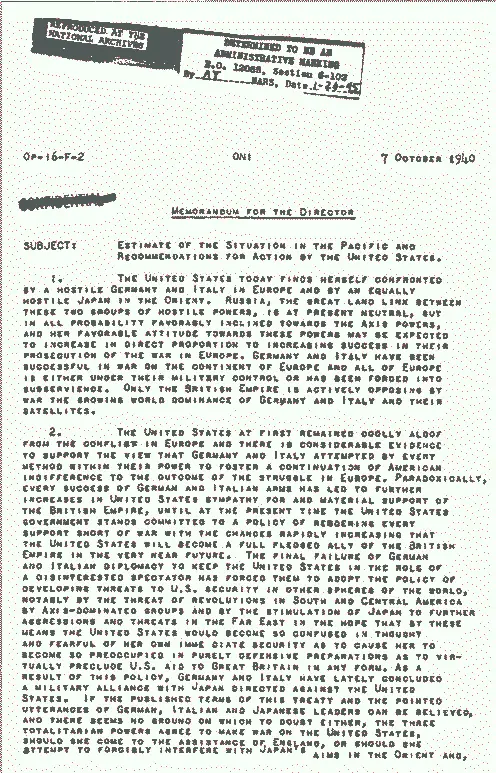
(McCollum memo, page 1)
In addition to the United States provoking the attack, there were clear signs that Japan was going to attack, yet those messages were going ignored. In January 1941, after the United States was able to decode all diplomatic messages in Japan, ambassador to Japan Joseph Grew intercepted a message that explained Japan’s plans to bomb Pearl Harbor by the end of the year (Fox 10 Phoenix). The individual who was tasked with diagnosing the seriousness of the issue was Arthur McCollum, the same person who wrote the eight-part action plan. (Robert B Stinnet. Independent Institute Talk). McCollum stated there was nothing to worry about, and the message should be ignored.
In addition, United States intelligence agencies and naval officers knowingly allowed a Japanese spy in Hawaii named Takeo Yoshikawa. Takeo would fly, dive, drive and roam around the area to become familiar with the patterns of the naval ships in the base’s harbor (Ron Laytner. "The Last Samurai"). He arrived in the United States in March 1941. Every two weeks he would send a message to the Foreign Ministry, which was then passed on to the United States Navy. By this time, we were able to decrypt every message that was being coded and it was understood he was in the area. In September 1941, Takeo would send a message to Japan that divided pearl harbor into an accurate grid, which showed areas of concentration of naval ships and important landmarks. The message was decoded in October and once again, dismissed by top Naval officials.
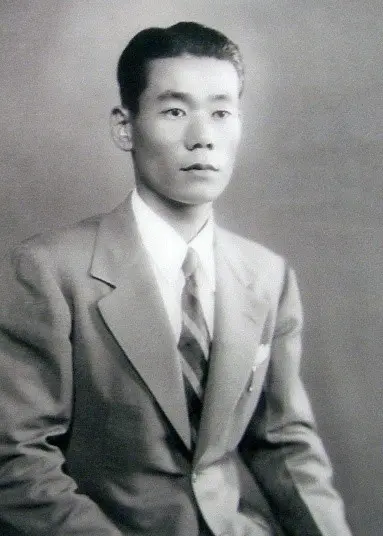
(Portrait of Takeo Yoshikawa)
Then, in November 1941, General George Marshall, who was Chief of Staff of the United States Army, the highest-ranking officer in that branch, meet with the media to discuss top secret information. After getting the members of the press to swear to secrecy, Marshall met with members of the press such as the New York Times, Newsweek, Time Magazine, the Associated Press, and more to tell them about the probability of war in the first week of December after decoding an encrypted Japanese message. Rather than telling the naval officers in Pearl Harbor about the potential of war, Marshall told the media who were not allowed to share the topic. (Robert Stinnet. Independent Institute Talk). One month later, on December 7th, 1941 “a day that will live in infamy”, as FDR would put it, the Japanese would send over 350 military planes in two waves to drop bombs on the Pearl Harbor Navy base in Hawaii. The attack would claim more than 2400 American lives, including civilians, and injure over 1100 more. (Rosenberg, Jennifer. January 23, 2019, "Facts About the Japanese Attack on Pearl Harbor")
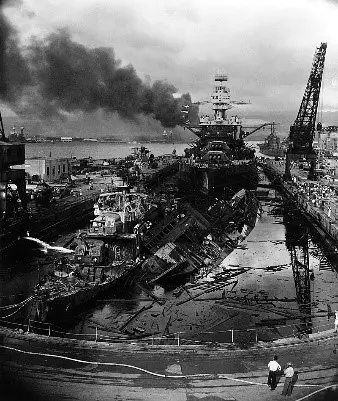
(The Pennsylvania, behind the wreckage of Downes and Cassin)
The United States would declare war on Japan on December 8th, which pulled them into war with Germany and Italy as well. Domestically, in response to the attack, Pearl Harbor was used as an important piece of political propaganda to encourage young men to volunteer for the war effort. In addition, FDR issued an executive order that would pull Japanese-Americans, including men, women, and children, out of their homes and place them in intermittent camps. All Japanese citizens were forced to leave Alaska, and over 110,000 Asian Americans in California were incarcerated and subject to forced labor, imprisonment, and reeducation. When a poll was taken in 1942, over 93% of the participants were in favor of the relocation of Japanese Americans ("Public Opinion Poll on Japanese Internment - Americans and the Holocaust"). Then in 1988, President Ronald Regan signed a reparations act that formally apologized for the government’s actions and paid 20,000$ to all remaining survivors of the World War II internment camps.
With the United States now involved in the war, they were able to send massive numbers of troops to Europe to help in the allied war effort. Once the United States entered, Germany began to lose battles against Russia, Africa, and in the Middle East from 1941-1944 and suffered huge defeats that saw millions of troops dead and German influence getting pushed back. In addition, in 1943 Mussolini was removed from office by Italian King Victor Emmanuel III after a successful allied invasion of Sicily. This event led Mussolini to be hated among the Italian community and would eventually be executed in 1945 by revolutionaries in Italy.
Furthermore, the Allied powers were able to begin their retaking of France during Operation Overlord, the nickname for the Battle of Normandy. The invasion of western Germany, previously France, started with the largest amphibious operation in history, the Normandy Landings or simply D-Day on June 6th, 1944. The Normandy Landings were one of the most intense logistical coordination in human history and consisted of around 1200 airplanes bombing the land trying to soften the landing zone and close to 160,000 troops sailing from Great Britain, across the English Channel to the European mainland, with 2,000,000 troops Arriving by the end of August. In addition, the U.S. military had to “ship 7 million tons of supplies to the staging area, including 450,000 tons of ammunition” (History Channel, D-Day Facts). However, the causalities were also large for both sides, with more than 220,000 causalities for the allies and 530,000 deaths or injuries for Germany. This massive attack by the allied forces began the pushback of German forces in France and would gradually build momentum for more victories.
In 1944 President FDR would be re-elected as president for a fourth straight time. His ability to win the election four times would cause an amendment to be added to the constitution down the road. FDR had an intense hatred for Hitler, and once the allied powers began winning numerous battles Hitler briefly hoped to negotiate peace treaties with the United States and Great Britain. Then, FDR would die in April 1945 and Harry Truman would become the next President. This improved the chances of negotiating a peace treaty, but the superpowers were unable to come to an agreement. Many of Hitler's supporters turned to his enemies, as they saw German defeat as the only possible outcome. Over the next few months, Hitler would have his top generals arrested or killed for going against his wishes. The final story goes that in late April 1945, Hitler and his wife killed themselves in a basement as Soviet troops approached their home, although a death certificate wasn’t issued until 1956, and the event was characterized as an assumption of death, because they were never able to identify his body (Joachimsthaler 1999, pp. 8–13). However, even after Hitler’s death, the war was not over. Japan was passionate about its country and did not see loss as an option. This led to the atomic bombings of Hiroshima and Nagasaki.
The Fat Man and Little Boy bombs that were created to carry out the bombing were conceived during the Manhattan project. The first stages of the Manhattan Project began in 1939 and quickly became one of the largest, secret military undertakings in the world. The discovery of a theoretical explanation of nuclear fission was first discovered by German chemists in 1938. This news spread fear that Nazis would use them to win the World War. Upon hearing of the news, European scientists, including Albert Einstein, sent a letter to President FDR asking for a nuclear program to be developed and expedited in the United States (Hewlett & Anderson 1962, pp. 16–20). Then, in 1940 American scientists were able to successfully demonstrate a nuclear fission reaction and created a series of nuclear reactor prototypes that would hopefully yield a significant discovery. After seeing the progress over the next year, President FDR reviewed and approved the creation of an atomic program in October 1941. This program would be run by the Army and led by his cabinet and in coordination with the British, since Great Britain was much farther along in their research than the United States (Jones 1985, pp. 30–32.).
After months of scientific experimentation and research with uranium, fissile materials, nuclear reactors, centrifuges, graphite, plutonium, electromagnetic separation, and thermal and gaseous diffusion; American scientists believed they had achieved a nuclear weapon of mass destruction. However, before it was used in War, the government believed it should be tested first. The test would be code-named Trinity and would take place in New Mexico in July 1945, after Hitler had surrendered. The nuclear bomb would be lifted on top of a 100-foot tower that would be used as the delivery mechanism, dropping it straight down while scientists and soldiers observed the denotation from 10,000 yards away. The timer began counting down from ten to zero.
The test was successful. When zero was hit a fireball that turned the sand of the desert land of New Mexico into radioactive glass roared across the desert. The mushroom cloud reached a height of 7.5 miles and the shock wave took 40 seconds for the observers 10,000 yards away to feel. The eruption was felt over 100 miles away from civilians and an explosion equivalent to 25 kilotons of TNT, or about 50,000 lbs. of TNT simultaneously exploding, created a pathway of destruction (Jones 1985, pp. 30–32.). One of the leading scientists in charge of managing the creation of the bomb, J. Robert Oppenheimer stated, “We knew the world would not be the same. A few people laughed; a few people cried. Most people were silent. I remembered the line from the Hindu scripture, the Bhagavad Gita; Vishnu is trying to persuade the Prince that he should do his duty and, to impress him, takes on his multi-armed form and says, 'Now I am become Death, the destroyer of worlds.' I suppose we all thought that, one way or another” ("J. Robert Oppenheimer on the Trinity test. 1965").
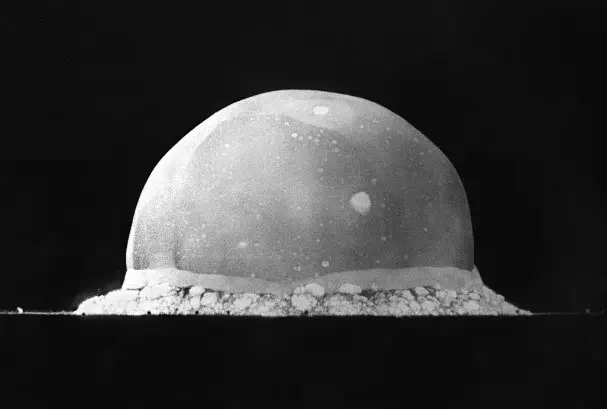
(The Trinity explosion, 16 ms after detonation. The viewed hemisphere's highest point in this image is about 200 metres (660 ft) high. By Berlyn Brixner / Los Alamos National Laboratory)
Now, the United States had a weapon of mass destruction and after seeing the activity in the Pacific, it was believed by top officials that the development of the Fat Man and Little Boy could be used in war. To prepare, engineers had to modify the B-29 Superfortress to carry the 17-foot-long nuclear weapon. Then, on August 6th,1945, the Superfortress named ‘Enola Gay’ departed for Hiroshima with the Little Boy as cargo. When the bomb was dropped, it detonated at around 1800 feet, resulting in 4.7 square miles of urban city and 80.000 people being destroyed instantly ("U.S. Strategic Bombing Survey:1946).
Three days later on August 9th, the Superfortress ‘Bockscar’ was carrying the Far Man and headed toward Kokura, the primary target. However, cloud coverage prevented a clear target and the bomber was redirected to Nagasaki. When the bomb was dropped, 40,000 people died instantly, while another 60,000 were injured (Groves 1962, pp. 343–346.). Tens of Thousands more would be sick or die in the aftermath of the war in Japan because of the massive radiation that spread throughout the regions causing cancer and birth defects. The United States planned to continue to drop atomic bombs in Japan, but President Harry Truman paused the activity.
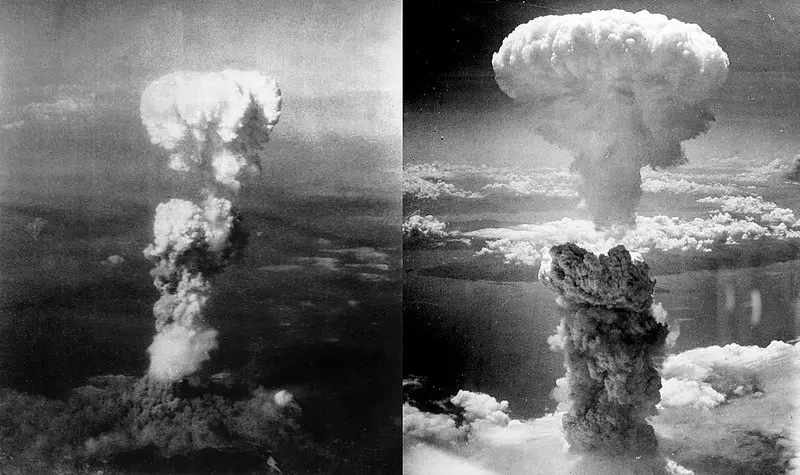
(Hiroshima on the left, Nagasaki on the right)
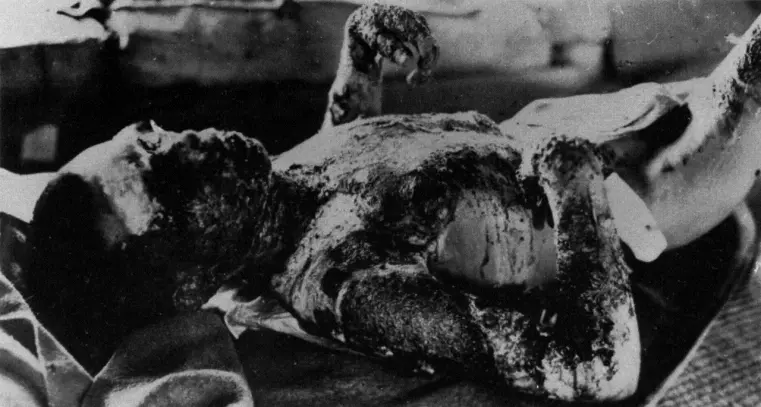
(A victim with whole body burns)
Finally, on August 12th the Emperor of Japan announced his surrender to the United States. World War II was over. 85 million people were dead and humans on earth saw the end of the world as a new era of civilization. They were right, but not in the way they believed. Rather than peace, tension was present, rather than wealth being spread, it was more concentrated more than ever before. Rather than continuity between ethnic groups, religions, and races, it was becoming more divisive than ever before thought possible. Now, the world had to decide how they were going to punish Germany, and ensure a war of such magnitude never takes place again. In addition, countries such as the Soviet Union and Joseph Stalin recognized the immense power that could be had if they were to develop atomic bombs and the scientists went to work again.
Since nearly the entire world was in armed military conflict with another, obviously Money Changers would be the largest benefactors of such situations. The Rothschilds owned and controlled the Creditanstalt bank, even during it was declared bankrupt and the government bailed them out. In addition, when Hitler annexed Austria, they were one of the first banks targeted due to the Jewish Rothschilds owning the bank. Louis De Rothschild, who ran and operated the bank and its industrial tentacles, was arrested and confiscated his property. Germany only released the Rothschild after his family paid a 21,000,000$ ransom, which is believed to be the largest bond ever paid in history for any individual ("Baron Louis De Rothschild Dead: Paid $21,000,000 Ransom to Nazis). Also during the Nazi regime rising to power, the Deutsche Bank, which still exists today, took control over Creditanstalt. The Deutsche Bank was friendly with the Nazi party and even helped fund the Auschwitz concentration camp (Schmid, John (5 February 1999). However, Deutsche Bank wouldn’t admit fault for building the camp until 1999, when they contributed to a $5.2 billion holocaust survivor fund. Deutsche reluctantly contributed to the funds, only after the United States threatened to block their $10,000,000,000 acquisition of Bankers Trust, which was started by J.P Morgan in 1903.
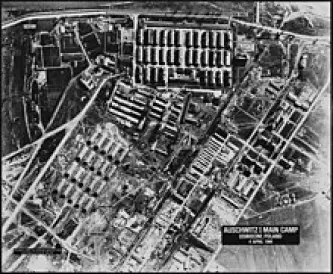
(Aerial photo of Auschwitz I in 1944)
After the war was over, Creditanstalt was nationalized by the Austrian government, which was being controlled by allied forces, and once again became one of the largest and most important banks in Austrian finance. Then, in 1956 Creditanstalt was once again privatized, by selling shares back to the Rothschilds. It wouldn’t be until 1997 when the last Rothschild sold out of their interest in the bank, which would be the last Rothschild to do business inside of Austria ("Rothschilds Sell Last Piece of Austrian Empire After 200 Years").
In addition, The French Rothschilds had difficulty getting along which led to a struggle. In 1939 Edouard Rothschild and Maurice Rothschild, two cousins got into an altercation that led to Edouard buying out Maurice’s shares in the French branch. In response, Maurice would start a branch in Switzerland, which began another spree of geographical domination by a Rothschild banking firm. Also, the Nazi takeover of France led to temporary issues that would nationalize the Rothschild bank. However, once the allied powers won, the bank was given back to the Rothschilds to continue managing ("Baron Guy de Rothschild, Leader of French Arm of Bank Dynasty, Dies at 98").
After the Second World War, the French Rothschild branch created a number of holding companies that would have equity in all of their interests around the world “These mainly included the Banque Rothschild (Bank), SGIM (property company), the SIACI (insurance), the Francarep (oil company) and the SGDBR (wineries), now Domaines Barons de Rothschild (DBR).” ("History". Domaines Barons de Rothschild. Retrieved 20 May 2019.).
In England, the Rothschilds had continued success by financing the war efforts and expanding their international influence. Some of the Rothschilds served in World War II including Victor Rothschild, who served as an M15 officer, which is England’s domestic counter-intelligence agency. In this role, he would assist in Britain’s war efforts by providing valuable roles in disinformation and espionage ("No. 36452". The London Gazette (Supplement).). As the years go on, the information regarding the Rothschilds is few and far between, and the depth of research that is needed to find credible sources becomes more and more difficult. My inclination would be that is a purposeful move to keep secret the various ways that Money Changers are involved in international conflict, but I will do my best to uncover the facts.
In the United States, the war was primarily funded by the newly created, recently tested, and freshly updated Federal Reserve System. The New York Fed during World War II was run by George Harrison and Allan Sproul. Harrison served after Benjamin Strong Jr and worked as the leader of the New York Fed branch until 1940. After serving at the Fed, Harrison went on to work for the Secretary of War as a special assistant for the atomic bombs and then went on to work for New York Life Insurance Company, one of the largest insurance companies in the world. Allan Sproul is regarded as one of the best central bankers in history (Federal Reserve Bank of New York). Sproul served until 1956 when he moved careers to become a director at Wells Fargo.
The Expenditures for the American war effort were substantial, “Military expenditures rose from a few hundred million a year before the war to $85 billion in 1943 and $91 billion in 1944.” Or about 1.5 trillion dollars in 2022 dollars (Federalreservehistory.org) This money was being used to pay private companies to create “thousands of ships, tens of thousands of airplanes, hundreds of thousands of vehicles, millions of guns, and hundreds of millions of rounds of ammunition” (Federalreservehistory.org). The Federal Reserve’s primary focus was handling the purchase of bonds from the government in order to fund the war. They did this in a number of manners, including marketing to the general public. The Federal Reserve Systems employee base grew substantially because of the large amounts of record keeping and advertising that had to be done, leading to an even more bloated bureaucracy. In addition, the Federal Reserve convinced Congress to change the Federal Reserve Act to 1) Give the Fed Board the ability to change reserve requirements of the New York and Chicago Fed at will 2) Authorized the Fed to purchase bonds directly from the Treasury, allowing the Federal Reserve to more easily adjust the money supply and have more control over the economy. What was supposed to be temporary measures for wartime, stuck around and are policies to this day.
In addition, the Federal Reserve played an important role in overseeing finance by creating the Exchange Stabilization Fund. This fund was created with the purpose of buying and selling gold and foreign currencies, and maintaining books and records of various central banks from around the world. “The NY FED engaged in foreign transactions on an extensive scale. It held gold and dollar accounts for fifty-nine foreign nations” (FederalReserveHistory.org).
Once J.P Morgan Jr. Died in 1944, he left his business to his two sons, Junius Morgan and Henry Morgan. Henry was responsible for founding Morgan Stanley in 1935 after the great depression and was married to President Herbert Hoover’s daughter. Morgan Stanley would go on to dominate finance by leading important bond offerings for many of the country’s largest companies. Junius Morgan took over the management of J.P Morgan.
As we’ll see through the next couple of sections some of the wealthiest families in the 19th and 20th centuries will not emerge as such once, we hit the 2000s. Of course, their families are still substantially wealthy, however many of the Morgan’s, Rockefellers and Rothschilds, and other money changers' heirs have taken a back seat to the financial sector and focused their careers on different industries. However, there are still hundreds of Rothschilds that have substantial wealth throughout the world today, the Rockefellers are involved with politics and real estate and the Morgans still own the stock that was inherited. All of these families still produce and hold substantial value. These families would set their future generations up for nothing but success and wealth, and the heirs of wealthy families usually decide to enjoy the work of their ancestors. Nonetheless, Money Changers always exist in the world and as we will see, the shift of power is substantial and leads into dangerous hands World War II was perhaps the largest shift of power the world has ever seen, which would see the United States emerged as the most powerful global empire in the world.






