We ended the last section by explaining that we will go deeper into the stories of the Money Changers during the turn of the 19th century in addition to the United States' response to being without a central bank. So, let's jump right into it.
The War of 1812 occurred only months after the closing of the First Bank of the United States, leaving no government-sanctioned, privately owned institution with the ability to print money. During this time, the United States relied primarily on Treasury Notes (Short term debt of the US gov) and other forms of debt or bonds as a method of currency. Therefore, for the United States to facilitate the economy, while simultaneously fighting in a war, it had to go deeper into debt with every passing day.
Although the First and Second Central Bank of the United States didn’t have nearly as much power as the Federal Reserve does today, they still held a great deal of influence in the production of money and movement of the economy. For the past 20 years, the United States had learned to rely on the authority of the First Central Bank and when the institution was sold and war had struck the nation, the United States found it difficult to capture the wealth of nations that were flourishing in Europe. Money Changers and Politicians quickly began formulating a plot to be competitive in the world economy. Up to this point, the United States was mostly fixated on being an agrarian economy, where the majority of its Gross Domestic Product (GDP) would come from the yields of its harvest. However, the US businessmen were witnessing global powers around the world amass much greater wealth on a system of printing money.
After the war ended in 1814, the United States entered into what is now referred to as the ‘Good Feelings Era’ that was marked by the fall of the Federalist party originally led by Alexander Hamilton, an end to the domestic political rivalries, and a nationwide consciousness of American patriotism. This was partly due to Alexander Hamilton, the leader of the Federalist Party, being dead from the duel with Burr where he was shot and killed. Furthermore, Thomas Jefferson and James Madison, who were both representing the Democratic-Republican party, served two terms back-to-back, spreading the influence of Democratic-Republicans. The nation’s voters were enjoying their domestic and foreign policies and after what the United States saw as a win in the second battle of independence with the War of 1812, the country was the most united it has ever been.
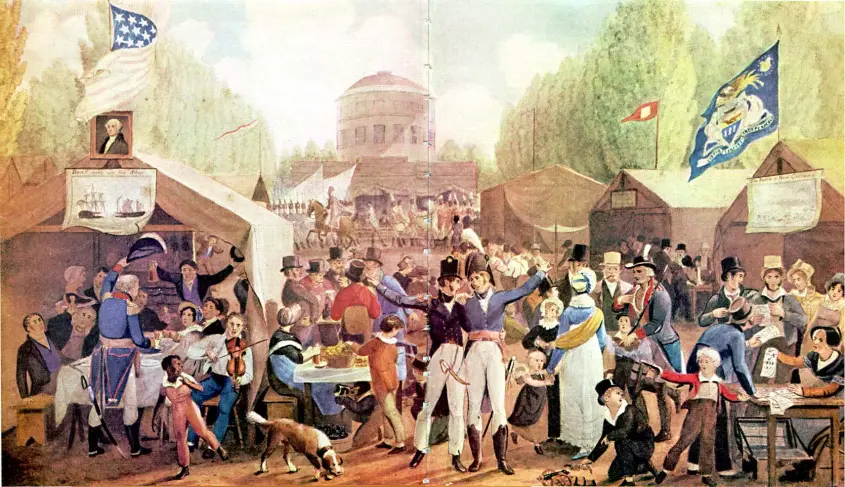
(Independence Day Celebration in Centre Square by John Lewis Krimmel, 1819)
However, the economy was being plagued when the United States territory was greatly expanding to the west and a lack of strong government bodies that could enforce the rules and regulations of money on a national level. In addition, domestic and foreign enterprises were becoming apprehensive the United States wasn’t an organized financial system and wouldn’t have the capability to recompense the debt or pay interest on their loans in the future.
Riding off the wave of national pride and unity, the Money Changers proposed a second central bank, called the Second Bank of the United States, in 1816. Once again, this institution would be a government-created and protected, privately operated central bank that was able to loan other people’s money to the government and operate in all of the different states within the country. This law gave the bank a virtual monopoly over the United States economy and once again, the United States citizens were subject to the royalty of power that was unparallel in banks.
The bank was created after President James Madison had worked with Congress to charter the organization. The bank would be given a 25-year charter that would expire in 1841 and be up to the vote of Congress to realize its renewal
The Financers of the bank would be as follows; Stephen Girard, Rep. John C. Calhoun of South Carolina, David Parish, Jacob Barker; Alexander Dallas, who would become secretary of the Treasury in 1814 and John Jacob Astor (federalreservehistory.org/essays/second-bank-of-the-us).
STEPHAN GIRARD
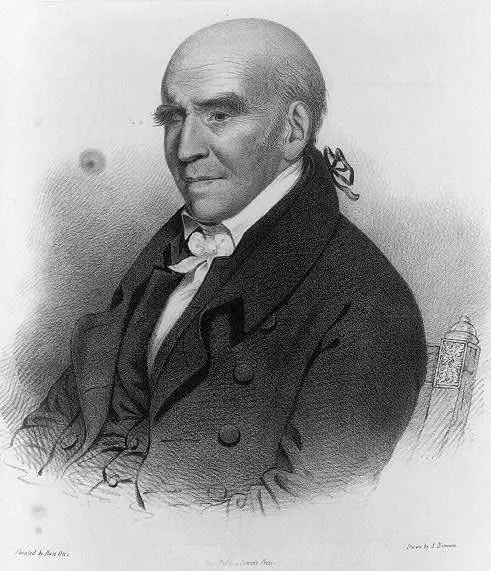
Stephen Girard was the person who purchased the First Central Bank from the United States in 1811 and immediately began funding their military efforts in the War of 1812. As we previously mentioned, these armed conflicts didn’t lead to any cultural or territorial changes of great consequence for the United States, Canada, or Great Britain. It did, however, lead to various Money Changers in the United States and Europe increasing their affluence and reputation in different parts of the world.
After Girard had purchased the First Central Bank from the US, he took private ownership of the company, naming it Girard Bank, and as a result acquired large amounts of assets and stock that would pay out large interest and dividends, in addition to having the ability to sell it at a profit. With this ownership, Girard would go on to become one of the wealthiest Americans the United States has ever seen. However, like other financial tycoons, he was not content with the wealth he hoarded up to this point. After the war of 1812 and seeing the setbacks to his trading businesses, which were suffering without a central bank to rely on for loans, he strongly pushed for the creation of the Second Bank of the United States. After working out deals with Congress and the President, Girard would become an original investor of the new institution and be one of the men appointed to the position of a bank director. Now that Girard could share in the profits of the Second Central Bank’s government-created monopoly on the United States Financial System and had the executive power of Director, he could immediately make decisions that would quickly increase the success of his and other Money Changers, business ventures, while ignoring the needs of the citizens of the nation.
Following his death in 1831 Girard, who was childless, would go on to pass his astonishing prosperity to many charities in the United States and specifically Philadelphia. His philanthropy was so great that many of his descendants fought against the directions in his will after his death, but the decisions were held up in the Supreme Court, and his legacy would be remembered with generosity. According to Fortune Magazine, as of 2009, he is estimated to be the Fourth Richest American to ever have lived (Fortune Magazine: "richest Americans: Archived 2009-09-19). However, because Girard did not have any heirs to take over his wealth and the majority of it was donated, his overall influence will end up being small potatoes to the impact of other financers during his time.
The privately-owned Girard Bank was a part of his trust that was largely donated in his will, thus shut down its doors in 1831. However, immediately after local financers in Philadelphia heard the news of Girard’s passing, they came up with a plan to create a business with Girard’s name, to garner his likeness and reputation, and buy up the assets that were held inside of the Trust. This was done successfully and officially continued to operate with his name until they reorganized to the Girard National Bank in 1863. The institution continued to exist and loan out other people’s money and in 1951, after many acquisitions and mergers, changed its name to Girard Bank. Then, in 1983 Girard’s Bank was acquired by Mellon who went bankrupt in the 2007 housing crisis and was acquired by the Bank of New York and became BNY Mellon.
JOHN CALHOUN
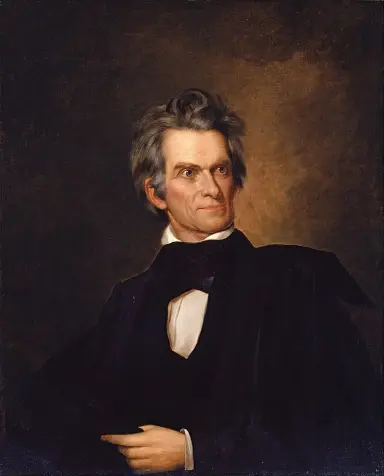
(Portrait by Charles Bird King c. 1845)
John C Calhoun was born in South Carolina of Scottish and Irish descent and was eventually elected to the House of Representatives in 1810. He married his first cousin in 1811, who was the daughter of a wealthy Senator and would go on to have 10 kids. There are normally two things that people strive for in the world. Influence and wealth, or both. In Calhoun’s case, he was content with large amounts of influence in politics without the personal wealth of Girard or others.
After the War of 1812, Calhoun was distraught at the United States' inability to formulate a strong military presence against Great Britain. At the time of the war, the United States had under 50 ships ready for military efforts while Great Britain had over 1,000. Thus, he pushed for policies and perspectives he believed would forge his legacy and stabilize his position in power for life.
As a result of the lack of funding for the military efforts and the First Central Bank charter expiring in 1811, Calhoun began advocating for the creation of a Second Central Bank that would provide the funding required to build a strong navy, robust army, and domestic manufacturing base for the new nation. As a result, Calhoun became one of the original proponents and investors in the Second Central bank that would allow the new establishment to fund his ambitious ventures, earn him massive profits, and spread his political influence. With a new Central Bank that would facilitate the movement of his undertakings, he was free to propose expensive ideas that would spread his authority and garner individual power over the nation.
Throughout his life, Calhoun was regarded as a prominent and well-respected public speaker throughout government and business. His success with persuasion and use of rhetoric allowed him to work his way up to Senator of Virginia, Secretary of State, and Vice President of the United States under John Quincy Adams and Andrew Jackson, thus his name will come up later.
DAVID PARISH
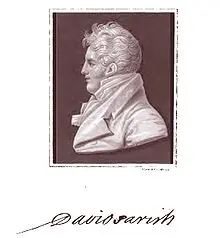
(Portrait and signature of David Parish. A portrait is from an engraved miniature painted on ivory in 1810)
The next Money Changer that invested in the Second Bank of the United States is David Parish. Parish was born in Hamburg, Germany, and worked his way to become a financer through partaking in land speculation, money-changing, and the transportation of valuable assets between nations. Shortly after coming to the United States in 1806, Parish acquired over 200,000 acres of land on the Saint Lawrence River that borders the United States and Canada, which would play a pivotal role in the battles that occurred on the boundary during the War of 1812. With the newly acquired land, David Parish would sell the property to settlers who were attempting to escape the religious, government, and economic persecution they were facing across the Atlantic in Europe. These transactions allowed Parish to greatly increase his wealth and influence with Americans, the British, and the Canadians, allowing him to serve as an ideal middle man for the international transactions and military funding that was occurring during the midst of the war. Throughout the war, international transactions seemingly occurred as normal. Many historians believe this is because of the relationships David Parish had and the opportunity to amass great wealth on the natural border and highway for all people (Taylor. 2010, pp. 275-77).
The wealth Parish was garnering was massive and during the War of 1812, without a central bank to rely on for funding the Federal Government and James Madison took a 7.5-million-dollar loan from Parish in 1813 to help the war efforts (Alan Taylor, 2010). At heart, Parish was a federalist, meaning he supported large government and friendly relationships with Great Britain and he understood the value and influence he could have with his business if he was able to negotiate peace deals with the conflicting nations. After the loan was announced, Parish was able to help negotiate peace with Great Britain and the United States at the Canadian border, allowing his family to continue to develop the region and become a large part of the manufacturing and economic expansion over the next few decades.
Parish knew that to secure his business ventures into the future he would need to have the ability to take loans and orchestrate policy from the financial monopoly of the central banking system. With the massive wealth Parish had amassed, he began strongly advocating for the creation of the Second Bank of the United States and became an original investor into the privately owned, profit-generating enterprise. With a new central bank, and him being at the decision-making table, he was able to secure his business ventures into the future and secured his wealth for generations to come.
Shortly after Parish began to earn profits and fund the creation of the Second Central Bank in 1816, he became an American citizen and moved back to Europe. In 1819 he served as a foreign ambassador but was removed only 4 years later, after making illegal loans to Emperor Francis of Austria in their military efforts against the War of Independence for Italy. Even after Parish was making illegal loans to foreign governments, he continued his mischievous businesses and eventually lost all of his wealth and according to sources drowned himself in the Danube River in 1826 after participating in Austrian bank fraud. David Parish’s family would go on to live in the Saint Lawrence River area in a huge mansion and wouldn’t do anything relevant from that point forward.
A quick side note that we will discuss later; In 1816, the same year Parish moved back to Europe, Nathan Rothschild and his brothers were lifted to the ranks of Nobels in Austria by Emperor Francis, the same individual who was taking illegal loans from the United States Foreign Ambassador David Parish which eventually led to his suicide. The lift in nobility for the Rothschilds was because of their company’s success in helping Emperor Francis and his family manage their investments and finances.
JACOB BARKER
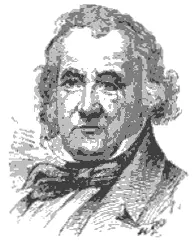
(Portrait of Jacob Barker from The National Cyclopedia of American Biography, Volume XI, 1901)
The next Money Changer we will discuss is Jacob Barker. Barker was born in Maine to a Protestant-Catholic family in 1779 and 1795, at the young age of 16, moved to New York to explore different business explorations. There’s not much known about Barker’s early life, but what is known is that over the next decade he become a successful and popular merchant who would eventually own several trading businesses where he was able to garner significant amounts of wealth. Leading up to the War of 1812, Barker became increasingly involved with business and hired Fitz-Greene Halleck. Halleck served as Barker’s secretary for the next 20 years and would eventually serve as the secretary for another wealthy businessman, John Jacob Astor, who we will discuss later.
Furthermore, there are several correspondences during the War of 1812 between Jacob Barker and the President of the United States James Madison explaining how Barker extended over $5,000,000 to the United States government in loans for their war efforts. Over the next several years Barker would earn period interest payments on the loan and make tremendous amounts of wealth. In 1815, only a year after the war had ended, Barker created the Exchange Bank of New York. After the war, without a central bank to loan out money, more banks began to prop up across the nation to serve the diverse needs of the nation. As a result, the citizens of the nation became more dependent on the services offered by these strategic corporations. A year after he opened the doors to his new bank, he was elected to become senator for the New York State Legislature, creating large conflicts of interest between his banks and position in the office.
Nonetheless, while serving for his country in office, Barker strongly advocated for the creation of the Second Central Bank, so his private banks could secure loans of other people’s money and facilitate the movement of the economy. His efforts were met with a prize after the Second Central Bank opened its doors, and he would secure massive funding for the bank, giving him part ownership and the right to profits generated from the company for the next 25 years.
Now that Barker held significant power, he turned his attention to more lucrative business opportunities. The most infamous was his involvement in the New York Life and Fire Insurance Company. During his tenure with the company, he was convicted of fraud for his involvement with malpractice that significantly affected the lives of many of the policyholders and ended the corporation in 1826. Eventually, the trial was disputed and Barker was free to go without serving any time in jail.
After being released from custody and supervision, he would move to Louisiana where he would spend the rest of his years and eventually declare bankruptcy leading up to the civil war. He had many kids, but they all either died young or didn’t have any significant impact.
ALEXANDER DALLAS
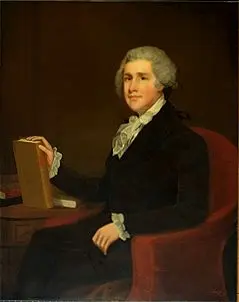
(1881 painting of Alexander J. Dallas by Freeman Thorp)
Connections and networking are important characteristics of the success you have because connections can introduce you to people outside of your everyday social circle. This was the case for Alexander Dallas. Dallas was born in Jamaica to a medical doctor and through his marriage had important connections to British Royalty in Europe, therefore Dallas was born into wealth. Dallas’ wealth allowed him to study law in many top universities throughout the world and he would eventually have correspondence with Albert Gallatin, who was serving as the Secretary of Treasury during the War of 1812 under the Presidency of James Madison. During the war, Dallas would frequently help Gallatin with financial decisions and obtain large amounts of funding that had to be collected or borrowed during the conflict. As a result, Dallas would go on to succeed Gallatin as Secretary of Treasury and serve under James Madison for the remainder of his term until 1816.
As Secretary of Treasury Dallas was able to briefly bring the budget to a surplus, although the overall United States debt would still be in peril for many years following, and bring back gold and medal coinage to be circulated and produced. How would he accomplish this? As Secretary of Treasury, Alexander Dallas was adamant that the creation of the Second Central Bank was vital to the success of the nation. Dallas would eventually be granted his wish and secure tremendous amounts of personal wealth and power in the process when James Madison put the final signature on the bank charter that would last 25 years. With the new charter, the Central Bank was able to have a monopoly over the economy and the United States Mint could produce gold and silver coinage as fast as the materials could be mined.
JOHN JACOB ASTOR
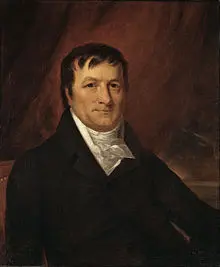
(John Jacob Astor portrait by John Wesley Jarvis, c. 1825)
The last major investor in the Second Bank of the United States, and the most influential, is a money changer named John Jacob Astor. Astor grew up in present-day Germany which was the Holy Roman Empire when he was born in 1763. After the American Revolutionary War had ended, when Astor was 20 years old in 1783, he boarded a ship that was to set sail toward the eastern coast of the United States. While aboard, he spoke to an ambitious gentleman that introduced Astor to the fur-trading businesses in America that were making individuals rich in the states. Inspired by this random encounter, when Astor landed on the East coast of the US in New York, he immediately began to peruse the professional undertaking.
After arriving in the United States without anything except the clothes on his back, he began to make considerable amounts of money from starting his own fur trading business. These initial profits from his investments and the liberty and luxury of the young country-inspired Astor to accumulate more wealth than anyone had ever seen. In addition, his family who already lived in America began utilizing Astor’s charisma and connections to increase their business revenues, and John Jacob Astor became a consultant for many of his families’ businesses. His practices continued to grow and were assisted with the Jay Treaty in 1794 that brought relative economic peace between Great Britain and the United States at the Canadian border. With this treaty, Astor immediately went after a substantial contract with one of the largest fur manufacturers in Canada and secured a deal that would bring him massive business.
During this period, animal furs were in extremely high demand because of the warmth they produced, the wealth they portrayed, and versatility in clothing. Furnaces did not exist in the early 19th century and oftentimes families had to rely on indoor fires or extra layers of clothing to keep warm. Furthermore, travelers often had to move goods large distances through towns and cities and could encounter unforgiving conditions in the Northern part of the United States in the Fall and Winter. Therefore, having fur clothing, coats or trim was an essential part of every American and European life at the time.
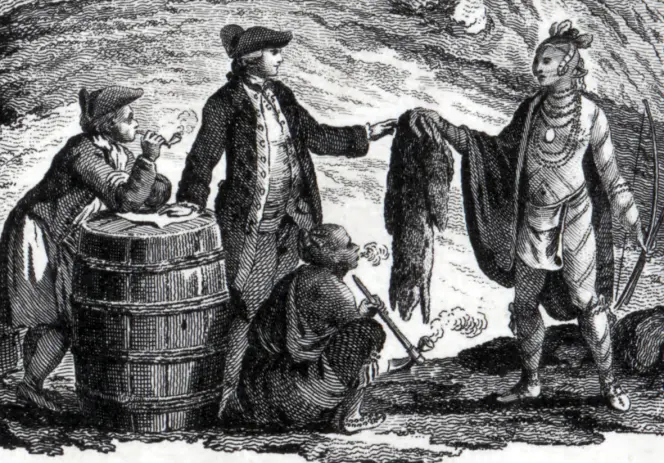
Additionally, on the supply side of the fur trade, gathering furs was customarily completed by hunters going into the thick and unexplored woodlands with inefficient weaponry, or traps to capture the animals. However, Astor would implement an innovative and unethical approach for retrieving the furs. Instead of partaking in the difficult journey of hunting down the animals or being patient enough to trap them, Astor would implement a strategy, and eventually a corporate policy for all of his businesses, of getting Native Americans extremely intoxicated with alcohol and drugs, then trading them furs for worthless European knickknacks the Native Americans would find fascinating. Once Astor had the valuable hides, he would cure them and ship them to London for massive profits. The information asymmetry allowed Astor to take advantage of the Native American's labor of catching the animals and utilize unscrupulous methods or brute force to get what he wanted.
By 1800, Astor had a sound business model that would import furs from the various territories of Canada and Native American tribes in the United States to his shops in New York, where they would be treated and shipped to London. His agents scattered throughout most of the continent, and he had made a name for himself all over the world as a primary front-runner in the fur trading business. Furthermore, John Jacob Astor created the city of Astoria in present-day Oregon in 1811. This was the first trading post west of the Rocky Mountains and was central to economic activity in this region. With this newly formed trading post, he made the first successful delivery to China from the United States. Astor began trading and reaping profits from the Chinese, whose demand for fur was great because of their essential use in everyday life and the wealth they portrayed on certain attire. Astor would accumulate massive wealth one just one voyage, but after continuous trips back and forth he would reap unimaginable profits in the years to come, by exploring an entirely new and massive market to the United States.
Astor would encounter a brief setback when Thomas Jefferson implemented the US embargo of 1807 that would prevent any United States company from trading with British-controlled Canada. However, Astor refused to be subject to this rule and after negotiations with Thomas Jefferson, he was allowed to create the American Fur Company in 1808, which would have a government-sanctioned monopoly on the fur trade within the United States, allowing Astor to establish a monetary empire. After he was granted the monopoly, Astor began opening subsidiary fur companies throughout the United States, allowing him to capture the wealth of an entire nation and root out many of the Native American tribes.
The War of 1812 proved to be another setback for Astor’s fur trading business after Great Britain had seized many of his trading posts in Europe and on the Canadian border. During the next 4 years, he would plan other ventures that would bring him extreme amounts of fortune that were impermeable to the nationalization or laws of government. Even if the war was a setback for Astor’s fur business, he wouldn’t let it stop him from increasing his wealth. During the war, the United States government was offering a 16-million-dollar bond to private entities to help finance the war. With the help of some business partners, Astor bought up 10 million dollars of that loan. Ensuring the United States government would pay the periodic interest payments and repay the principal at the end of the term and knowing that a government was the most secure form of investment. Instead of waiting for the bonds to mature though, Astor sold the bonds to other financers for a 2-million-dollar profit.
When the war was over, Astor was one of the biggest proponents of recreating the central banking system and became was one of the major financiers, and therefore owners of the government-sanctioned monopoly. As an owner of the Second Bank of the United States, he would reap the massive benefits and profits from cornering the financial market of an entire country and population. Now that Astor was part owner in a central bank of an emerging economy, he would be the ultimate benefactor of the monopolies on fur and finance that was granted by the Legislative and Executive branch of the US and was sitting on a throne of money.
When Astor originally set sail for America he was determined to acquire unprecedented wealth and did not want to stop after he was granted monopolies over two different sectors of the United States economy. Only months after the creation of the Second Central Bank, he entered into the Opium Smuggling Trade with China under the camouflage of his fur trading company.
The Opium trade in China had plagued the Chinese people for decades because of the massive amounts of imports that were occurring from around the world. Opium started in China for medical purposes in the 600s, but by the 1600s the practice of mixing the drug with tobacco to create a euphoria put the commodity in higher demand throughout Asia, and eventually the world. The Chinese government was constantly battling with its citizens on the legality of the trading and usage of Opium, by 1800 when there were over 4500 chests imported into the country strict bans were placed on the trading of the drug. However, European powers ignored those laws and continued to traffic the material. By the early 1800s, American businessmen began entering into the trade even though it was illegal to trade in the United States. By the 1830s massive quantities of Opium were being imported to the country by European and American powers and it eventually led to the First Opium war. We will discuss this later.
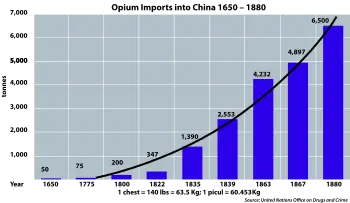
In one well-recorded instance of Astor smuggling opium under the guise of the American Fur Company he, “purchased ten tons of Ottoman-produced opium, and shipped the contraband to Canton on board the packet ship Macedonian” (The Opium Kings: Opium Throughout History". Frontline. PBS). The current day street value of that quantity of opium is $145,000,000. Although that isn’t the monetary amount Astor brought over, it gives you some perspective into the massive amount he received of wealth and notoriety he gained from the deal.
Astor was still not settled with the massive amount of wealth he had accumulated and by the 1830s changed his business model to become a perpetual money-making machine. Since the turn of the century, Astor began buying up valuable real estate in New York, which at this point at only been farmland. However, by 1830 he sold all of his holdings in the American Fur Company to peruse more real-estate ventures in what is now downtown Manhattan. With the farmland in Manhattan, Astor would begin urban development with massive office buildings and residential buildings. Astor had correctly predicted the quick urbanization of New York and when the values of his properties began to increase, instead of selling the property for a profit, he would lease out the buildings to tenants who he would charge large rents. The large rents then fueled the purchase of more property and more property fueled larger rents and the eternal and uninterrupted money generating system was created.
By the time of Astor’s death in 1848, his wealth was estimated to be .9% of the United States GDP, which is equivalent to Jeff Bezos' worth of $200 billion in 2020. However, Astor was not a very generous philanthropist.
“One time a group of people came to his office and asked for a donation to some worthy cause and Astor grumpily wrote out a check for $50 and the men looked at him with some dismay and said “But Mr. Astor, even your son William has given $100” and Astor said, “Oh well William has a rich man for a father” (Wealth and Power - The History Channel: The Tycoons)
Astor left a large majority of his fortune with his heirs, who would decline in power in America, but some of the early family moved to Great Britain, where they did see better success and continue to thrive today.
The 6 main investors in the Second Central Bank of the United States were able to convince the United States Congress and President James Madison that the Second Bank of the United States would be in the best interest of the people and in Madison’s last year as President chartered the Second Bank of the United States for 25 more years from 1816 to 1841. These 25 years would not go without being volatile for the United States and the world and we will look into these years as we continue our discussion in the future as well as other European Money Changers who had a large impact on world events and our how society is set up today.
We talked about many different individuals who all had a hand in the creation of the Second Central Bank, all of these individuals had a personal interest at stake with their businesses and political interests. As a result, the team of Money Changers pooled their resources together to create a centralized form of money creation and money changing. This centralized form of money changing leads directly to an increase in the Money Changers profits because they have a government-protected monopoly over the financial sector within the United States. In addition, other government-sanctioned monopolies were manifested, because of the relationships the Money Changers have with government officials that allows the Money Changers, without taking any consideration of the population at stake; to corner the market, increase profits and take part in harsh business practices to get what they want. The impact of these individuals is so great, that in many of the places they resided there are street names, cities, and buildings named after them, cementing the legacy they had on the foundation of the United States. Although it was 200 years ago, in the grand scheme of things these events did not occur very long ago, and their actions still have a lasting impact on our society today, and their heirs are still enriched from their decisions.