
With the turn of the 19th century, the world continued to see the clash of emerging countries and historic European powers, especially Great Britain, and was involved with multiple wars in the early 1800s. We left France with Napoleon Bonaparte returning from his military expeditions and being named First Consul of the French Consulate and taking control of the country from the Directory in 1799. In addition, we mentioned how France had just created a Bank of France, on the backs of bribery and sponsorship from Napoleon to 16 of the richest bankers in France.
From 1793-to 1815, you will see that Great Britain and France were arch-enemies who constantly were in military and economic conflict with one another. Throughout the topics, we have been mentioning the French Revolution, which is really a broad term to define the period of constant military conflict between France and surrounding nations that was driven by economic success in Europe and abroad. So far, we’ve talked about many internal disputes that were occurring, as well as the War of the First and Second Coalition, and touched on the Napoleonic wars. We will also mention more wars including the War of the Third, Fourth, Fifth, Sixth, and Seventh Coalition, which all occurred between 1793-1815, and more internal disputes inside of France. Don’t be discouraged by the titles of these events or think that it’s too much to learn. It's more helpful to think of these “wars” as long, drawn-out battles that take place over a couple of years. The actual ending of the French Revolution is disputed by many historians, so you can think of the end whenever you like, but I like to think of the French Revolution as the period between 1793-1815 when all of these “wars” were occurring with France being the centerpiece of military and economic conflict in Europe.
Thinking back to 1799, European monarchies were attempting to suppress the revolutionary efforts of France and were actively engaging the country in the War of the First and Second Coalition. The Second War started in November 1798 and was created with an even larger alliance than before. The kingdoms were led by Great Britain, Russia, Austria, the Ottoman empire, and more fighting against the revolutionary supporters of France and Spain. Therefore, when Napoleon took control over the country, not only was the domestic conditions in turmoil, they were actively fighting in wars with foreign monarchies.
Some of the first steps Napoleon took as the new leader was to quickly build up the military and create laws that would establish himself as a superior, without the ability to be voted out. Napoleon knew that the Second Coalition was forming and he had to come up with unique ways to defend his country and defeat his enemies. From 1799-1801 France successfully defended itself from some of the largest empires the world has ever seen while also plunging other countries into battle on the back of the revolutionary ideals and the military leadership of Napoleon.
In 1802, two treaties were signed that ended the war efforts between France and their opponents of Great Britain, Russia, and the Ottoman Empire. However, the many European powers were not finished with the bloody battles they have been encountering over the past decade. By 1803 Napoleon had gained massive support of the people of France because of his successful military expeditions that had gained France large pieces of territory and liberated people of other countries from their previous regimes.
Even if Napoleon wasn’t successful in his battles, he was a master of propaganda and was famous for printing his own newspaper articles that featured stories of his heroic clashes and would be passed around to the people of France. One of the popular measures Napoleon implemented was bringing back the Catholic Church to France after coming to an agreement with the Pope that laid down hefty restrictions that wouldn’t allow them to accumulate power. For the people of France, they were extremely happy because they had the opportunity to practice freedom of religion, and for Napoleon, he loved it too, because he knew that organized religion was a great tool to keep the poor from revolting. “Religion… Keeps the rich from being massacred by the poor.” (Napoleon). Furthermore, Napoleon implemented the Napoleonic code in 1804, which is a principal framework of codified law that proved to be one of the most influential government documents in existence and is still widely used for many European country's regulations and continues to be referenced in France today.
With the increasing popularity and increasing military success, Napoleon was steadily increasing his influence and economic power and many of the surrounding monarchies, especially Great Britain, became increasingly fearful of the power Napoleon was accumulating. In response, Great Britain once again declared war on revolutionary France, led by their military leader Bonaparte and began what was known as the Napoleonic wars.
After Great Britain officially declared war on France, Napoleon had to quickly bolster his military and economic strength to take on one of the strongest empires in the world once again. Napoleon came up with a crazy plan, to invade Great Britain and begin to take control over the country. A major step to provide success for his plan, and the French economy, was to sell a large chunk of land that Napoleon had secretly acquired from Spain in 1800. The land would be that west of the Mississippi River that bordered the new United States. Thomas Jefferson, who was the American President at the time, orchestrated a deal with Napoleon to buy the over 2,140,000 km2 or 530,000,000 acres in land in exchange for 15 million dollars in what’s known as one of the largest land acquisition deals in world history with the Louisiana Purchase.
This large purchase was financed mostly with bonds issued by the US Government at a price of $87.50 per $100 where they would receive that 100$ per bond at maturity and receive periodic interest payments in the meantime. These bonds were sold to a British banking Family, called the Baring, who was among the most powerful banking families in London at the time and has amassed tremendous amounts of wealth through real-estate speculation and the slave trade and the Rothschilds would eventually take over. We will discuss this later.
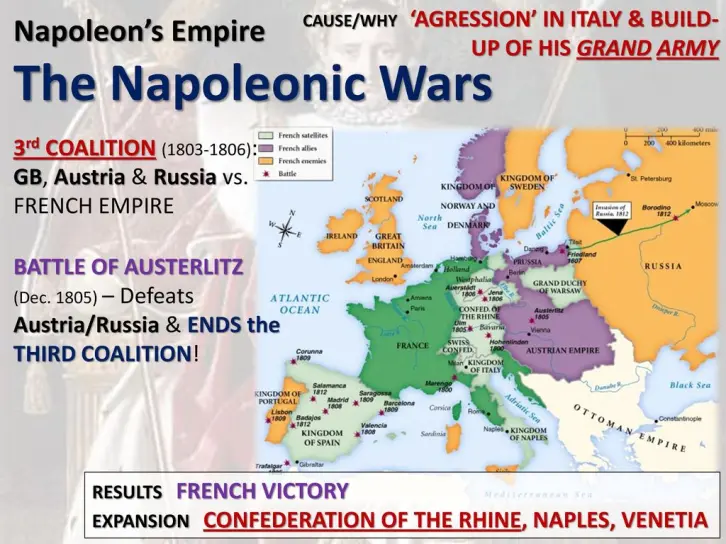
Meanwhile, while France was increasing their military and economic success, Great Britain had plans to do the same and formed a third alliance, called the third coalition, and began fighting in the War of the Third Coalition from 1803-1806. On one side, it was France and Spain and they were fighting against the monarchy powers of Great Britain, the Holy Roman Empire (Austria), Russia, Naples, Sicily, and Sweden.
During the conflict with Great Britain and other countries, one of the measures Napoleon took to ensure his power was to hold a vote for him to be named Emperor of France. During the vote, only Napoleon’s supporters would show up and the obviously engineered results showed that 99.9% of the French population voted in favor of the proposal, and Napoleon was officially named Emperor. The detractors of Napoleon didn’t show up to the vote because they feared for their safety. Subsequent to the military dictator taking power, he would often show examples of control by exiling, prisoning or killing people who went against his views.
Great Britain did not engage in many armed conflicts throughout this battle but focused on its naval strength as a defense weapon and financing other countries' military efforts as its offense. Therefore, Napoleon focused his attention on the rest of Europe and defending his growing nation. During these battles that took place, Napoleon showed his military success in his prime and reinforced why he was such a great General and leader in his previous armed conflicts.
After Napoleon had fended off Russia, Austria, and Naples in France, by 1806 it was clear that the French had successfully defeated their enemies once again. After the War of the Third Coalition was over, Napoleon ordered Austria to hand over large chunks of land and gold. In addition to treaties that said Austria would never attempt to fight France again. With this agreement, France could now turn their focus on the rest of Europe.
(https://slideplayer.com/slide/12829927/)
With the victory over Austria, Napoleon consolidated the many Germanic States and established the Confederation of Rhine. Although it only lasted from 1806-to 1813, it was still a large part of Napoleon's strategy and also had large financial and social implications as well. The Confederation of Rhine was Napoleon’s version of Germany and shortly after he claimed the territory, he declared a requirement to terminate the Holy Roman Empire, an empire that had lasted over 1000 years.
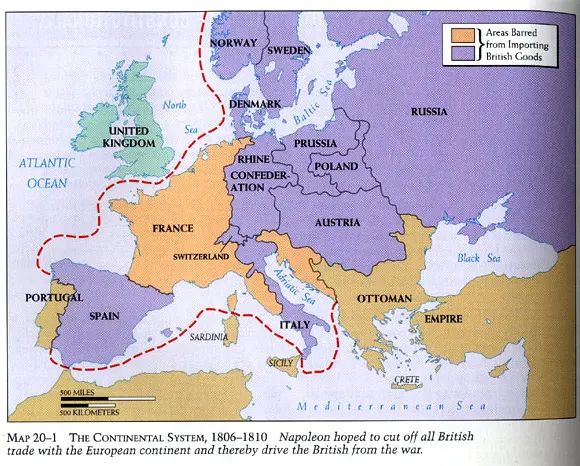
Furthermore, Mayer Rothschild also lived in Germany and was still managing wealth for Crown Prince Wilhelm’s massive estate. While these battles were occurring, Rothschild fled with the Crown Prince and continued to grow his businesses and family’s wealth while avoiding the armed conflicts that were taking place throughout Europe. He began investing more actively in Great Britain while also setting up his son, Nathan Rothschild, with a new business in London to start the growth of a banking empire in 1797. In the meantime, he was also forming new trading routes that would avoid Napoleon's famous Continental Blockade that essentially split Europe from the North Coast to the South Coast and put an embargo on Great Britain. This Blockade by Napoleon in 1806 began to halt much of the European foreign commerce. However, Mayer Rothschild would continue to reap massive profits from moving valuable possessions from high-profile nobles of the various European monarchies to otherwise restricted parts of the continent.
https://commons.princeton.edu/mg/the-continental-system-1806-1810/
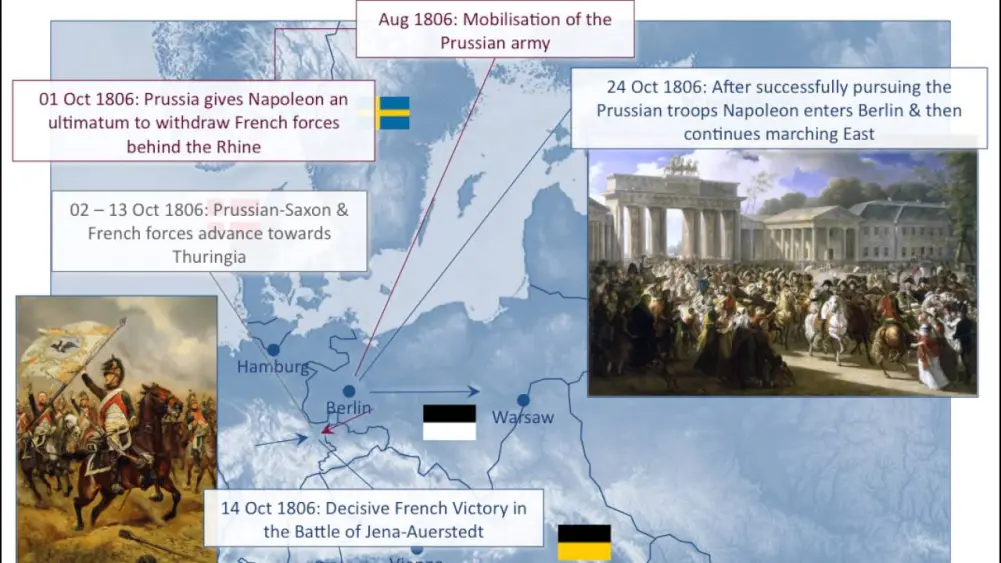
Also in 1806, because of the Holy Roman Empire’s dissolution, the Prussian king feared for his monarchies' stability and declared war on France. This began the War of the 4th coalition that lasted from 1806 to 1807. It was all of the usual suspects, minus the Holy Roman Empire who had officially fallen to Napoleon and France. Instead of allying with the other nations involved in the war, Prussia decided to attempt to fight France independently without the help of their fellow monarchies because of logistical and communication issues between the nations.
Within a month, Napoleon had gained large pieces of Prussian territory, including Berlin, and exiled the king to Russia. The Russian and French forces then faced off in bloody battles over the next winter and spring, but after it was all said and done, Napoleon had conquered and defended more territory, resources, and property for the French nation. After the War of the 4th coalition, Prussia had essentially dissolved and lost much of its territory to Russia and France. In addition, King Alexander of Russia and Napoleon became allies after having mutual respect for each other personally and in battle. Now the only two enemies that remained for Napoleon were Britain and Sweden, two of France’s biggest enemies.
(https://www.youtube.com/watch?v=kQpyIivI3U8)
The blockade to the United Kingdom began to put a dent in their economy just as Napoleon had intended. However, some of the French Emperors thought to be closest allies were starting to disobey the blockade because of the impact it was having on their economies. In particular, the Spanish were having political and economic unrest within their nation on who should take over the throne, and Napoleon, being close to the crown, brought the family into France in order to mediate their differences. At the end of the meeting, Napoleon pronounced his brother King of Spain, but for all intents and purposes, Napoleon was the King and was first in command when it came to the decision-making within the newly acquired territory.
As a result, in 1807 the people of Spain began to revolt against the idea of being taken over by a foreign power and started bloody battles with the French occupiers who were within their country. With the aid of the British, Spain was able to fight with France in the Peninsular War until 1814, and even after years of warfare on land, which Napoleon excelled at, he could not find a way to defeat the Spanish and take control over the country. This long, drawn-out battle between Spain and France began the gradual weakening of Napoleon's military forces and influence within Europe.
With France now at war on many fronts and struggling to secure its influence within Europe, Britain made the decision to support Austria economically to attempt to drive Napoleon and his forces out of the area once more in the War of the Fifth Coalition that occurred 1809. However, Austria was defeated and Napoleon was able to put down the foreign threat.
The battles were bloodier than before. After years of being in battle and advancing strategies, the troops were now becoming experienced and more tactile with the weapons. In addition, the industrial revolution was on its way, driven by military expansion, which was producing deadlier weapons. In the process, Napoleon also married the King of Austria’s daughter, giving him control over the vast land and resources of the nation. Furthermore, in Sweden, one of Napoleon’s closest nobles was made Crown Prince, allowing France to have more support across the continent in their future armed conflicts with surrounding European Kings.
Many things were looking positive for France militarily, although they still had to deal with the British and Spanish, he was able to defend the vast territory that he had conquered over the last 7 years. However, Napoleon was not done yet, during his youth he had studied Julius Caesar and the vast amount of terrain he had conquered. Napoleon wanted to create a name for himself that was greater than any of his predecessors and to do that he had to do something no one has done successfully before. Napoleon was going to invade Russia.
An accelerant to the eventual armed conflict would be when the Russian King Alexander began relaxing the restrictions of the Napoleon-demanded Continental Blockade, which was stifling the Russian economy and started to trade with Great Britain once again. Napoleon wanted strict loyalty from his followers and any support toward Great Britain or insurgence against his executive decisions would immediately result in violent disapproval.
Over the next three years, Napoleon would amass the largest Army Europe had ever seen up to this point with over 650,000 standing soldiers ready to fight. In 1812, Napoleon and his massive army began the Invasion of Russia and began marching into foreign territory with the goal of capturing Moscow. The Russians knew that Napoleon’s large armies relied on living off the land in order to move quickly and outmaneuver his opponents. Therefore, the Russian army went into a continuous retreat, while burning the land behind them, forcing the French to carry heavy carts of supplies and food that would ultimately slow them down.
While Napoleon was pushing the Russian armies back, many of his men were dying from the extreme conditions of Russian summers and not having enough supplies to keep an army fed and hydrated. Eventually, the Russians stopped at Moscow and turned to fight Napoleon, as they would defend the historic city with all of their might. In the Battle of Borodino, The Russians defended their homeland in a blood-spattered battle with tens of thousands of people dying on each side. Eventually, Napoleon won over Moscow and the Russians continued the tactics of burning the city to the ground so Napoleon and his army could not live off its resources. Fearful of the harsh winter that was coming and the lack of supplies in Moscow, Napoleon ordered his troops to begin making their way back to France. However, during their trip, a Russian Winter set upon them and they were stuck marching in the blistering cold. By the time the French had escaped Russia, its army was less than 100,000 men and the morale and influence of Napoleon was appearing to dwindle.
Now that the French had finally seen defeat, the surrounding monarchies believed they now had a chance to finally take back Europe from the revolutionaries of France. Russia began the War of the 6th Coalition in 1812 with the support of Britain, Prussia and Sweden, and Austria who had turned on Napoleon because of territorial disputes. In addition to the armies being well trained now, Britain continued funding their fellow monarchies with their privately owned central bank that had no limits to power.
The French continued to withdraw farther into France while the monarchies began coordinated attacks against Napoleon's forces. After the bloodiest battle of the Napoleonic Wars, the Battle of the Nations, the French army was decimated and they lost enormous amounts of territory. France lost their Germanic states and the Confederation of the Rhine officially collapsed. In addition, France was losing influence and territory in the south with Spain and Italy. Everything was beginning to collapse for Napoleon and France and after the monarchies had taken over Paris, Napoleon had finally stepped down from the throne with the Treaty of Fontainebleau signed in 1814. He was exiled to a nearby island to the west of Italy and was distraught at his failure to capture the world.
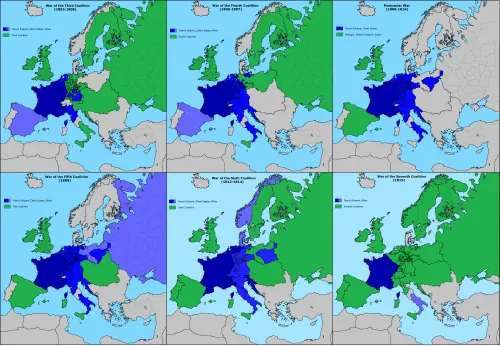
That same year France reinstated the brother of King Louis XVI, putting France in the same place it was before Abbé Sieyès recommended the creation of the National Assembly in 1793. Napoleon stayed in exile for less than a year before returning to the southeast coast of France. Once he returned, Napoleon began making his way to Paris where he would continuously gather troops that were sent to arrest him from the French King. The troops could not bring themselves to arrest their previous general and Emperor and instead supported him on his way to Paris. As the king gained knowledge of this, he fled to a nearby kingdom and Napoleon regained the throne of France unopposed.
The European monarchies strongly opposed Napoleon regaining control of France and feared that he would reignite revolutionary ideals in their citizens. Therefore, from March to July in 1815 the War of the Seventh Coalition, or more famously the Hundred Days War took place where the allied coalition didn’t declare war on a particular country, but specifically on Napoleon. After Napoleon was defeated in the famous Battle of Waterloo in 1815, he was exiled to Saint Helena, a small island on the west coast of Africa which is much more isolated than before, where he would be guarded by 2000 British soldiers and have 2 British Naval ships circling the island 24 hours a day, 365 days a year. It is here where Napoleon would live out the remaining years of his life and die in 1821.
The French continued to struggle for their revolutionary ideals and again reinstalled the Monarchy, but the ideas did spread to large parts of Europe. Even though the French Monarchy was reestablished after Napoleon’s death, it does not discount the immense influence and inspiration he had directly on the people of Europe then and around the world today. The Napoleonic code he created in 1804 is still used to widely influence France and it serves as the basic legal framework in many European countries today. Not only were his military tactics immaculate and innovative, but his ability to influence people to fight for their freedom against a malicious group of monarchies also shined through his life.
Napoleon did take part in tactics that restrained his citizens from active participation in politics and free-thinking because he wanted to remain in power, nonetheless, he will be remembered in history as one of the most historical emperors the world has ever seen. One of Napoleon's most famous quotes reads, “There is no immortality but the memory left in the minds of men… to have lived without glory, without leaving a trace of existence, is not to have lived at all.”
During all the talks of the war, we may have again forgotten about the Rothschilds. Nathan Rothschild was sent to London with £20,000 (£2.2 million when inflated to 2021 prices) in 1798 and by 1804 he became a citizen of Great Britain. He immediately started a business in finance taking after his father’s lessons. In 1809, he began his money-changing business for gold bullion and only a year later formally founded N. M. Rothschild & Sons in a famous financial district of London where the company is still headquartered in a skyscraper today. Niall Ferguson states, “For a contemporary equivalent, one has to imagine a merger between Merrill Lynch, Morgan Stanley, JP Morgan Chase & Co. and probably Goldman Sachs too—as well, perhaps, as the International Monetary Fund, given the nineteenth-century Rothschild's role in stabilizing the finances of numerous governments" (1999). It’s funny because that quote was from 1999 and after the recession of 2008 some of those banks did consolidate.
Furthermore, Nathan Rothschild came to an agreement with a general of the Britain army to be responsible for moving large sums of money to pay for soldiers on the front lines. Therefore, every time I referenced Great Britain funding other European Monarchies, it was the Rothschilds who were paid for moving the money and potentially the Rothschilds who owned the Bank of London who printed the fiat currency, which at this point was the world reserve currency because of Great Britain’s vast dominance in global military affairs.
Throughout the Napoleonic wars, Nathan Rothschild made considerable profit from speculating on securities and betting on the outcomes of various battles. The most famous among those battles is the Battle of Waterloo, which was the last battle of the Napoleonic Wars, and had the largest economic and political repercussions and ended Napoleon’s reign as the French Emperor. In the Battle of Waterloo, Nathan Rothschild was paying close attention to the outcome, because of his deep investments into the armies against Napoleon. When his assistants learned that the outcome was decided, they quickly arranged for the information to be passed through messenger to Nathan in London, and before any of the government officials or any of the traders knew the outcome, Rothschild was able to ride on the emotional selling of his peers while secretly buying up those same positions they were selling for a discount. When everyone learned of the outcome of the battle, the price of the security significantly rose, allowing Nathan to increase his overall wealth and sell the positions at a huge profit, making millions of pounds on a deal made in the 1800s.
Once again, the Money Changers sat in the background profiting while families lost their husbands, brothers, and sons to battle. In addition, the Rothschilds were able to garner huge influence, without anyone even knowing about it. They were able to control the economy's crashes and expansions because of their deep pockets, knowledge about emotions, predatorial strategies, hidden connections, vast resources, and overall unwillingness to care for the equity and good of all. Instead, they cared more about accumulating massive amounts of wealth for generations to come in order to control the outcomes of future legislation, government and economic structures, and more.
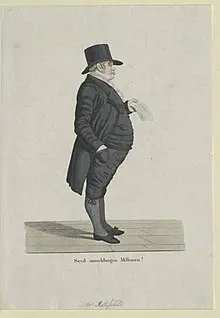
(Portrait of British banker Nathan Meyer Rothschild, 1817)
If you like what you read please visit my Discord and also be the first person to join my Discord! I'm on a journey to create a community of Finance people.






