After the financial crisis during the Panic of 1819 began winding down, markets started to turn around and the economic outlook was appearing bright, another internal dispute was emerging in the United States. A war. However, the war was not fought with guns, it was fought with words and propaganda in a Bank War.
By the time James Monroe left office in 1825 the Panic of 1819 had taken a major toll on the American economy. The damage to the economy subsequently guided the United States into social unrest and divisive politics. The next leader of the country had to find a way to navigate this financial disaster and attempt to unify the nation.
However, before the next leader would take office there would be corruption and manipulation by Money Changers in order to get a President of their choosing in the White House. After James Monroe decided not to run for a third term, the 1825 presidential campaign was riddled with controversy and corruption. Among the candidates were Andrew Jackson, John Quincy Adams (son of former president John Adams), Henry Clay, and William Crawford. When the voting took place Andrew Jackson had won a convincing plurality over his opponents in the Electoral College and popular vote (Sumner 1910, pp. 114–116).
However, the laws written at the time specifically enumerated that a majority of the Electoral College votes needed to be won to be elected as President. Therefore, with Jackson only securing a plurality of the electoral college votes, the final decision on who would be the next president would be determined by the House of Representatives. At the time Henry Clay, one of the original creators and advocates for the SBUS, finished near last in the race for president and was the Speaker of the House inside the House of Representatives. The Speaker of the House is among the most powerful positions in America and especially in the legislative branch because of its ability to bring forward discussion and choose which topics will be debated inside of Congress.
Being conscious that his personal wealth was one the line and understanding Andrew Jackson was a large opponent of the SBUS, Henry Clay colluded with candidate William Crawford and the US Congress to elect John Quincy Adams as President. In return for his efforts, John Q. Adams appointed Clay as Secretary of State, a position many former American politicians held before finally reaching the presidency. With Henry Clay quarterbacking this agreement, another example of politicians manipulating the system in plain sight for their personal benefit and gain took hold of politics and the economy. This arrangement was later coined a ‘corrupt bargain’, where politicians maneuver around the demands of the people to protect and preserve the wealth of aristocrats. (Meacham 2008, pp. 44–46.)
The theme of John Quincy Adams' presidency can be characterized by centralization of the economy, increased taxes, and political overreach. Daniel Howe states in his book What Hath God Wrought: The Transformation of America, 1815–1848, “Adams pursued an unpopular course by attempting to strengthen the powers of the federal government by undertaking large infrastructure projects and other ventures which were alleged to infringe on state sovereignty and go beyond the proper role of the central government” (Howe. 2007). John Quincy Adams had openly manipulated the outcome of a presidential election for personal gain with the help of Secretary of State Henry Clay, an individual with close relationships with the wealthiest Money Changers in the United States and a significant supporter of the SBUS, all while spending the money of everyday Americans at will.
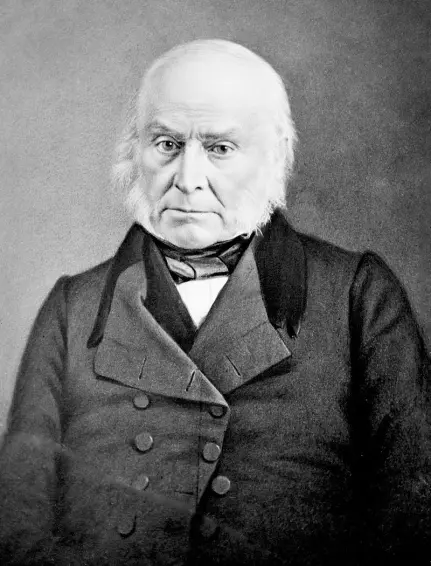
(Adams c. 1843–48, photographed by Mathew Brady)
In the next election in 1828, Andrew Jackson would run for president again. However, this time Jackson would be putting his reputation at risk by making his position on the SBUS abundantly clear. In addition, Jackson would showcase his leadership skills by taking a contradictory view on the status of American economics during his lifetime and taking a stand for the everyday person who he believed should be the center of American policy.
Another significant change occurred during the 1828 election that involved the population that was able to vote in elections. The presidential election of 1828 marked a dramatic increase in the number of voters that entered the political realm jumping from around 3% of the total population in the previous elections to around 9% in 1828 (Kish, J.N. "U.S. Population 1776 to Present". Google Fusion Tables). Laws allowing more widespread voting allowed for populism and the lower and middle classes have more of a voice in politics and the results would eventually illustrate this point.
A rematch of Andrew Jackson and the incumbent John Q. Adams for the president was occurring once again; with Andrew Jackson representing less government involvement and opposition to the SBUS, while John Adams represented the interests of bankers and the elite of the country. From the onset of Adams' presidency, partisanship started to creep its way back into politics; revolving around the issue of national financialization, centralization of power, and getting involved with foreign wars. However, the campaign trail saw even more vicious personal attacks made from, both sides of the aisle which resulted in partisanship becoming prevalent in American media and society.
One of the first divisive topics of debate that arose during the 1828 presential campaign was John Adams showing interest in involving the United States Military in armed conflict within the country of Panama. The goal of this strategy was to have strong United States military influence in Latin America because of their crucial geographical location to maritime transport and crop production, Panama was fresh out of the revolution against Spain and emerged victorious and independent in 1821. Once they left the Spanish, Panama voluntarily joined Gran Columbia, which consisted of present-day Ecuador, Columbia, and Venezuela.
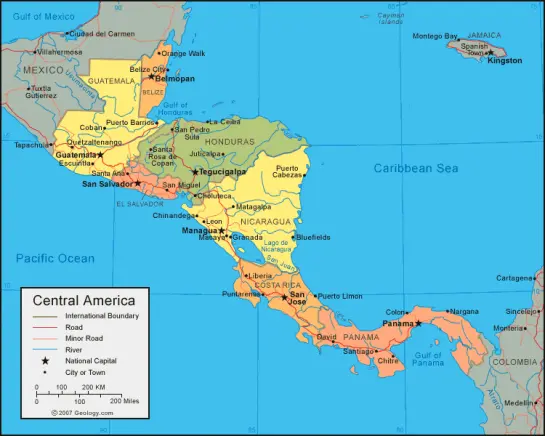
(https://geology.com/world/central-america-satellite-image.shtml)
Through foreign policy and the Second Central Bank, John Q Adams and the United States were attempting to influence groups in Panama and Latin America to succeed from Columbia, to allow American influence and economics to dominate in the region. After Panama joined Gran Columbia, the United States government periodically attempted to get the Panamanians to revolt against Columbia to push American influence and gain international support in an important geographical location for transportation and military movement. Adams was one of the first presidents to make this effort, while Jackson was his biggest opponent stating, “The moment we engage in confederations, or alliances with any nation, we may from that time date the downfall of our republic”. Jackson was of the belief that engaging in foreign wars would lead to damaging the United States economy while raking in profits and government contracts for the wealthy who controlled the production in the private economy. Adams, who supported the wealthy aristocrats, endorsed foreign conflict because of his belief of American involvement in the foreign conflict was beneficial for its citizens or was just tricked by Money Changers into believing so.
Another pressing issue was the centralization of power within the Federal government and the executive branch extending its power beyond what the constitution allows. From the onset of Adams' presidency, he established goals of nationalizing infrastructure by creating roads, canals, and bridges that would be headed by the newly created Department of Interior. All of this sounds good in practice, but Robert Remini, an author for the New Tork Times Books points out that most of the construction and infrastructure projects were carried out by private companies, with the government funding the majority of the projects (John Quincy Adams. New York: Times Books. 2002). This point illustrates that creating an entire division of federal government to carry out large infrastructure projects is not only unfeasible and inefficient but infringes on individual and state powers in government decisions and budget making. Adams' presidency was filled with attempts at creating additional federal departments to make decisions on behalf of the states and people, which led to the resentment toward his presidency that was growing within the nation.
The most pressing issue that drove division in politics between the followers of John Q Adams and Andrew Jackson was the Second Bank of the United States (SBUS) because the bank represented foreign ownership in the largest bank in the US, the direction of the economy could be dictated by unelected and unreviewable aristocrats without public backing and Money Changers becoming more intertwined in politics. An article written by Lucas Kawa for Business Insider states that the Rothschilds were some of the largest owners of the First and Second Banks of the United States. Furthermore, the article states that the transition from the FBUS to the SBUS combined with the War of 1812 that increased military production, and wartime spending/lending “definitely swelled the family's riches” (Business Insider, 2013). The reality that foreign aristocrats had ownership over the FSBUS and SBUS left Americans with the creating value that was not funneling back into increasing their standard of living. Instead, the value that Americans were creating would be funneled in the form of bank profits to the Rothschilds, Money Changers, foreign investors, and speculators.
One of the major supporters of Andrew Jackson was none other than the writer of the Declaration of Independence, Thomas Jefferson. Jefferson had died on July 4th,1826, however, prior to his death he was a formidable supporter of Jackson stating he was, “an honest, sincere, clear-headed and strong-minded man; of the soundest political principles” and in opposition to Adams stating, “that the three ruling branches of that department are in combination to strip their colleagues, the State authorities, of the powers reserved by them, and to exercise themselves all functions foreign and domestic”. Jackson used Jefferson’s quotes and sponsorship as a means to gain the support of the public and once the campaigning occurred and the election of 1828 was said and done, Andrew Jackson emerged victoriously.
With the SBUS charter scheduled to come up in 1833, Jackson took time during his first term to dismantle the credibility of the SBUS and attempt to establish a new national bank that was owned by the public and did not fall outside the scope of the constitution. However, by the time his first term came up in 1832, no changes have been made and the status-quo remained.
After four years passed and no major changes were made to the bank, Jackson maintained his conviction that the SBUS was an evil institution that served the interests of the elite during his second campaign. Henry Clay, John Q. Adams, and Nicholas Biddle (the SBUS director) maintained the desire to keep the SBUS in operation and recharter the bank for another 15 years. There were large amounts of uncertainty between both political parties on whether or not Jackson would veto the bill because it had been passed by Congress and approved by the Supreme Court. As the election grew closer Jackson had asked Clay and Biddle to wait until after the election to bring the bill to congress, but they did not listen. A recharter bill was sent to Congress and approved in both the House and the Senate, leaving it to the President for a final signature to determine if the bill would become law and recharter a privately owned central bank for another 15 years. The bill hit the president’s desk on July 4, 1832, a symbolic date. Around the same time President Jackson became sick and one of his cabinet members Martin Van Buren came to check on Jackson’s health. At the check-in, Martin Van Buren remembers the conversation with Jackson and something the President told him, "The Bank, Mr. Van Buren, is trying to kill me, but I shall kill it" (Remini 1981, p. 366).
Jackson vetoed the bill and Congress failed to achieve a Supermajority to override the president’s veto. Opponents of Jackson said it was an abusive use of executive power and started the involvement of the president intervening in the legislative process. Supporters of Jackson were thankful the institution would finally be put to rest, and allow American economics to prevail without the influence of a private, unelected group of individuals that were owned by foreign investors running the nation.
During Jackson’s veto, he delivered a communication that is among the most “popular and effective documents in American political history” (Remini 1981, p. 369). In the document, (which can be found at https://millercenter.org/the-presidency/presidential-speeches/july-10-1832-bank-veto) Jackson states iconic passages that I will quote below.
“[I’m] deeply impressed with the belief that some of the powers and privileges possessed by the existing bank are unauthorized by the Constitution, subversive of the rights of the States, and dangerous to the liberties of the people”
“It enjoys an exclusive privilege of banking under the authority of the General Government, a monopoly of its favor and support, and, as a necessary consequence, almost a monopoly of the foreign and domestic exchange. The powers privileges, and favors bestowed upon it in the original charter, by increasing the value of the stock far above its par value, operated as a gratuity of many millions to the stockholders.”
“More than eight million of the stock of this bank are held by foreigners. By this act, the American Republic proposes virtually to make them a present of some millions of dollars. For these gratuities, to foreigners and to some of our own opulent citizens the act secures no equivalent whatever.” Knowing the situation in Europe, the Rothschild family was most likely the largest foreign shareholder in the institutions.
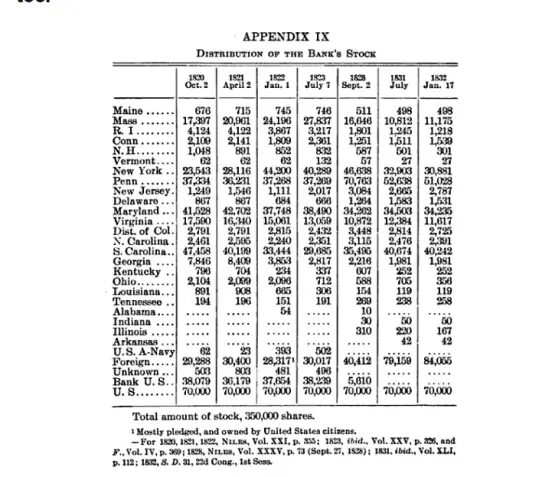
(The Second Bank of the United States, by Ralph Charles Henry Catterall. As you can see large foreign ownership in the Bank)
“If we must have a bank with private stockholders, every consideration of sound policy and every impulse of American feeling admonishes that it should be purely American. Its stockholders should be composed exclusively of our own citizens, who at least ought to be friendly to our government and willing to support it in times of difficulty and danger. So abundant is domestic capital that competition in subscribing for the stock of local banks has recently led almost to riots.”
And my personal favorite paragraph from the document, “Should the stock of the bank principally pass into the hands of the subjects of a foreign country, and we should, unfortunately, become involved in a war with that country, what would be our condition? Of the course which would be pursued by a bank almost wholly owned by the subjects of a foreign power, and managed by those whose interests, if not affections, would run in the same direction there can be no doubt. All its operations within would be in aid of the hostile fleets and armies without. Controlling our currency, receiving our public moneys, and holding thousands of our citizens in dependence, it would be more formidable and dangerous than the naval and military power of the enemy.”
As a result of the Bank Directors and politicians sending the charter to President Andrew Jackson’s desk before the election and President Jackson’s veto of the bill, the Second Bank of the United States was the central debate leading up to the 1832 Presidential Election.
Although around 2/3 of the media was suppressing the public in pro-SBUS propaganda (Wellman 1966, p. 129), President Jackson and his supporters managed to create a narrative in the United States of “The people” against “the aristocrats” (Remini 1981, p. 374.). This narrative became crucial to the success of Jackson’s campaign, because of voting rights being expanded to more people and citizens desire to become more involved with politics. After the election was finished, Jackson finished with 55% of the popular vote and over 76% of the electoral college votes and Jackson would remain president for another four years ("Electoral College Box Scores 1789–1996". National Archives and Records Administration). In the next four years, Jackson would make a large impact and reinforce his legacy as an Anti-Bank president.
Now that Andrew Jackson’s presidency was solidified, he began to come up with plans to replace the SBUS, as the charter was set to expire in 1836. This plan started with removing the deposits inside of the SBUS and putting them into privately ran state-banks in 1833 and 1834. Henry Clay and the SBUS director at the time Nicholas Biddle continued the attempt at dismantling Jackson’s plans of creating constitutional national bank by contracting the amount of credit and money circulating in the economy, forcing interest rates to quickly increase.

(1833 cartoon shows Jackson destroying the "Devil's Bank")
Workers lost their jobs, factories could not receive loans, and Biddle’s strategy of crashing the economy to manipulate citizens in believing that the economy was unsustainable without the SBUS working to perfection. Business leaders and individuals began calling upon their representatives in Congress to show support for the SBUS (Schlesinger 1953, p. 103.). With political tension increasing, constituents began reaching out to Andrew Jackson to restore the SBUS charter. Andrew Jackson responded by pointing them to Biddle, “Go to Nicholas Biddle. We have no money here, gentlemen. Biddle has all the money. He has millions of specie in his vaults, at this moment, lying idle, and yet you come to me to save you from breaking. I tell you, gentlemen, it's all politics”. When the voters went to Biddle, they were left with no response and he was found to be “out of town”. (Parton 1860, pp. 548–550.)
In 1834 after the short recession caused by Biddle’s contraction of the monetary supply, the economy began to blossom under bipartisan financial laws that gained the support and confidence of the public. The booming economy reinforced the idea that a privately owned central bank is not required to have a successful economy in business leaders' and individuals’ minds. The deposit-banking method of finance now had a chance to show potential. This potential began to show on January 1st, 1835 when under Andrew Jackson’s presidency the United States, for the first and only time, was able to pay off its debt entirely (Smith, Robert (April 15, 2011). When the U.S. paid off the entire national debt (and why it didn't last).
Furthermore, the first attempt to assassinate a president with a gun occurred against Andrew Jackson on January 30, 1835, by Richard Lawrence, with two pistols. Both pistols misfired and Jackson beat the man with his cane. Lawrence later stated a dead president would mean, “money would be more plenty” It would later be deemed that he was mentally incapable and taken to an asylum. (Remini 1984, p. 229.)
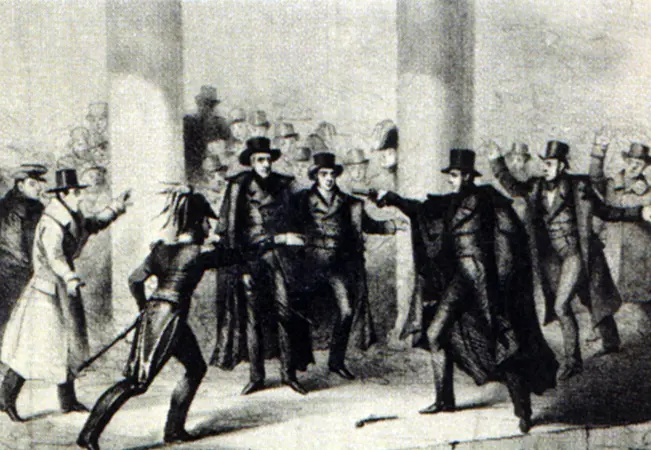
(Richard Lawrence's attempt on Jackson's life, as depicted in an 1835 etching)
While the economy was booming in 1833, Henry Clay, Nicholas Biddle, and others began forming another political party whose views were quite the opposite to those of Andrew Jackson’s views of dismantling the SBUS and giving power to the states. In Spring 1834, the Whig party was born, a play on words meant to imitate the English Whig party that was created to fight politically against the English Monarchy.
During the creation of the Whig political party, it held a majority of representation in the senate and successfully passed a vote to censor Andrew Jackson on the grounds of breaking the Constitution when Jackson ordered the removal of the SBUS deposits (Parton 1860, p. 541). An important part of the censorship of the President was an unwillingness to be reviewed or investigated by House committees or the executive branch. After future president James Polk started a committee to investigate the SBUS, even after subpoenas were ordered for the books, the banks still refused to hand them over (Parton 1860, pp. 556–558). The committee recommended the bank directors, including Biddle, be arrested. However, no action was ever taken (Parton 1860, pp. 557–558). The political power that Money Changers and politicians had allowed them to escape the law while if ordinary citizens broke the same rules they would be jailed for a lifetime. However, the political skirmishes occurring were being tracked daily in the media which swayed the public’s support in favor of Jackson and the trust in the operations and directors of the SBUS was falling rapidly (James 1937, p. 379)
Early in 1836, just before the bank charter was scheduled to end Biddle maneuvered the system and took the bank private in Pennsylvania, turning it into a state bank to continue running the organization rather than letting it disband completely (Hammond 1947, p. 155). However, at Biddle’s direction, the bank borrowed large amounts of specie from European banks to purchase Cotton, and after a recession occurred in the Panic of 1837 Biddle made the decision to leave the company altogether. Throughout the remainder of his life, he was riddled with lawsuits stemming from his time at the SBUS and after he took it private. Following Biddle leaving the SBUS. The bank was officially suspended in 1831 and after Congressional Committee Investigations “exposed massive fraud in its operations, the Bank officially shut its doors on April 4, 1841” (Remini 1984, p. 472).
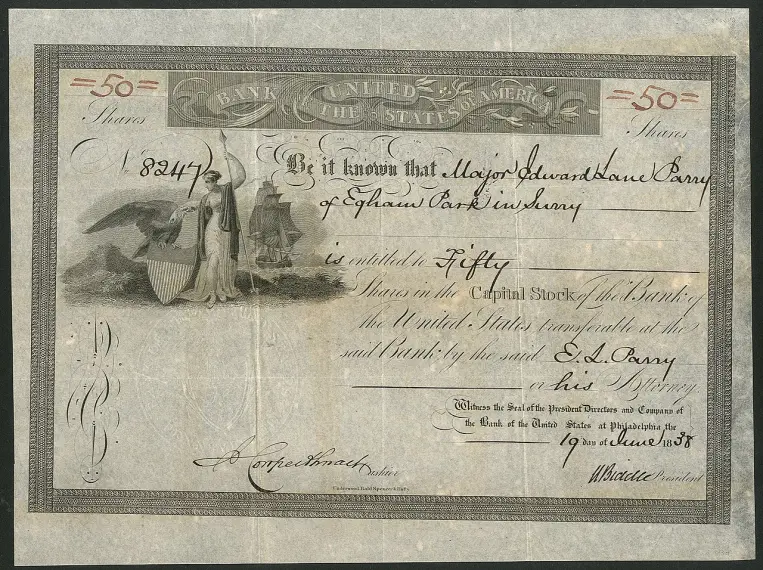
(Share of the Second Bank of the United States, issued 18. June 1838, signed by Nicholas Biddle)
The next major financial crisis that occurred was the Panic of 1837. However, it would occur under a new president after the elections of 1836 with Martin Van Buren, Andrew Jacksons Vice-President, winning the campaign. This panic was a major economic downturn inside the United States that lasted into the 1840s because of a contraction in the money supply, speculation, and restrictive lending. However, there is always more to the story and important characters involved.