
After John Booth’s assassination of Abe Lincoln and the Civil War had finally come to an end, the United States political leaders had to develop methods for reintegrating a divided population into one country, which had serious impacts on the future generations to come.
The first and most noticeable effect of the Union victory in the Civil War was the freedom of slaves from the Emancipation Proclamation and the 13th amendment of the Constitution ratified in 1865. After Lincoln announced the Executive Order to end slavery in the rebellion states, black people who were previously slaves would now be gradually freed as Northern armies defeated military efforts in the south. Slaves who weren’t freed by the Emancipation Proclamation were liberated by the 13th amendment which abolished involuntary servitude in the United States, except when being used as a punishment for a crime. Although slavery had officially ended in the states, discrimination against black Americans still persisted in the economy, society, and politics. Many former slaves migrated to the North, but for those who stayed in the South, their living conditions largely remained the same when working on the plantations.
There were some improvements that were optimistically conquered by and for black Americans, such as all-black college universities, primary schools, new hospitals being built, and slavery is dead. In addition, positions like lawyers, teachers, and nurses were now becoming occupied by former slaves. Nevertheless, discrimination and racism persisted throughout American society as a consequence of Jim Crow Laws, the Separate but Equal Clause, and the Black Codes being just some examples of the disenfranchisement of black Americans in the decades following the end of the Civil War. Jim Crow laws not only allowed but mandated that black Americans be segregated from the rest of the population in public. The Separate but Equal Clause was the legal doctrine that empowered this behavior and made it Constitutional to do so, which would eventually be overturned in the Supreme Court case Brown V. Board in 1954. Black codes were state laws that determined the way black people were to be treated in society. An example of the Black Code in Mississippi went like this, “…It shall not be lawful for any freedman, free negro, or mulatto to intermarry with any white person; nor for any white person to intermarry with any freedman, free negro, or mulatto; and any person who shall so intermarry shall be deemed guilty…[and] confined in the State penitentiary for life” (Central Piedmont Community College, “Black Code and Jim Crow Law examples,”)
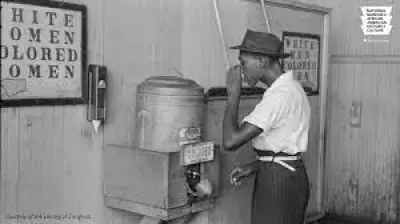
(Early 19th-century photo of segregated water fountains)
Recall that only a week after the civil war had ended, Lincoln was assassinated by Boothe. This would play a huge role in how the reconstruction era would unfold in the following years. After Lincoln’s death, the entire country and parts of the international community mourned his passing, although there were some confederate sympathizers that celebrated the circumstance. During the transportation of Lincoln’s body to Illinois where he would be buried, the carriage drove through dozens of cities over a period of three weeks that were occupied by hundreds of thousands of people lining the streets to celebrate Lincoln’s life.
To take his place Lincoln’s place his Vice-President, Andrew Johnson, immediately assumed the Presidential office and was able to stay in power from 1864 to 1868 because of Lincoln’s recent victory in his election. Johnson was a southern democrat who was strategically selected to run alongside Lincoln in his 1860 and 1864 campaigns to balance the presidential ticket and earn the vote of democrats in the North. Johnson’s presidency consisted of large controversy surrounding his treatment of the Southern States during the rehabilitation of the Confederacy into the Union.
Before Lincoln was shot, his plans to integrate the Confederacy into the Union involved slaves owning their own land, reparations being paid by the states, and increased rights for former slaves. On the other hand, Andrew Johnson believed the reconstruction should be interpreted as if the South had never left the Union, by allowing the same stakeholders who held power before the conflict to maintain power after the war. For instance, Johnson allowed all of the slave owners to maintain their land, rather than distribute it to former slaves and black soldiers who fought in the Union army as was promised by leading generals, Furthermore Johnson appointed a military rule over the south and appointed all white legislators that looked eerily familiar to the past (Crash Course: America History. John Greene).
As a result of Johnson’s views on the South and servitude, the lives of slaves were mostly the same in the South. Freeman continued to work on plantations, but rather than slavery, sharecropping was adopted. Sharecropping was when the people who work the land take home a share of the crops they produced while giving the remainder to the landlord. In practice, this was quite similar to what slaves had been experiencing before, except they had slightly better living conditions and slightly more control over their labor. However, it made migration for black families difficult because of their inability to save money or buy property. Toward the end of the 19th century and moving into the Great Depression, most of the sharecropping was done by white Americans because of the wealth being concentrated in the hands of property owners and the financial difficulties the middle and lower classes were facing (Crash Course, Reconstruction and 1876)
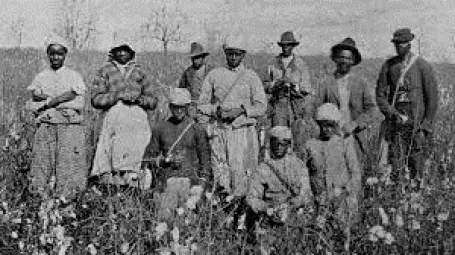
(Black family sharecropping in late 19th century)
More controversy occurred during Johnson’s presidency when he was impeached by a Republican-dominated Congress in 1868 because of his actions toward helping the south, dismissing Republican Secretary of War Edwin Stanton, and ignoring the rules around improving black Americans rights that Abraham Lincoln and Republicans stood for. Ultimately, Johnson was acquitted by the Senate by one vote and was able to continue his practices of catering to the southern states while fraud and corruption were rampant against freeman for the remainder of his presidency. However, the event and his actions stained his legacy as an ineffective leader, and is generally regarded by historians as one of the worse United States Presidents to ever take office.
In response, the Republican-led Congress took the reconstruction into their own hands by passing the Civil Rights Act of 1866. This act had three main objectives, “1.) a definition of American citizenship 2.) the rights which come with this citizenship, and 3.) the unlawfulness to deprive any person of citizenship rights "on the basis of race, color, or prior condition of slavery or involuntary servitude” (Christopher A. Bracey. June 27, 2018. "Civil Rights Act of 1866")
Showing his true colors Andrew Johnson immediately vetoed the bill because “it discriminated against white people” (Foner, pp. 250–251.) The bill was sent back to the House and Senate where for the first time in American political history Congress overrode the president’s veto by a 2/3 vote and the act was passed. In response, even without Executive or Judicial support, the United States legislature successfully added the 13th (1865) 14th (1968), and 15th amendment (1870). The 13th abolished slavery, the 14th recognized African Americans as citizens and the 15th amendment gave former slaves the right to vote. Many historians agree that the 14th amendment is perhaps the most important amendment in the constitution and is regularly used in constitutional debates today. However, these laws were widely ignored in the south by states who created State Constitutions and local laws that allowed the white population to discriminate against the freed slaves.
These laws and amendments that extended rights to minorities angered radical political groups in the United States to the point of individuals coming together to create domestic terrorist organizations such as the Ku Klux Klan (KKK) in 1866. The KKK carried out numerous murders and assaults targeted at black citizens and their allies in the Southern United States. In the 1860s the KKK had the goal of throwing out the republican-dominated government that supported the rights of Black Americans and had been appointed by Lincoln and Johnson in an attempt to modernize governance in the South.
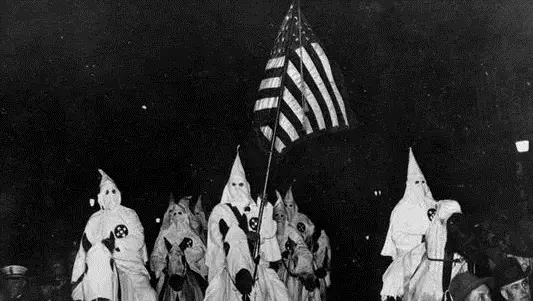
(Picture of KKK. Source: History: KKK begins in Tennessee. Jerry Mitchell Clarion-Ledger)
The worst massacre carried out by the KKK occurred as a result of the radical racial group disputing the election results of a Republican governor in the south. On Easter Sunday in 1873, the Colfax massacre occurred in Louisiana that resulted in around 150 members of a black militia being murdered by the KKK and their dead bodies being left in the streets or dumped in a nearby river.
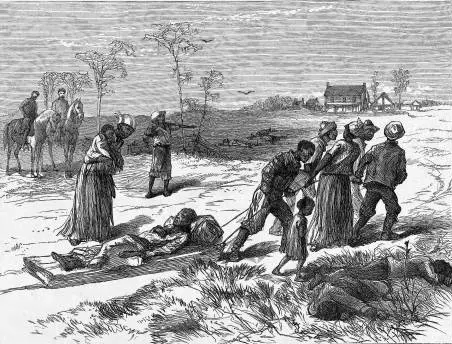
("The Louisiana Murders—Gathering The Dead And Wounded". Published in Harper's Weekly May 10, 1873, page 397 after the Colfax massacre in Colfax on April 13, 1873.)
To understand the repercussions for the KKK after the genocide, we need some context. In 1870 the federal government ratified the Enforcement Acts that sought to give African Americans the civil rights of voting, being on a jury, and more. In the aftermath of the massacre and during the prosecution of the KKK around 90 members were arrested and only 9 were prosecuted. Only 1 was charged with murder while using the Enforcement Acts as a justification for the charge. As a result, the federal prosecutors appealed to the supreme court for only finding one guilty charge, and the Supreme Court ruled the Enforcement Acts only applied to governments and not private groups of people, so the decision of whether or not the perpetrators should be held accountable falls to the State level. The state of Louisiana didn’t press charges on any members of the KKK and in fact openly supported their actions in some cases. Therefore, the KKK members were subsequently released. The release of the KKK members spurred other pro-white groups to pop up across the South who would publicly display their distaste toward minorities, George Rable explains the white paramilitary groups acted as, “the military arm of the Democratic Party.” (But There Was No Peace. University of Georgia Press, 1984, p. 132). The presence of radical white political groups continued to haunt minority groups in the south through their practices of murder, kidnapping, rape, false imprisonment, and stealing from black leaders, politicians, women, and children in the South throughout the 19th and 20th centuries, despite the federal government and broad support from citizens for fair and equitable treatment of minority groups in the United States.
Economic Causes and Impacts of the Civil War
Now we will dive deeper into the economic causes and effects of the civil war by analyzing the pain points the southern population was experiencing to cause succession from the Union and the discomfort the respective economies experienced during the recovery after the war, which may sound familiar when compared with today.
We understand that slavery was the main cause of the Civil War, but why was the South so angry about freeing slaves that people were willing to kill, murder, rape, and torture to keep the status quo? The answer lies in the population and production of black Americans in the South leading up to and during the armed conflict.
There were a number of economic factors that led southern citizens to become fearful of their financial situation and the idea of slavery being abolished. First, over 40% of the South’s population and 25% of its production came from their most valuable asset, not their land, but the labor produced by the slaves who worked the land.
During the time leading up to the Civil War, the value of slaves was rising exponentially because of the immense value they provided to the economy. Therefore, when Lincoln enacted the Emancipation Proclamation, nearly half of the southern population was made free, allowing them to flee to the North which created a large setback in the overall production of southern plantations.
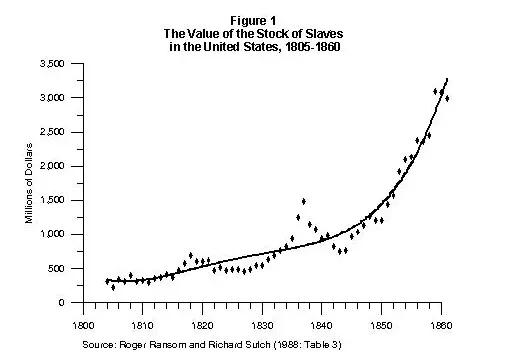
(Value of Slaves increased throughout the 19th century. https://eh.net/encyclopedia/the-economics-of-the-civil-war/)
The reason the value of labor was rising in the southern plantations was that farms were having success harvesting their most profitable cash crop, cotton. Throughout the 19th century, the production of cotton increased due to a growing slave population working on farms. Their product would then be exported to the Northern US or Europe, with Great Britain being one of the largest consumers of slave-produced cotton.
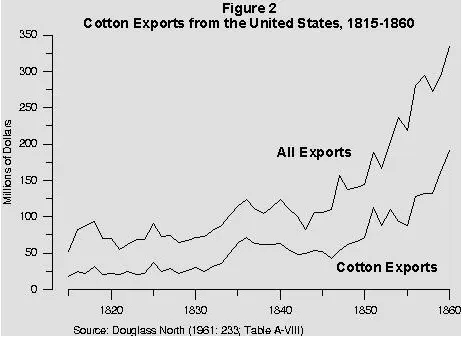
(Cotton exports in the US)
Next, the North was much more urbanized than the south, containing more advanced ports, transportation, manufacturing facilities, and concentrated sources of labor.
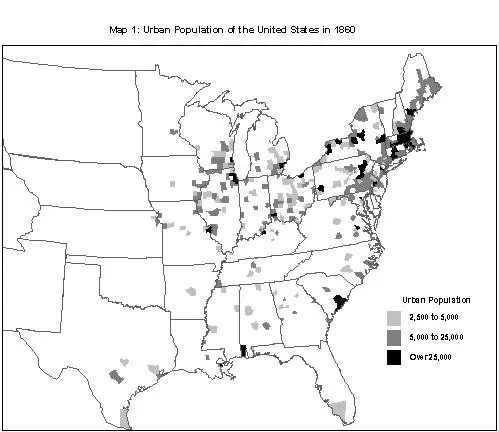
(Source: United States Population Census, 1860.)
As a result, citizens of the South were fearful that its main economic engine would no longer be feasible and their wealth would dwindle, which created anxiety and eventually led to resentment toward the North, eventually sparking the Civil War. However, most of the plantation owners were more concerned about being stripped of their land and property (slaves) than fighting for the succession or patriotism of a nation, which over time dampened the enthusiasm of the CSA and led to Union victory essentially being inevitable.
As a whole, the Civil War was the first modern war in world history that saw the innovation of advanced weaponry and innovative financing used in the conflict. Machine guns, cannons, and explosives were common weapon choices during a time when old war tactics were being used, resulting in hundreds of thousands of soldiers being wounded or killed, including instances of the same family fighting on opposite sides of the battlefield. All of this matters because when the war was kicking off in 1861, neither the North nor the South was anticipating an armed conflict that lasted long. The elongated estimates ranged from 1 to 2 years. However, both sides would soon realize their approximations were vastly underestimated when the war ran a long and bloody four years and finally ended in 1865. In addition, the Civil War largely took place in the south, without any major battles occurring in the North. Therefore, the destruction of the economy and infrastructure like railroads, farms, and manufacturing centers was far greater in the South than in the North.
The Civil War was not only the deadliest war in American history, but it also represents the largest financial strain on a government during a war effort for the United States. Overall, the USA and CSA took three main approaches that are historically used by world governments to gain financing through years of battle; printing money, selling bonds, and increasing taxes. However, different concentrations and strategies were used by each respective nation based on its citizen's and politicians’ willingness to increase taxes, increase inflation, or run debt on the government balance sheet for the objective of winning the war.
The Union Funding Methods
In the world historically, presently, and in the future; governments use three primary methods of funding a war: printing money, selling bonds (issuing debt), and increasing taxes. All of which have large intended and unintended implications that can sometimes be hidden in nature. The USA’s financing during the war stands out because of its large number of bonds issued, the legal tender act that created Greenbacks, and increased tariffs to pay for internal improvements.
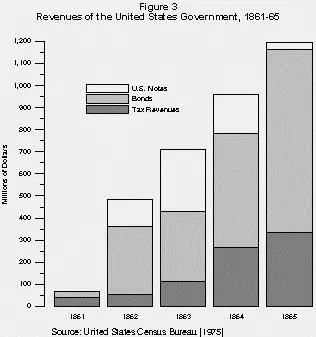
Historically in the United States, issuing debt was a mechanism for raising money by the government that was only used during the war, contrasted with today’s politicians who brutally abuse that power and run tremendous deficits while the average person suffers. Founding fathers, politicians, and citizens had a natural aversion to the idea of running large deficits on the government's balance sheet or issuing bulky amounts of debt creating somewhat of a distaste for the idea. In 1857, four years before the Civil War began, the United States was holding around $28 million in debt which was a reasonable amount for the time period. By the time Lincoln took office in 1861, Congress and the Treasury authorized debt issuances that totaled nearly $200 million, and the national debt over doubled while making its way to over $70 million.
Early in 1861 when Southern states were in the process of leaving the Union to form their own country, USA’s Congress authorized another $70 million in debt to start to prepare for battle. However, because Union citizens disagreed with the idea of the federal government running tremendous deficits and carrying substantial debt, less than half of the $70 million dollar bond offering was purchased by investors. This failed bond offering left the United States underfunded when compared to the calculated budget needed to bolster the Union Navy and Army for the armed conflict (Robert T. Patterson, “Government Finance on the Eve of the Civil War”. The Journal of Economic History, Vol. 12, No. 1 (Winter, 1952): 42.).
Once Lincoln was in office and the Civil War was in its beginning phases, Lincoln and Chase understood that the Union was severely underfunded to carry out a victory. Therefore, In July 1861 Lincoln called for a special session of Congress with Treasury Secretary Chase leading the meeting. Chase suggested Congress authorize a never-before-heard of $320 million in fundraising for military efforts through issuing debt, printing money, and increasing tariffs.
In response to the proposal, Congress authorized a $250 million debt issuance to investors and the public, alongside an income tax that was being imposed upon Union Citizens. Once again, the bond issuance was unpopular with investors and the government was only able to sell around $150 million of the offering to popular and wealthy bankers on the East Coast (Gary Giroux, “Financing the American Civil War: Developing New Tax Sources”. Accounting History, Vol. 17, No. 1 (2012): 92.)
After only a year in battle, it was becoming clear for the North that this conflict would be prolonged and difficult when facing off against the superior military leadership and tactics of the South. Therefore, the North needed more money to fund their efforts, and in 1862 the US Congress authorized the issuance of $500 million of debt to the public. Seeing the low levels of success in the prior issuances, Treasury Secretary Chase contracted Jay Cooke & Company, a large investment bank in Philadelphia that was started on January 1, 1861, to help solicit the sale of debt to the public and investors.
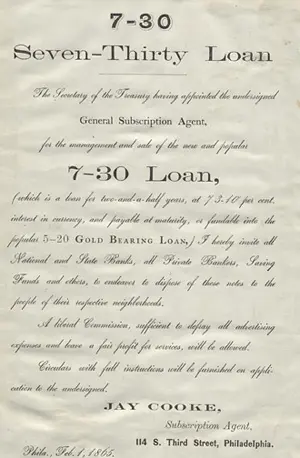
(Example of 7-30 Civil War bond. Callable in 7 years with a 30-year maturity.)
Cooke used innovative methods to advertise the bonds for the time and was extremely successful in his efforts. Cooke began advertising the sale of bonds inside newspapers across the Union with bond offerings as low as 50$ that would allow lower- and middle-class citizens to participate in the investment and increase the overall reach of people eligible to loan money to the government. While advertising these bonds, Cooke convinced the public that participating in the investment was a patriotic act that would help secure the nation and end slavery. In addition, Cooke created a network of over 2,500 salesmen across the country that would use studied marketing tactics to sell bonds throughout the North, West, remote cities, and even the South after states in the Confederacy became under the control of the Union.
Once congress saw the superior success Cooke was having when selling the bonds, they quickly hired him again to sell another round of debt totaling around $830 million in 1865. Cooke was able to fulfill the bond offering in less than 6 months. At the end of the war, the direct costs of the Union totaled over $3.2 billion with more than 60% of the cost being funded by issuing bonds. In four short years, the United States federal ballooned from around $70 million to an unprecedented $2.7 billion.
So, what does it mean that the US federal government was in $2.7 billion in debt? Well, let’s look at it from the start. When the federal government sells bonds, they are issuing debt. When an investor buys government bonds, they are lending money to the government in return for a periodic interest payment and the promise of repayment of principal upon maturity. So, when an investor buys bonds, they are forgoing part of their personal consumption to loan money out. The money that otherwise would have gone to personal consumption is getting lent to the government (mostly for military purposes in this case) to spend or invest however they please. So how does the money get paid back to the investors at maturity and how does the government pay for the periodic interest payments? The government has two choices to pay back the money, they can increase taxes or print money; both have negative consequences for the everyday citizen and those who don’t have a financial education. Most of the bonds issued by the government were 20- or 30-year long terms. This means that the $2.7 billion would have to be paid back to future generations of the original investors who became quite wealthy during the end of the century because of this deal, which helped with the continuous industrialization and growth of the US economy.
Now that we understood the role issuing debt played on the Union's ability to fund the war, we can talk about a method the government uses to raise money and collect revenue to pay back the debt it issued, taxes. If the government increases taxes, it’s obvious how this will impact citizens, you will take home less money from your income and you will pay higher amounts for goods and services. Taxes are the largest cost for most people, including their mortgage.
Joseph J. Thorndike states that throughout the Civil War the total tax revenue generated compensated for over 1/5th of the total funding, which is a substantial amount (An Army of officials: The Civil War Bureau of Internal Revenue”. Tax Notes, Vol. 93, No. 12 (Dec. 2001): 1753.) During the onset of the war in 1861, Treasury Secretary Chase convinced Congress to impose an income tax on its citizens. However, it was largely unsuccessful because of the small tax rate and effective date of the tax starting in mid-1862. In total, only around $2 million was generated from the income tax proposal throughout the war. However, the income tax is not the only source of the government’s revenue, there are property taxes, estate taxes, poll taxes, excise taxes, business taxes, taxes on specific goods, import taxes on merchandise from around the world, and more.
Now, if the government prints money, the impacts aren’t as obvious as issuing debt or increasing taxes. If the government prints currency, the supply of currency in the economy increases. When all else is equal if the supply of something increases the value decreases. Therefore, it will take more currency to buy the same goods and services because your dollars are less valuable. As a result, merchants will increase their prices because money in the economy is more plentiful, while production is stable. This leads to inflation (prices of goods to rise) and debasement of currency (currency losing value) the words are essentially synonymous in a fiat world. Citizens are losing purchasing power. This means each dollar you earn is now worth less than it was before. This means that the currency was printed (or typed in electronically today) and even if you receive a return on your bonds or an increase in wages of 5%, if the rate of inflation is 5.01% or higher, you are poorer.
In fact, many people call inflation a hidden tax. Remember that after President John Adams vetoed the passage of the Second Bank of the United States in 1832, the United States has been operating with state banks issuing money with different denominations, different degrees of risk, and different types of collateral. During the war, government officials such as Salmon Chase saw this as a large hindrance to their ability to raise money for the war effort (Frederick J. Blue. Salmon P. Chase, A Life in Politics (Kent, OH: Kent State University Press, 1987), 157.). As a result, Treasury Secretary Chase worked with his colleagues to announce the Legal Tender Act which authorized Congress to create and distribute $150 million of the first fiat currency issued by the federal government, called a Greenback.
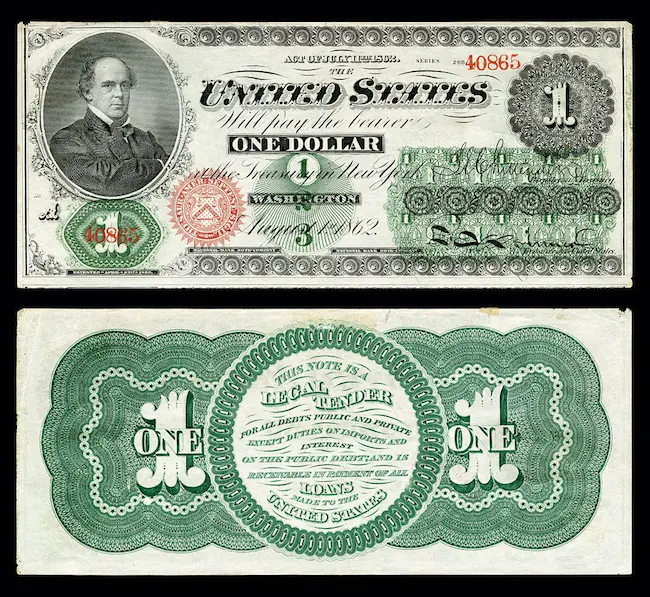
(Front and Back of Greenback)
What is a fiat currency? It’s a form of paper money that, rather than having gold or silver reserves to back the value of the currency, is valued because of the government's assurance that it was legal tender and can be bought for goods and services. This inherent trust in the system and knowledge that it can be used to purchase real items created an unconscious demand for paper money. Up to this point in American History, the US government used gold or silver as their primary money or as a reserve for paper currency, but this significant change in its monetary system indicated a transformation in United States policy and tradition regarding the issuance and collateralization of money.
By the end of the war, there were nearly $400 million worth of Greenback fiat circulating in the economy with denominations as low as $1 and went all the way up to $1,000. “Greenbacks are reported to have funded 15% of the war's costs. But the rise in their value also increased the cost of everyday goods and supplies—inflation was 14% in 1862 and 25% in 1863 and 1864.” (Museum of American Finance. "Greenback.") The issuance of paper money caused large controversy and concern among bankers who were anxious about the government being involved in markets, advocates who believed it was unconstitutional for the federal government to issue fiat money, and politicians who debated whether or not the greenbacks should be redeemable for gold or silver. Ultimately, the government would make its way into markets, the supreme court said it was constitutional for the federal government to issue fiat money and politicians eventually agreed to allow the redeemability of greenbacks for gold or silver.
The Confederacy Funding Methods
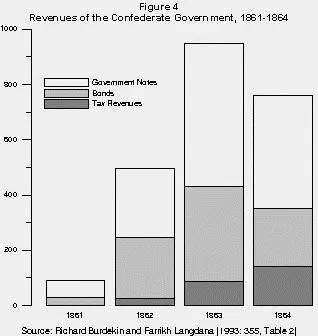
Similar to the Union, the CSA used the issuance of debt, raising of taxes, and printing of money in order to fund their government efforts during the Civil War. However, the uses of each strategy differed in concentration when contrasted with the USA.
The first major difference between the USA and the CSA is that the CSA issued far less debt than the USA, partially because of their short credit history. The slave population and cotton production inside of the CSA made it the 4th largest economy in the world at the time (Fred Bateman and Thomas J. Weiss, "A Deplorable Scarcity: The Failure of Industrialization in the Slave Economy U of North Carolina Press, 2017 pp 4, 42.).
This wealth initially garnered the interest of American and European investors which allowed them to have a decent amount of capital to carry out its military functions. $15 million was issued for debt to a French-based bank with European connections, but the money was largely wasted on failed naval ships that never left the port. After this point, the CSA found it difficult to raise money from European sources who were more concerned with avoiding the Union’s naval blockade than helping the South win the War.
The south had an attitude of “Cotton is King” but many European countries had large supplies of cotton which made the South's cotton supply obsolete. In addition, the largest economies in Europe were more dependent on the grain supply that was being exported from the North to provide food for their citizens rather than the CSA’s cotton. This fact ultimately led to a decline in the interest of the Southern bonds that were in most cases issued to pay out cotton in the future. As the war went on and a Union victory became clearer, especially after the Battle of Gettysburg, European investors refrained completely from giving the south funds fearing the CSA would be unable to pay back its debts.
The next tactic used by the South to provide funding for their army and naval efforts against the Union was raising taxes. The CSA’s ability to raise taxes can be characterized as unorganized, ineffective, and overall unsuccessful. The main tax income for the CSA was a tariff on the import and export of goods, especially cotton. However, after the Union blockade, Cotton exportation dropped by more than 95% and other goods fell too, making the value of the tariff negligible.
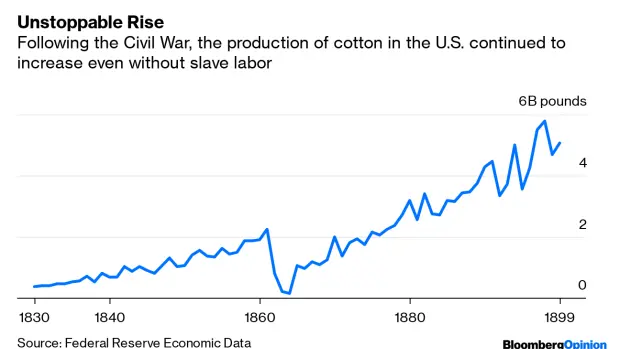
(Cotton Production)
As a result of this failure, the CSA continued to try to implement additional taxes on property, including slaves, to make up for the shortfall of the tariff. However, unorganized collection systems, bureaucracy, and transportation made it difficult for the CSA to collect revenue from the states.
The last method the CSA used to fundraise for their military efforts was the printing of money. As was the case with the Union at the beginning of the war, the south did not have a national banking system but instead relied on the ability of state banks to issue their own money in the forms of banknotes that would circulate throughout the economy. However, the CSA needed to raise funds for the war, so, the CSA issued treasury notes (another type of debt) to the public to the tune of, “more than $300 million by the summer of 1861 and to more than $1.5 billion by the end of 1865” (Todd, Confederate Finance, 120.). One mistake by the CSA was their inability to name any specific note legal tender, as they believed it infringed on state powers. The desperate need for money prompted states, cities, private companies, and even individuals to issue their own debt which would circulate in the economy as money. Obviously, this system was inefficient and ultimately led to high inflation, confusing exchanges, and economic decline.
Ultimately, the success and failure of a nation’s government depend on its capability of raising funds. For the government, raising funds comes in three forms: Issuing debt, printing money, or increasing taxes. For the government to maximize its yield when raising funds, they require the nation to be productive. When a country is productive, they are considered to have good credit and its debt terms will be favorable which will allow them to pay less in interest. When a country is productive, the inflation that occurs from printing money can be minimized because consumers now have better products and higher wages from their increased production. When a country is productive, the nominal value of its taxes will be higher because the number and quality of their goods increases. Therefore, the success and failure of an overall nation come down to the production of the people inside of it. Nearly half of the population in the South were slaves, that when the Emancipation Proclamation was announced freedman and their families attempted to flee to the North in troves, creating labor shortages in the South. Furthermore, when the Union blockade was set, Southern exports fell dramatically.
All together the southern concern for their land and property was much stronger than their concern for fighting for a new nation. In addition, the North was far superior at raising funds from their citizens and investors than the South. The North's industrialization, transportation systems, and infrastructure were a far greater power than the “cotton is king” mentality that the south relied on for their economy.
Finally, the economic strain the Civil War put on the United States had never been seen before. At the same time, the production of the US was increasing at unprecedented rates. New technology, innovations, and more productive workforces led to the US economy being able to withstand the tension and eventually come out of the tragedy as a single nation. However, the financial strain would return to the United States when in 1872 when the world experienced one of the most devasting economic panics to date.






