
Before we jump into the effects of the Civil War, we will look at one of the most important events in American History that leads directly into the post-civil war era: the assassination of Abraham Lincoln at the Ford Theatre in Washington D.C. by John Wilkes Booth. This was the first successful attempt at assassinating a president in American history and went on to change the political and social landscape forever. On April 15th, 1865, less than a week after Robert E. Lee’s surrender to General Ulysses S. Grant in Virginia, John Booth’s plan to assassinate three important Union political leaders in the North came to fruition. Although two of the targets failed, Booth successfully used a single-shot pistol at point-blank range to shoot Lincoln execution-style on the left side of his head at the climax of a memorized play. Lincoln was able to be partially resuscitated until the next morning when he was pronounced dead. So how and why did Booth do it?
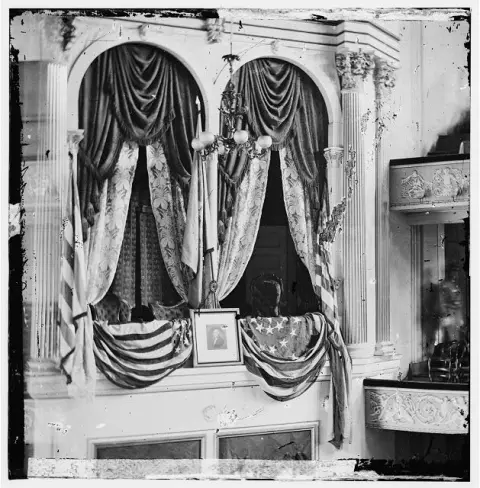
(Lincoln's Presidential box where he was shot)
Booth was the mastermind of the plan to kill Secretary of State William H. Seward, Vice President Andrew Johnson, and President Abraham Lincoln, but he wasn’t alone. Booth drew on the help of Lewis Powell, George Atzerodt, David Herold, and a barrage of other coconspirators to carry out the plan. Atzerodt was tasked with killing Andrew Johnson, however, Atzerodt got drunk and abandoned his portion of the plan at the last second. Secretary of State Seward was only injured from a stab wound by Lewis Powell. These plans were being made in advance of the assassination attempts and were part of a larger plan to boost the confidence of the confederacy and reignite war efforts. Booth’s actions can be interpreted as revenge and seeking to be a martyr for what he believed to be a just cause. His ultimate plan was to restore confederate confidence in their ability to win the war that was all but over after General Lee had only surrendered less than a week before the assassination.
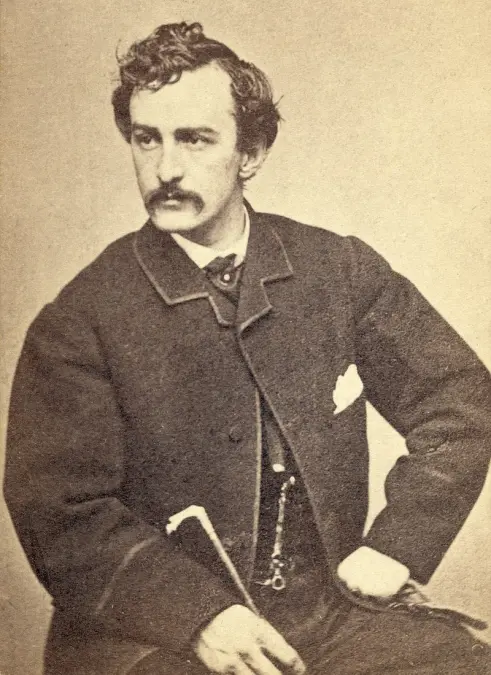
(Photograph of John Wilkes Booth taken in the early 1860s)
After Lincoln won the election and earned a second term in office, he gave his second inaugural address in March of 1864 with Booth in attendance. After joining the event Booth wrote in his diary, “What an excellent chance I had, if I wished, to kill the President on Inauguration Day!” (Kauffman, Michael W. 2004). Illustrating plans to harm Lincoln as early as March, however, as Spring went along more Southern States were surrendering to the North, fueling the anger in Booth and potentially changing the plan from kidnapping into murder. Booth once again attended Lincoln's speech on April 11th, 4 days before the assassination. Lincoln was giving a speech regarding civil rights for abolished slaves. In response, Booth proclaimed, “That means n****** citizenship. ... That is the last speech he will ever give." (Masur, Louis P. (2015). McPherson, James ed.). This statement would turn out to be true and four days later Booth would carry out his plans.
Booth was a famous actor and was nationally recognized for his works. In addition, he was familiar with the Ford Theatre and has even performed there while Lincoln was in attendance a few years prior. On the night of the assassination, Booth was able to walk through the front doors of the auditorium and greet his friends and people who recognized his fame. Once the play started, Booth made his way through a side door and up the stairs to the presidential suite. At the time, the only bodyguard that was supposed to be guarding Lincoln was off drinking at a bar. After Booth recognized that Lincoln had no protection, he barged through the doors while the crowd was erupting in laughter and pulled the trigger.
Common knowledge states that Booth shot Lincoln in the head, jumped around 11 feet down from the presidential balcony, got caught on a photo of George Washington, and broke his ankle.
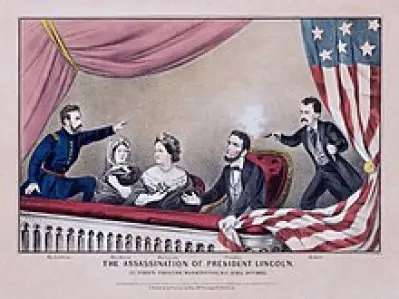
(New York Printing Business, Currier and Ives, portrayal of Lincoln's assassination)
During the chaos ensuing in the theatre after the shooting Booth escaped out a side door and met with fellow coconspirator David Herold at Mary Surratt’s confederate tavern in Maryland where they would receive guns, food, and other supplies.
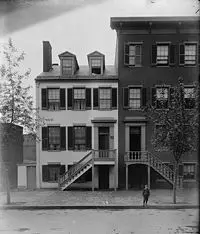

(Mary Surratt's boarding house in the 1890s and present where it remains a restaurant in Washington D.C
After the Tavern Booth and Herold made their way to Doctor Mudd’s office where he reset and treated his leg injury.
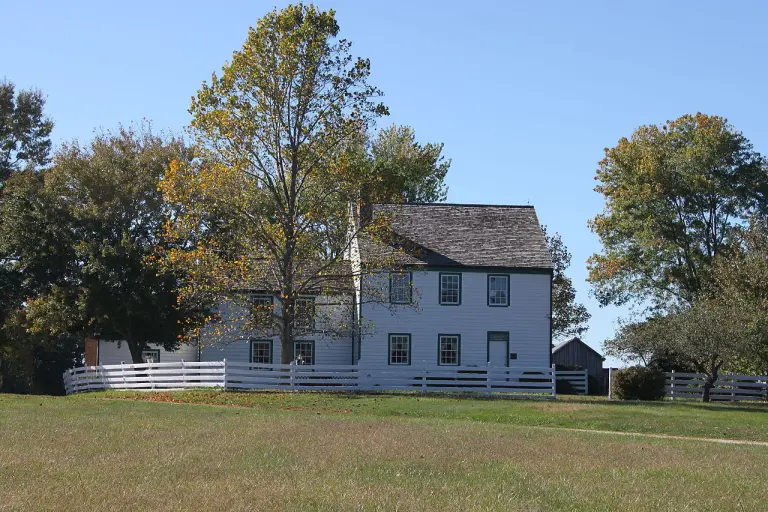
(Dr. Samuel Mudd House, now known as St. Catharine, presently maintained as a museum)
The next morning the fugitives left Mudd’s home and made their way South to a barn in Virginia where the fugitives were planning to meet up. Booth and Herold arrived on April 24th, but their accomplices were nowhere in sight. Two days later the barn was surrounded by 26-armed Union soldiers, police officers, and security personnel anticipating the largest reward in American history for capturing a criminal with a prize of over $100,000.
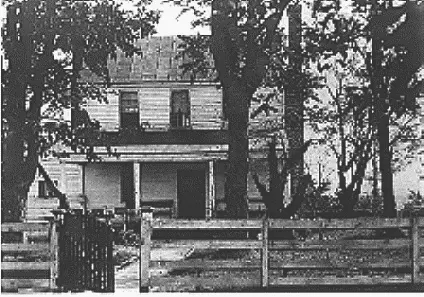
(Garrett Farm and Barn which was surrounded by Union soldiers attempting to capture John Wilkes Booth and David Herold).
Refusing to be taken prisoner Booth turn down the offer to come out of the barn. Attempting to force Booth out, the soldiers lit the barn on fire. As booth was inside, the heat from the fire was getting closer to engulfing him in flames and Booth made his way toward the door armed with guns in each hand and tried to escape. While he was attempting to escape, a soldier shoots Booth in the back of the head, severing his nervous system. Two hours later Booth would be pronounced dead. Booth managed to lead authorities on a 12-day chase before he ultimately saw his demise.
As a result of President Lincoln dying and being voted into office, Vice-President Andrew Johnson would assume office for an additional four years until 1868. Johnson’s presidency and the reconstruction era that followed the Civil War will have controversy surrounding it and we will discuss it in more detail in the next section.
Lincoln’s assassination has large controversy around it because of the circumstances related to John Wilkes Booth’s death after the assassination. Specifically, regarding the 12-day chase that occurred subsequent to Lincoln’s death. What I’ve told you so far about John Wilkes Booth's death is the well-known and official story; Booth killed the president, made his way to a confederacy tavern, then to the doctor Mudd’s office, then to a barn in Virginia that was burned down by Union soldiers, forcing Booth to exit then shot in the head. However, there is more to the story than initially meets the eye.
The History Channel created an episode hosted by Brad Meltzer that explains a different theory in regard to the two weeks following Lincoln’s assassination. The theory states that Booth did kill the president, fall from the Presidential suite inside of the theatre, and hurt his leg. The theory also states that Booth did make his way to a confederate-aligned Tavern and Doctor Mudd’s office to treat his leg wound. The discrepancy in the official story and the theory proposed by Brad Meltzer in Decoded comes after Booth arrives at the Barn in Virginia. Common knowledge states that Booth was shot in the head at the barn two days after arriving, other theories suggest that Booth did not stay at the barn for two days but instead left before the Union troops arrived and actually lived out the remainder of his life using pseudonyms, traveling and even getting married and there is compelling evidence to suggest that was the case.
So, what happened, and what is the evidence to suggest there was a cover-up?
The original story states that John W. Booth and David Herold were the only two men inside the barn that was surrounded by soldiers. While Booth and Herold were inside the barn, Herold did not want to be shot or engulfed in flames, so he made his way out with his hands in the air and surrendered to the Union soldiers. That left Booth inside of the burning barn by himself, armed with two weapons, and was shot in the back of the head by Union soldier Boston Corbett. Once Booth fell, the Union soldiers converged upon Booth and dragged him out in the barn to die. End of story. However, theories suggest there were more than two people in the barn. This is where the discrepancy occurs and there is strong evidence to suggest the original story is flawed. Joan Chaconas, the assistant Director at the Surratt House and Tavern Museum explains that after Herold was captured by the soldiers and Booth was being dragged out after being shot, Herold says to Union Army Officer Edward P. Doherty,
“Who is that man that was shot?”
Doherty responded, “You know exactly who that man is.”
Herold replied, “No I don’t know what that was, he said his name was Boyd, I didn’t know it was Booth.”.
Someone who was just captured by the Union army and understood his fate has no incentive to lie through a casual conversation. But how could someone escape from a barn that is surrounded by 26 Union Soldiers? Well, it’s possible that Booth wasn’t even there that night, and left the day before Union Soldiers arrived. This makes sense, if someone just assassinated the president, that person would want to go as far south as possible to meet with confederate sympathizers that would understand his cause and even help him. In addition, if Booth was there that night if someone just shot who they thought was Booth, you can picture the large group of soldiers flocking onto the body like seagulls with scraps, leaving ample time and room for Booth to escape out of the back of the building in the middle of the night.
This isn’t the only piece of evidence that exists. Conventional wisdom tells us there were only two people in the barn, so was Boyd even a real person, and if so? How many people were in the barn? And how did he arrive in the barn on that night?
One of the researchers from Brad Meltzer’s documentary went to the National Archives to discover the reliability and story beyond the mystery man Boyd and quickly discovered a service record regarding a Confederate Army Captain named James W. Boyd who was captured as a Prisoner of War (POW). Inside this service record, the researcher discovered a letter written by Secretary of War Edwin Stanton that read, “By direction of the Secretary of War, I have the honor to request you will order captain James W. Boyd, rebel army and a prisoner of war, recently transferred from Fort Delaware to Hilton Head South Carolina to be delivered to the Provo martial in Washington D.C with as little delay as practical.” This letter was sent out and dated exactly two months prior to the assassination attempt on Abraham Lincoln and indicated no reason as to why the transfer was occurring. So, Boyd was a real person and very well could have been in the area at the time of Booth’s death. Stanton transferred Boyd to Washington D.C to turn him into a spy where he would scout and report on confederate troops and supply movements, and potentially when Stanton needed someone to put an end to the Booth chase, kill and use him as a Patsy in place for John W. Booth.
In fact, there is a picture of James William Boyd that was taken in the early 1860s that has a striking similarity to someone.
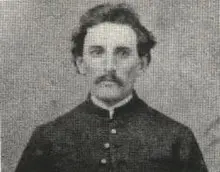
(James William Boyd)
Here are the pictures side by side
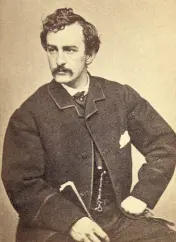
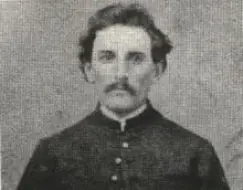
(John Wilkes Booth on the left and James William Boyd on the right).
They look strikingly similar and could have been used to replace Booth that day at the barn. After April 1865 no death records, hospital records, marriage certificates, endorsed checks, signatures, or other documents were found regarding Boyd, meaning he essentially disappeared off the Earth.
Another interesting piece of evidence is that researchers on Brad Meltzer’s History Channel Documentary discovered that three separate witnesses who worked on the dead body including the doctor who performed the autopsy, who had previously worked on John Wilkes Booth, stated that the body he worked on during the autopsy had strawberry blondish hair, looked much older than John W. Booth and had freckles. Remember, Booth was a famous actor and was well recognized by almost every American at the time by having jet black hair, no freckles, and was only 26 at the time of the assassination. In addition, the doctor who performed the autopsy had previously worked on Booth two months prior, so would be able to easily recognize the body.
The fact that the body looked significantly different from how people remembered Booth only months prior was suspect, but it gets even worse. When the body at the barn was taken for an autopsy, the body wasn’t taken to a hospital or morgue as were the standards at the time. Instead, the following day he was transferred to the Navy ship USS Montauk where 10 out of the 13 spectators had direct connections to the federal government and the Secretary of War’s office. John Frederick May, who had treated Booth only 3 months prior to the autopsy stated that the body looked nothing like Booth. His statements were hidden from the public for 70 years but eventually made it to the National Archives. The summation statement reads, “I’m sure this is Booth. But it doesn’t look like him. But this is certainly John Wilkes Booth.”
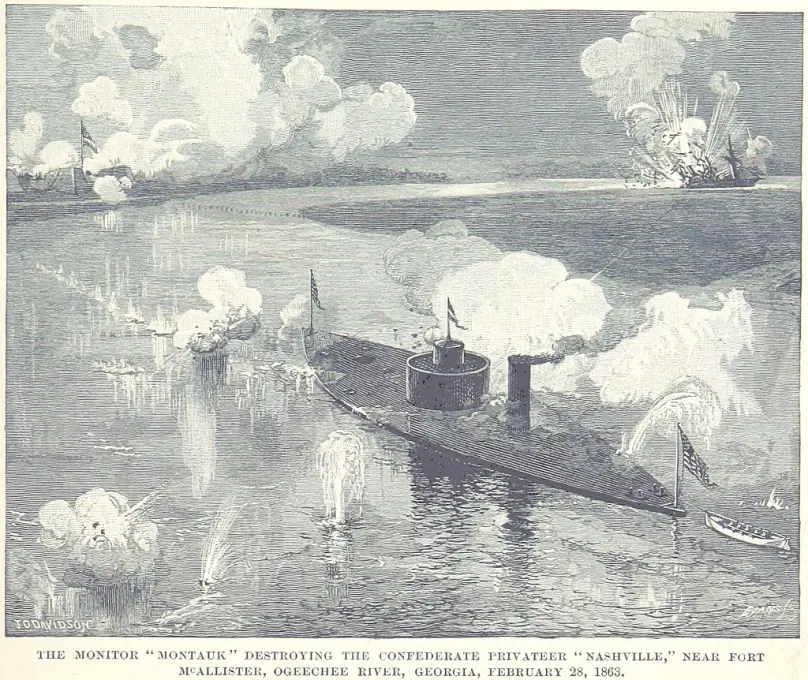
(The USS Montauk while in action and before it was used as a floating prison for POWs.)
Dr. May was in duress and understood that if his conclusions didn’t point to this being Booth, then there would be trouble for him next.
Nate Orlowek, another Lincoln Assassination historian discovered and spoke about in his documentaries that there is numerous eyewitness testimony from the day he was shot and the autopsy that show discrepancies in the official story.
“Lieutenant William C. Allan worked for the United States Secret Service in 1865. In August of 1937, his widow, Mrs. Helen Allan, told a journalist that her husband had told her that he saw the man at Garrett’s farm who had been killed and that the man had red hair. And that the government knew that that man was not Booth, but they were determined to foist this man on the nation as Booth.”
Wilson Kenzie a Union soldier, who knew Booth personally and was at the barn the night he was shot states, “As I rode up, Joe Zisgen called ‘Here, come here Sergeant, this ain’t John Wilkes Booth at all.’ I could see the color of his hair. I knew at once it wasn’t he. His body was exposed and he had no injured leg.”
One of the individuals who did not have a connection to the government on the day of the autopsy was only one photographer. That photographer took one single photo of the dead body that day. The single picture was developed and sent straight to Secretary of War Edward Stanton, and that photograph has never been retrieved or reappeared since then. In addition, Booth’s family, friends or any of his actor colleagues who were familiar with Booth and in the area were not allowed to come aboard the ship to help identify the body. This piece seems to be especially suspect considering the documentation of Lincoln’s assassination was thorough and detailed, including having multiple pictures of Booth’s coconspirators during their time in prison and at the moment of their hanging.
Let’s think about what motives the soldiers had to lie about capturing and killing Booth. Well, remember that the people who brought Booth and Herold to Justice were to receive the largest bounty in American History to that point? all of the officers and soldiers who were at the farm were rewarded enormous and life-changing sums of money for finding and capturing Herold and Booth. Also, the officers who went against the official narrative would most likely be hung as they would be acting against the government's interest.
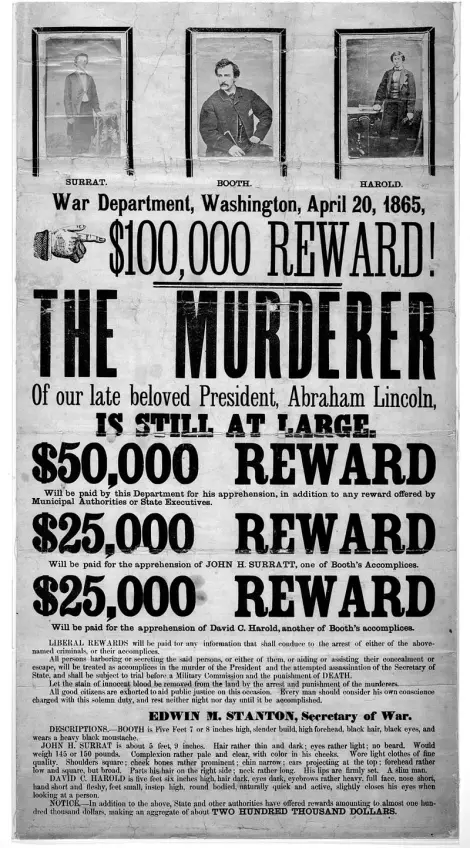
What would be politicians and the federal government's motive for putting a rest to the John W. Booth chase? Well, the Civil War had just ended less than a month prior and the support for the Confederacy breaking apart from the Union was still rampant across areas in the South. Therefore, with a smooth transition of Andrew Johnson taking office and Booth dead, it left no room for the Confederacy to muster up the energy to revive the war effort.
Who was in charge of organizing the chase and bringing Booth to justice while the country is in complete chaos? That would be Secretary of War Edwin Stanton.
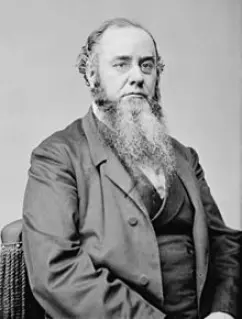
(Secretary of War Edwin Stanton Photographed by Mathew Brady, c. 1860-1865)
Edwin Stanton was a strong Union supporter and helped the Union military to victory during the Civil war. After the war and Lincoln’s assassination, Stanton openly criticized President Andrew Johnson’s policies that catered to the south which led to Johnson dismissing Stanton from his cabinet. In response, the republican-majority House of Representatives attempted to impeach President Johnson as a response but fell one vote short in the Senate. The Secretary of War and the offices under the institution had important involvement in the assassination of Lincoln and the chase that ensued afterward. This was the office that had direct control of the organization and implementation of the chase of John Wilkes Booth. A high-ranking member of the Secretary of War had a controversial statement that lends itself to confirming that Booth did not die that night at the barn.
John. P Simonton worked in the office of the Judge Advocate General of the War Department for over 43 years from 1870-1920 and was a graduate of the Georgetown University of Law School. During his service, Simonton had all of the material documents and records pertaining to the Booth assassination and capture. Simonton concluded under oath, “I studied the evidence in this case and examined all the exhibits as an expert and found no definite proof that John Wilkes Booth was ever captured” (8:4. John P. Simonton., 1925. E. H. Swaim Papers. Georgetown University Manuscripts. https://findingaids.library.georgetown.edu/repositories/15/archival_objects/1292425 Accessed June 28, 2022)
Having such a high-ranking member who worked directly in the office that studied the case is damming evidence that suggests the capture, killing, and autopsy of John Wilkes Booth was botched.
There is one thing we could do if we really wanted to figure out the answer to this question. The answer is through testing forensic evidence by using DNA samples from John Wilkes Booth's spine that was removed and still exists at the National Museum of Health and Medicine at the Walter Reed Medical Center and comparing it with DNA from Edwin Booth, John W. Booth’s brother, that is buried in Massachusetts.
The issue? It would cost around $70,000 and there may be actors who want the story to remain the same, making it difficult for researchers to find the real truth. In 1994, the Booth family and their legal team petitioned to have the body exhumed and to have access to the DNA samples at the Walter Reed Medical Center. When the family originally made the request the State Attorney’s Office in Maryland approved the exhumation of the body to identify the remains and use them for DNA. However, someone appealed to the courts and it went to the Judge. The judge denied the request. However, that was over 20 years ago, so the technology has advanced that gives us the ability to exhume a body easier and cheaper. It's just a matter of gaining enough public support and pressuring the courts and government.
So, if John Wilkes Booth wasn’t in the barn and wasn’t shot, where did he live the remainder of his life? The History Channel’s documentary has two different theories, one of which comes to a dead end so I will focus on the most intriguing theory, which is that John W. Booth took the alias of John St. Helen. Again, what is the evidence to back up this claim? The historians in Brad Meltzer’s documentary discover primary documents discovered by Dr. Arthur B. Chiddy from the Franklin County Clerk House in the marriage registry that have John Wilkes Booth's signature dated 1872. The reason we find Booth’s signature is because he found his way into Texas while on the run and fell in love with Louisa Paine. Booth confessed to Louisa that he had killed the president and was using the alias John St. Helen to cover up for himself. Louisa was angry, not about the killing of the president, but rather that she married a man with a fake name. Therefore, Booth and Louisa made their way back to the Clerk House where his signature can be found.
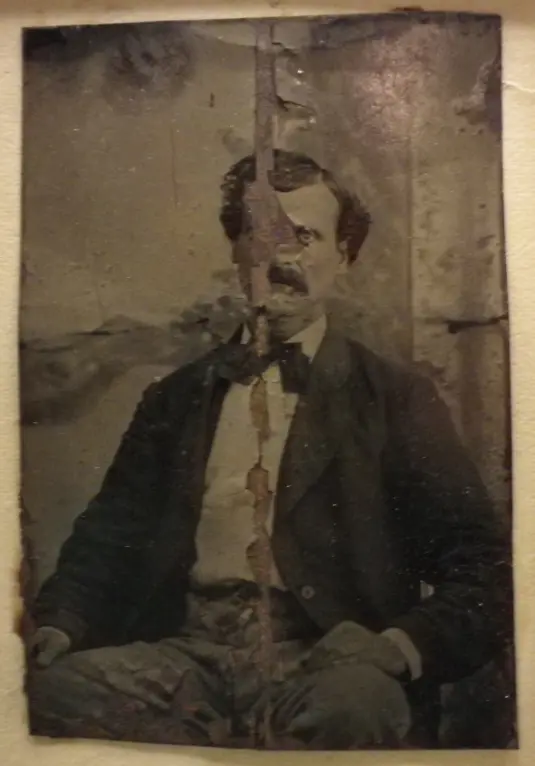
(Original damaged photo of John St. Helen given to his friend Finis Bates in 1877 when Booth would have been 38)
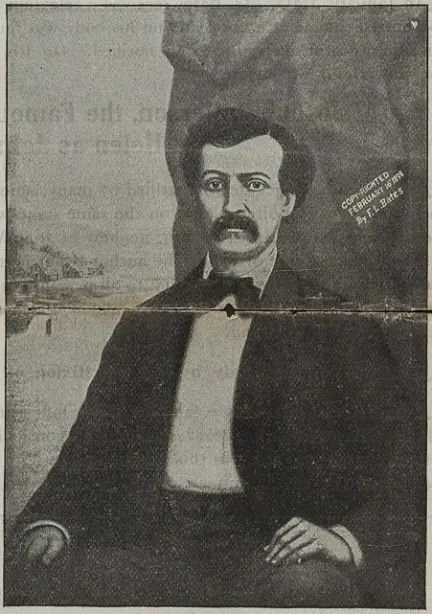
(Original painting of the John St. Helen photo, copyrighted by Finis Bates in February 1898)
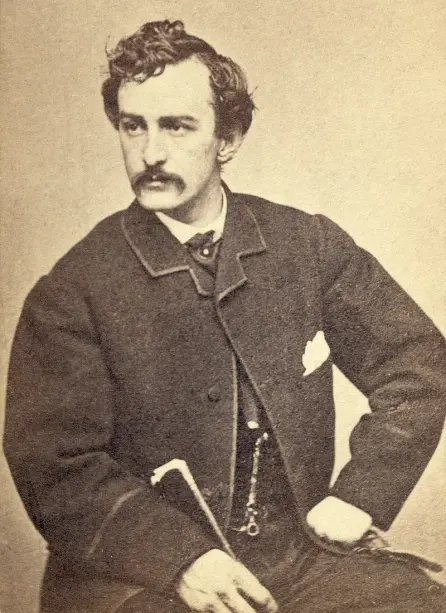
(Photograph of John Wilkes Booth taken in the early 1860s)
Once again, a striking similarity, especially considering Booth would have aged by then. In addition, they caught up with the 90-year-old Juanita Keele, who is the granddaughter of Louisa Paine’s sister. Juanita explains how Louisa and John moved to Memphis, Tennessee. However, Louisa got homesick and returned to live in the Paine House. After this John Booth stopped communication with Louisa
While at Juanita’s home they brought Mary Bates Wehbi, the granddaughter of Finis Bates. Finis Bates was a lawyer in the south and became closely acquainted with John W. Booth under the alias John St. Helen in Texas. They became so close that Booth gave Finis a picture of him. Some years later, Booth was sick and bed-ridden in the hospital where he thought he was going to die. Finis visited him and Booth admitted that he was the man who killed the president. Finis believed that no person would have any incentive to lie on their death bed about such drastic action if it weren’t true.
However, Booth didn’t die that day, instead after he recovered moved to Oklahoma where he would take a new alias. This time he would choose David E. George. If you remember his conspirators during the Lincoln assassination, David Herold and George E. Adzerodt. In 1903, there was a clipping from Oklahoma about a man confessing that he was John W. Booth Finis went to Oklahoma to identify the body and Finis discovered it was the man he remembered to be John St. Helen or John Wilkes Booth. The man found in Oklahoma committed suicide by drinking arsenic, which actually mummified his body and it was stuck in Finis' garage until his wife sold it to a traveling circus and was most likely discarded in the 1970s.
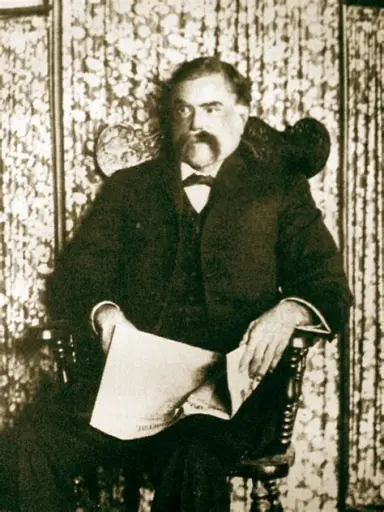
(Photograph of mummified David E. George in Enid, OK in 1903 when Booth would have been in his 60s.
Now after reading all of that, there are some holes in the story, and it's inconclusive at this point whether or not Booth lived out his remaining days with an Alias. However, there is compelling circumstantial evidence, eye-witness testimony, and human incentives that point to the government covering up John Wilkes Booth's death and that he did not die that day in the barn.
Ultimately there is only one way to tell definitively and that’s to exhume the body of Booth’s relative and compare the DNA with the spinal samples taken on the day of the autopsy. The family's support for the decision should be enough to understand what their family’s true history is. However, to this day courts refuse to do so, even with the family’s support and financial means. What is the incentive to keep things the way they are? Well, if the DNA samples are tested and it’s true that they match, then the case is closed. However, if it’s discovered that the samples are not a match, then it casts doubt on the entire system our nation was built on. In addition, it will leave people skeptical of our current judicial, legislative and executive system that is the foundation of what our country was built on. People will be convinced that the government could partake in other cover-ups, or deploy more patsies (foreshadowing). The government, our judicial system, and even the common person benefit from having the story remain the same.
Eight people who either helped Booth or were part of Booth's master plot to kill three political figures were put to death, including Mary Surratt who was the first woman to be executed by the US Federal Government even after clemency was asked for by the jury who decided on the case to President Johnson. Johnson claims he never received the request and Surratt was hung.
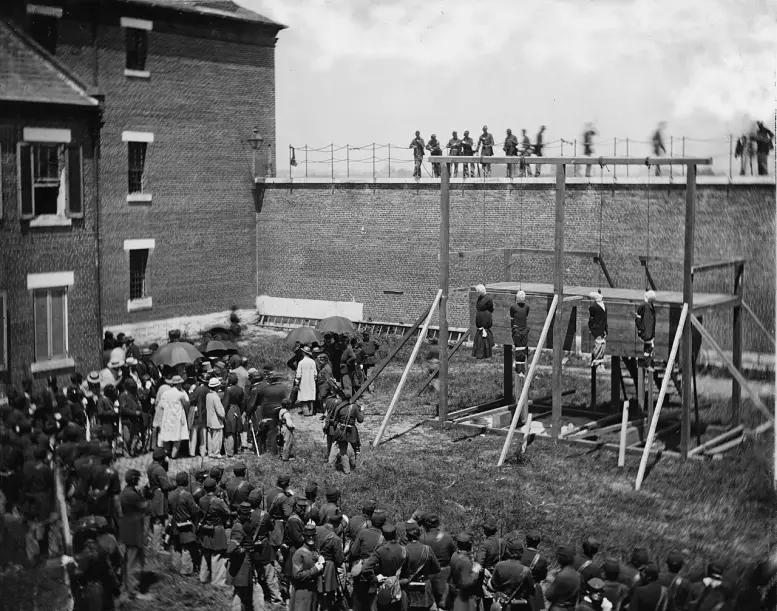
(Execution of Mary Surratt, Lewis Powell, David Herold, and George Atzerodt on July 7, 1865, at Fort McNair in Washington City)
Even if Booth did die that day, it shouldn’t scare us from asking relevant questions about controversial and questionable acts. The power to question and have a constructive debate regarding important topics is the basis for which humans grow. When we grow to become polarized it serves only the Money Changers who wish to divide the population and conquer power and wealth.






