
The ratification of the foundation of the University of Coimbra took place on March 1, 1290, through a royal diploma issued by D.Dinis, King of Portugal.
Thus, Coimbra has the oldest higher education establishment in Portugal, although throughout the Middle Ages university studies fluctuated between this city and Lisbon.

In the year 1537, King D.João III definitively transferred the University to Lusa-Athens, thus consolidating the city's previous school tradition and affirming its autonomy at the same time.
Perched on a hill, the Paço da Alcáçova former medieval palace where kings remained during their stay in Coimbra was the building chosen to host the University of Coimbra, undergoing refurbishment in the reigns of D.Manuel I and D.João III.
Thus, Coimbra grew in the shadow of its University of Coimbra, at the same time as the school buildings were the object of reforms in the seventeenth and eighteenth centuries.
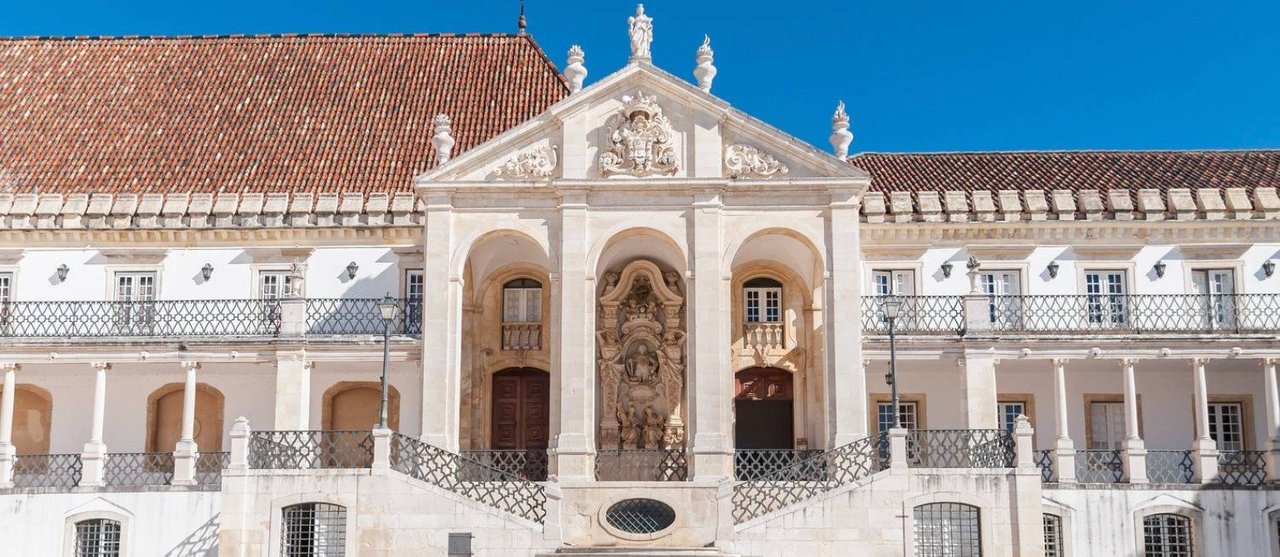
The Iron Gate, which provides access to the school yard, incorporates allegories that refer to the faculties of Medicine and Law abroad and the faculties of Theology and Canons inside, as well as statues of the kings that established them, D.Dinis and D.João III, and still figure of Sapience that crowns all this set.
On the left side of the façade is St. Peter's College, a simple-mannerist mannerist building that was built over the former palace quarters of the Infantes, serving until 1834 as a hostel for candidates to the various colleges.

From 1855, part of its facilities at the University of Coimbra served as rooms of the royal family and as residence of the various rectors.
Entering the Courtyard of the Schools we see, on the right side, the Via Latina, in the center of which stands a noble staircase leading to a body ported and topped by a triangular pediment.
In this space stands a sculptural altarpiece in stone, work of the French sculptor Claude Laprade and executed in 1701.

Via Latina we can access the Rectory and its dependencies, mostly reformulated in the Pombaline Reform of 1773, during the reign of D. Francisco de Lemos. By way you can also reach the Sala dos Capelos, where the most significant ceremonies of academic life usually take place.
This room occupies the space of the former noble hall of the Manueline palace, built by Marcos Pires during the second decade of the 16th century. In the upper gallery of the hall we can see large canvases with all the kings of Portugal, painted, until D.João IV, by Carlos Falch. The rest were painted by several national artists.

Back on Via Latina, we walked toward the area of the old classrooms, arranged around a two-story cloister. These occupied the former premises of the queen's palace.
One of the ex-libris of the city of Coimbra is the Tower of the University of Coimbra, which was erected at one of the angles of the Schoolyard. In the continuity of the tower we find the Chapel of S.Miguel, a Manueline style temple that occupies the area of an oratory of the medieval palace.

Chapel of S.Miguel
Chapel of S.Miguel

Its noble portal is a naturalist Manueline composition, with polylobated arch and torsion columns, where symbols related to the "crucifixion" of Christ and the heraldry of D.Manuel I.
In the inner court of the chapel we find the entrance of a dependence that has been converted into a Museum of Sacred Art and where you can admire some of the finest works of goldsmithing, jewelery and painting belonging to the collection of this university establishment.

Bookstore of the University of Coimbra
Bookstore of the University of Coimbra
In the continuation of the Chapel of S.Miguel stands the magnificent Bookstore of the University of Coimbra, better known as the Joanina Library, a baroque enterprise made between 1717 and 1728, under the patronage of D.João V.
The imposing Baroque interior is divided into three quadrangular rooms, divided by arches of perfect back, where we can see gilded university emblems, surmounted by D.João V royal crown.

Bookstore of the University of Coimbra
But, more important than the richness of the materials and the artistic refinement of the Baroque decoration, the Joanina Library also has some of the rarest and most important books in national bibliographic backgrounds, so it can be said without a doubt true artistic temple dedicated to human knowledge.
Even today, in our country, when talking about University, the University of Coimbra the mother of higher education in Portugal comes to mind.

Bookstore of the University of Coimbra








