
The Italian automotive industry has birthed us some of the most exotic, and charismatic cars throughout history. From the ruins and ashes of two world wars, it has sparked decades of romanticism in a world forged by iron.
One such company that comes to mind, is Maserati. They are the quintessential figure that portrays the beauties, and flaws of Italian carmakers. Marking the start of this new millennium, it hasn't been easy on some carmakers, including Maserati.
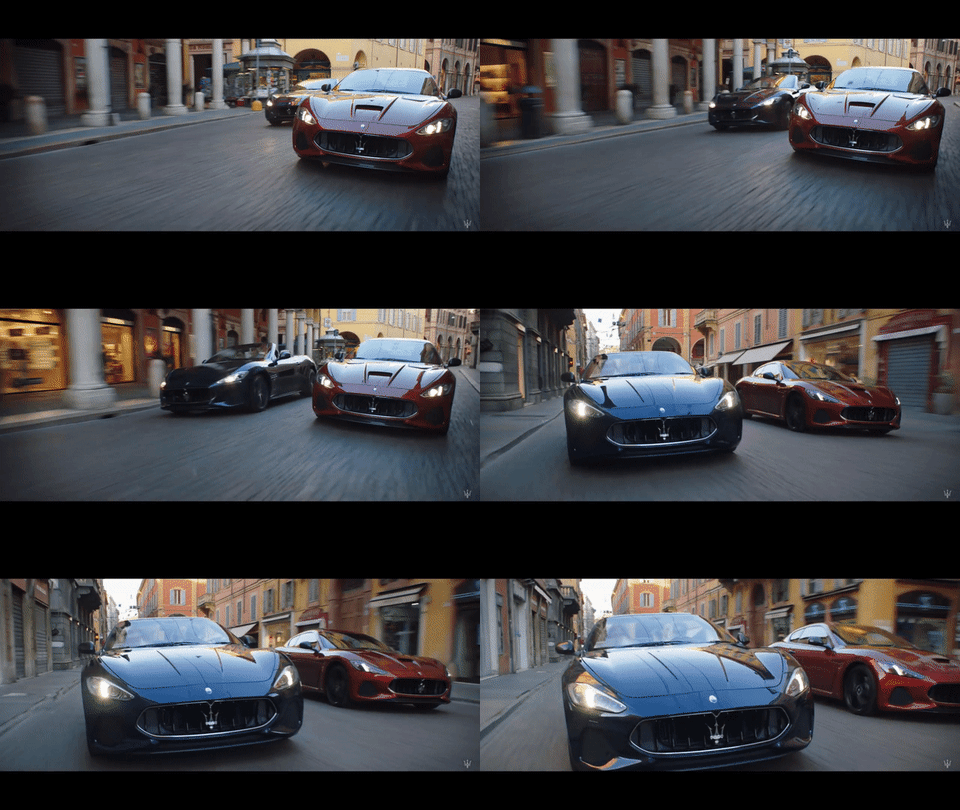
Credits to: GIPHY
Faced by renewed challenges to make cars friendlier to our Mother Earth, carmakers are at a juncture, between embracing our new electrified future, and preserving over a century of history and tradition.
This is a daunting leap of faith for a company like Maserati, where its core clientele have remained loyal to their throaty V8s, and 105 years of heritage. Recently however, Maserati has announced their difficult embrace for the future of electrification.
Excited as we are, the company has even released a teaser, and the world now knows how Maserati's future electric cars will sound like. Before my fellow petrolheads grovel and snicker - calm down, pay attention, and take a listen.
How does it sound?
In short - it sounds good, even if it may take some getting used to. Yet, considering that we're on the verge of ending over a century of internal combustion, perhaps I should explain a bit more.
Contrary to popular belief, electric cars are not entirely silent, especially if their electrification is taken advantage for the sake of performance. Typical of other EVs, Maserati's powertrain has the same high pitch whine and whistle, which sounds more of a fighter jet, rather than the rumbly V8s that they're known for.
I'm not an audiophile, but I can certainly hear a difference between this, and a high-spec Tesla Model S. Maserati's motor has more rawness to it, unadulterated yet refined, with a somewhat low-mid heavy tone, perhaps reminiscent of old V8s.


Credits to: Wheelsage and Turgut Motors
The recent crop of Maseratis, including my favourites - the Granturismo and the Quattroporte - have all used Ferrari-derived engines for almost 20 years. Specifically, the 4.2L and 4.7L V8s came from Ferrari's F136 engine, which was also used in the Alfa Romeo 8C, Ferrari 430 Scuderia, and 458 Speciale, just to name a few.
In the current line-up, due to emissions regulations, Maserati have gone and used turbocharged engines from Ferrari instead, the highlight of which is the F154 engine. This particular twin-turbocharged V8 is an award winner, having bestowed the title of "Engine of the Year" for four consecutive years, and powering special cars such as the 488, the upcoming SF90 Stradale, and also Alfa Romeo's Giulia and Stelvio.
The times are a-changin.
Reports had come that Marenello would soon no longer supply engines to Maserati, due in effect sometime around 2021 or 2022. As a farewell, Maserati had released a slew of limited-edition trims and specifications, potentially as a swansong to their combustion engines.


Maserati's new Royale and Ribelle special limited edtions. Credits to: Maserati
Electric cars are quiet, for better or worse, although some people, like myself, enjoy the sound of an engine. For our future of electrified propulsion, it makes sense for some companies to be more progressive, but for some others, it's not so simple.
Case in point, are manufacturers of sports, and performance cars- which is where our original Maserati conundrum began. These are companies that thrive not only for their driving sensation and stunning good looks, but also for the sound that they make.
It’s how we identify them, from the racy V12s of Ferraris, or the aristocratic rumble of an Aston Martin V8. Electrification is becoming a challenge for them, and especially for Maserati, which in recent times, have made some of the best sounding cars in history.
Moving forward, it remains an important factor for all car enthusiasts, that companies continue to make their electric cars sound more unique, and distinct from one another. Whether we like it or not, we'll just have to get used to the sound of electric motors.
Final Thoughts.
These are certainly interesting times for us, and Maserati's move into electrifying their brand could not have come at a more critical point in history. The legendary marque had not been given an easy upbringing, and their sales have been floundering in past years.
This decision could have very well been the chance which Maserati needed so badly, to return the brand back to its glory days. For now, we can only wait, as Maserati will soon announce more on their future in May 2020. Then, we shall see what the Trident has in store next.





