
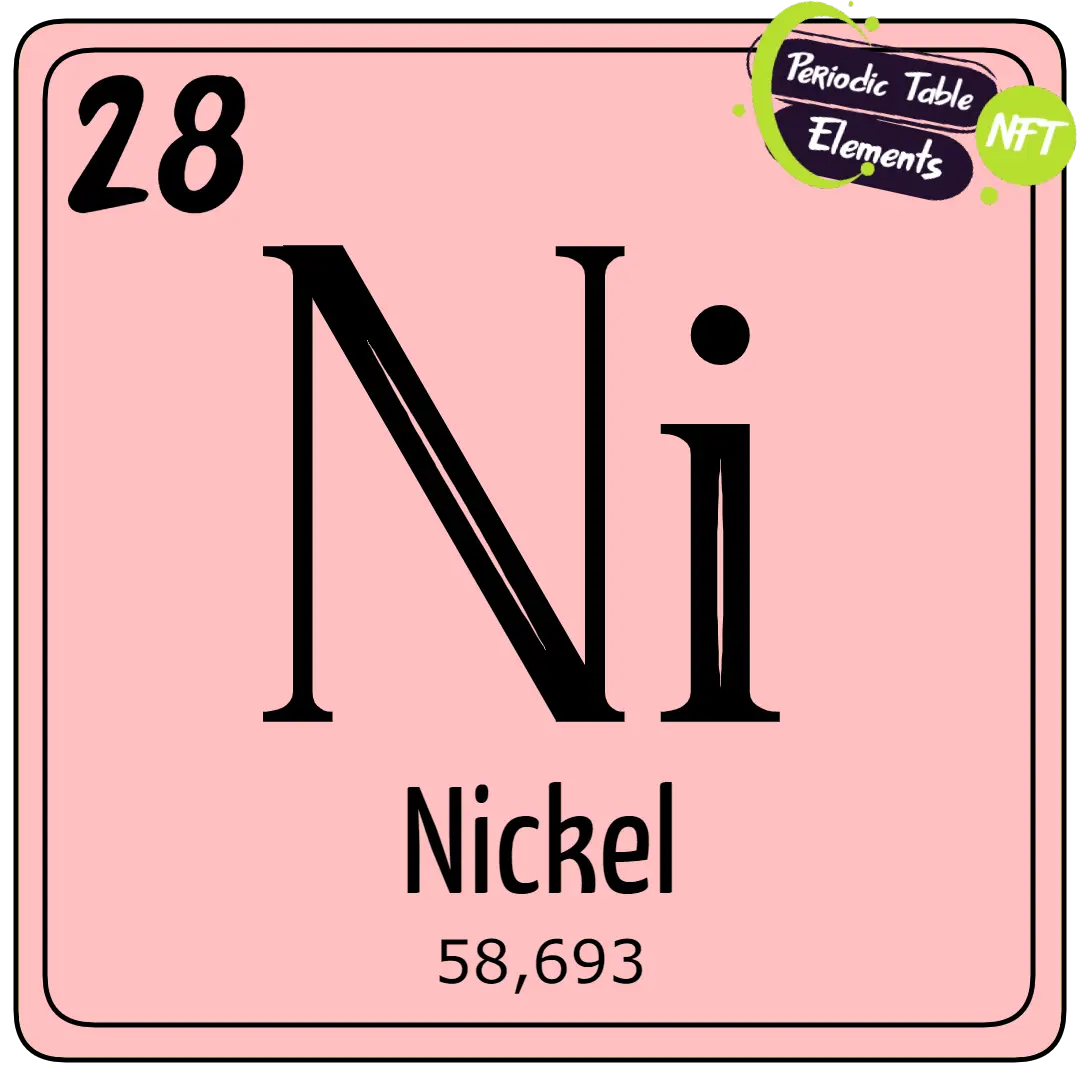
Nickel is the chemical element with atomic number 28 and its symbol is Ni.
Nickel has been used since at least 3500 BC: some bronzes from what is now Syria contain up to 2% nickel. There are also some Chinese manuscripts which suggest that "white copper" (paitung) was in use in the East between 1700 and 1400 BC. However, as nickel ores can easily be confused with silver ores, the conscious use of nickel as such dates back to the contemporary era.
Nickel is a silvery metal. It belongs to the iron block and is hard, malleable and ductile.
Nickel is one of the five ferromagnetic elements. It is very often accompanied with cobalt: both can be found in meteoric iron. It is highly appreciated for the properties it gives to the metal alloys to which it belongs. The US currency called "nickel" due to the particular alloy used is not ferromagnetic, while the Canadian equivalent was until the year of minting 1958 inclusive.
The first pure nickel coin was minted in 1881.
The largest reserves of nickel are in Australia and New Caledonia and amount to approximately 45% of the total known reserves.
About 77% of the nickel consumed in the Western world is used to make austenitic stainless steel; another 12% is used in superalloys. The remaining 23% of the requirement is divided between other types of steel, rechargeable batteries, catalysts and other chemicals, minting, foundry products and plating.
Given its excellent resistance to oxidation, nickel is used:
- in the production of stainless steel and other corrosion resistant alloys;
- in the production of nickel steel, used for low temperature applications;
- in the production of alnico, an alloy used in magnets;
- in the production of mumetal, which has a particularly high magnetic permeability and is used to shield magnetic fields;
- in the production of monel, an extremely corrosion-resistant nickel alloy used in ship propellers, kitchen equipment and industrial chemical piping;
- in the production of shape memory alloys, such as nitinol, used in robotics and endodontics, a branch of dentistry;
- in the production of rechargeable batteries such as nickel-metal hydride and nickel-cadmium batteries;
- in coinage: in the United States and Canada, nickel is used in one-cent coins; in Italy the 50 and 100 lire coins were made of acmonital or cupronickel,
- two nickel alloys. It is contained in the 1 and 2 euro coins. Many other states use or have used nickel in their coins;
- in electrodeposition;
- in the construction of crucibles for chemical laboratories;
- in the hydrogenation of vegetable oils: finely pulverized nickel is a catalyst;
- in the coating of iron, brass and other metal materials;
- in the production of certain alloys, such as German silver.
Giveaway
The first giveaway of the year follows the traditional assignment methodology: a part to the first who will comment on this article with their WAX address and another part assigned in an extraction among all the other users.
The deadline to participate in this giveaway is January 6th at 16:00 CEST.
Up for grabs are 90 Nickel NFTs, 35 for the first to comment and 55 drawn among all the others.
Remember to take a look at the auctions in progress to find the elements necessary for the creation of the molecule: Auction
The Periodic Table NFT project
The Periodic Table NFT project aims to raise awareness of chemical elements in a modern key, basing the approach on blockchain and Non Fungible Token.
Day after day it will be possible to know the single elements that make up the table, to collect curiosities about each of them and about the table in general.
We are working to be able to learn, in a playful way, also what happens by combining the various elements.
The whole project is based on the collection of NFTs that can be bought on the site https://wax.atomichub.io/market?collection_name=periodicelem&order=desc&sort=created&symbol=WAX or by participating in simple giveaways published on publish0x.
Elements released
- #1 Hydrogen (max supply 200)
- #2 Helium (max supply 200)
- #3 Lithium (max supply 200)
- #4 Beryllium (max supply 99)
- #5 Boron (max supply 99)
- #6 Carbon (max supply 200)
- #7 Nitrogen (max supply 200)
- #8 Oxygen (max supply 299)
- #9 Fluorine (max supply 149)
- #10 Neon (max supply 200)
- #11 Sodium (max supply 299)
- #12 Magnesium (max supply 99)
- #13 Aluminiun (max supply 299)
- #14 Silicon (max supply 200)
- #15 Phosphorus (max supply 200)
- #16 Sulfur (max supply 200)
- #17 Chlorine (max supply 299)
- #18 Argon (max supply 149)
- #19 Potassium (max supply 249)
- #20 Calcium (max supply 200)
- #21 Scandium (max supply 99)
- #22 Titanium (max supply 200)
- #23 Vanadium (max supply 149)
- #24 Chromium (max supply 200)
- #25 Manganese (max supply 200)
- #26 Iron (max supply 299)
- #27 Cobalt (max supply 200)
- #28 Nickel (max supply 200)
Molecule released
- H2O - Water (max supply 37)
- NaCl - Salt (max supply 64)
- CaC2 - Calcium carbide (max supply 46)
Link to save
- Market on atomichub for the purchase of NFTs
- Blog on publish0x to be updated
- Telegram channel
- Discord: in the "all-projects" channel
- Molecule contest: KMnO4 (deadline January 7, 2021 at 16:00 CEST)
(Photo by Matthew Lancaster on Unsplash)





