
In September 2026, Nike (NKE) officially dropped out of the S&P 100 index (the top 100 largest U.S. companies). Just to put that into perspective, Nike had been in this elite list for 18 years. Its market capitalization has plummeted by nearly 80% from its 2021 peak of $264 billion, sitting right now around $55-57 billion. What's most interesting is that the traditional giant's spot has been taken over by tech companies tied to AI, such as Dell and Palo Alto Networks.
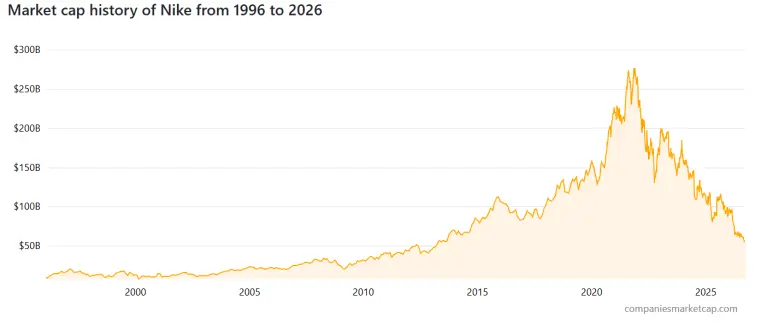
Just to give you a sense of the scale, Nike:
-
Has seen over $200 billion simply evaporate from its market cap over the last 5 years.
-
Lost about 36-40% of its stock value in this year alone.
-
Has watched its key market in China post declining sales for 8 consecutive quarters.
There are definitely multiple reasons behind this outcome, but in my view, these are the main culprits:
A disastrous sales strategy. Instead of selling through traditional retail networks and multi-brand stores, they pivoted hard to selling exclusively through their own stores and apps. While they were pulling this move, competitors happily swept in and took over their shelf space in supermarkets and shopping malls. This is easily one of the biggest mistakes.
However, a huge role was also played by Nike's near-total lack of innovation. Back in the day, athletes bought their sneakers not just for comfort, but for the advanced foam technology, cushioning units, lightweight builds, and so on. You probably remember what Nike sneakers looked like 5-10 years ago and earlier-they were genuinely high-quality footwear, whether for daily wear or sports.
New, aggressive players like Hoka and On Holding capitalized on this. They've been putting up impressive numbers, steadily snatching market share in the running sector away from Nike in both the US and Europe.
Finally, another major global factor was a botched share buyback program. Instead of pouring billions into developing revolutionary products, Nike flushed about $17.6 billion down the drain between 2024 and 2026 buying back its own stock at much higher prices than it's worth today. This led to a severely inefficient allocation of capital.
That's why Nike's fall is such a textbook cautionary tale for any business. Even if you dominate the market for decades, a single flawed strategy and a lack of innovation can throw you right out of the race.
And by the way, along with Nike, other traditional heavyweights like Colgate-Palmolive and Honeywell Aerospace got booted from the index. In their place, we now have:
-
Dell Technologies (building servers for AI)
-
Palo Alto Networks (cybersecurity)
-
Arista Networks (networking infrastructure for data centers)
-
SanDisk (memory and data storage)
So the real question now is: can the brand reclaim its greatness, or is its era officially over? Or will its massive market share just be swallowed up by emerging players and Chinese competitors?





