
NOTE: Some days ago we released the new element: Copper. As we have been doing lately, the first mints are placed on the market for its purchase, pending the giveaway. After the first purchases we realized that we had the wrong name of the item. 4 wrong NFTs were sold and we offered all 4 users a trade with the correct one. A big thank you to the 3 users who accepted the exchange. We have marked their WAX address and we would certainly have the opportunity to reward this collaboration. Instead, a user chose to keep the wrong NFT. In agreement with him we have reported that that NFT cannot be considered for the creation of any molecules, even if it is purchased by others. This is the # 2 that in the correct version we keep for a possible swap. We apologize for the inconvenience and thank you for your understanding.
The Copper
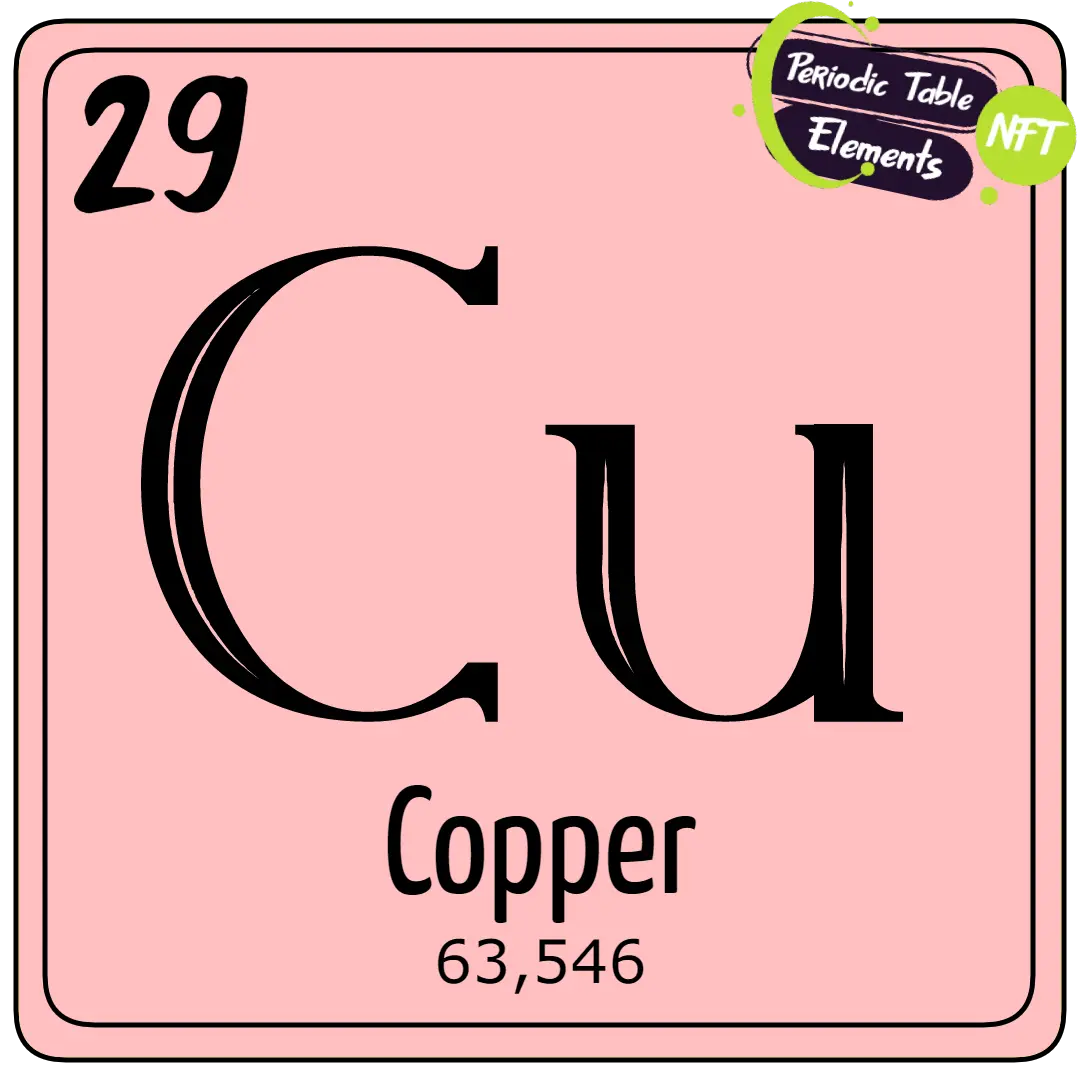
Copper is the chemical element with atomic number 29 and its symbol is Cu. It is also called "red gold" due to its coloring.
In all likelihood, copper is the metal that humanity has been using for the longest time: copper objects dated 8,700 BC have been found.
In Roman times, most of the copper was extracted from the island of Cyprus, a reality which was underlined with the term aes Cyprium, "copper or bronze of Cyprus". In fact, in Roman times there was no difference between pure copper and bronze, its most important alloy obtained by adding tin.
A native copper pendant dated to around 9500 BC. was found in the Šhanidar cave in the Zagros Mountains (Iraq). Other copper objects dating back to 7000 BC have been found in Turkey. Signs of copper refining activity starting from its mineral oxides date back to 5000 BC, a thousand years earlier than those relating to the use of gold.
Copper and bronze artifacts of Sumerian origin have been found in city sites dating back to 3000 BC. and pieces produced with copper alloy and tin by the ancient Egyptians date back to the same period. One pyramid houses an approximately 5,000-year-old copper alloy exhaust pipe system. At the Berlin State Museum you can see the first copper water pipe dating back to 2750 BC. The use of copper in ancient China dates back to 2000 BC, whose bronze production reached excellence around 1200 BC.
In Europe, the use of copper is confirmed by the finding of the man from the Similaun (also known as Ötzi), the mummified body of a man dating back to 3200 BC. found in the Alps, whose ax has a tip made of 99.7% pure copper. The high arsenic content found in his hair suggests that the man's activities also included producing copper.
Who knows how long we could go on with indications on how much man has used copper since the most distant times, but let's see some other characteristics.
Copper is a pink or reddish metal, with very high electrical and thermal conductivity, surpassed only by those of silver; it is very resistant to corrosion (due to an adherent patina that forms spontaneously on the surface, first brown in color and then green or green-blue) and it is not magnetic. It is easily workable, extremely ductile and malleable, but it is not suitable for machining with chip removal, because it has a rather pasty consistency; it can be easily recycled and its scrap has a high recovery value; it combines with other metals to form numerous metal alloys (it is estimated that at least 400 are used), the most common are bronze and brass, respectively with tin and zinc; among others, also cupronickel and cupralluminis (also called aluminum bronzes). Its uses can be for electric motors, brass taps and for bronze bells.
Copper is almost always found in the form of minerals and much more rarely in the native state in the form of nuggets.
The main mines are located along the Andes and the Rocky Mountains: the main mining countries are Chile, Peru, China, the United States, Congo, Australia; other important mines are found in Indonesia, Papua New Guinea, Zambia, Canada, ex-USSR countries, Poland and Finland.
And if copper was used in so many ways in the past, how is it used now? It's up to you to indicate its current applications (see giveaway).
The giveaway
The max supply of this item is 249 of which 100 assigned to this giveaway.
To participate in the giveaway it is necessary to comment this article with two information:
- your WAX address
- a contemporary use of copper also in one of its alloys
The first 30 users who comment on this article will receive a Copper NFT as a gift and all the others who comment by January 13 at 16:00 CEST will participate in the extraction of 70 NFTs.
Over the next week KMnO4 molecules will be sent.
The Periodic Table NFT project
The Periodic Table NFT project aims to raise awareness of chemical elements in a modern key, basing the approach on blockchain and Non Fungible Token.
Day after day it will be possible to know the single elements that make up the table, to collect curiosities about each of them and about the table in general.
We are working to be able to learn, in a playful way, also what happens by combining the various elements.
The whole project is based on the collection of NFTs that can be bought on the site https://wax.atomichub.io/market?collection_name=periodicelem&order=desc&sort=created&symbol=WAX or by participating in simple giveaways published on publish0x.
Elements released
- #1 Hydrogen (max supply 200)
- #2 Helium (max supply 200)
- #3 Lithium (max supply 200)
- #4 Beryllium (max supply 99)
- #5 Boron (max supply 99)
- #6 Carbon (max supply 200)
- #7 Nitrogen (max supply 200)
- #8 Oxygen (max supply 299)
- #9 Fluorine (max supply 149)
- #10 Neon (max supply 200)
- #11 Sodium (max supply 299)
- #12 Magnesium (max supply 99)
- #13 Aluminiun (max supply 299)
- #14 Silicon (max supply 200)
- #15 Phosphorus (max supply 200)
- #16 Sulfur (max supply 200)
- #17 Chlorine (max supply 299)
- #18 Argon (max supply 149)
- #19 Potassium (max supply 249)
- #20 Calcium (max supply 200)
- #21 Scandium (max supply 99)
- #22 Titanium (max supply 200)
- #23 Vanadium (max supply 149)
- #24 Chromium (max supply 200)
- #25 Manganese (max supply 200)
- #26 Iron (max supply 299)
- #27 Cobalt (max supply 200)
- #28 Nickel (max supply 200)
- #29 Copper (max supply 249)
Molecule released
- H2O - Water (max supply 37)
- NaCl - Salt (max supply 64)
- CaC2 - Calcium carbide (max supply 46)
Link to save
- Market on atomichub for the purchase of NFTs
- Blog on publish0x to be updated
- Telegram channel
- Discord: in the "all-projects" channel







![🌐 DIA (DIA): The Open Oracle That's Transforming the Future of Web3🚀 [PT/SPA/ENG/GER/KOR]](https://www.publish0x.com/img/1189948.webp?action=resize&ar=1&enc=webp&h=287&inv=0&ori=1&st=1&up=1&w=510&signature=726d2fe9be968dbd1d4345e4cc8ff760b4421ded4185698d749242c3b0f3f278)

