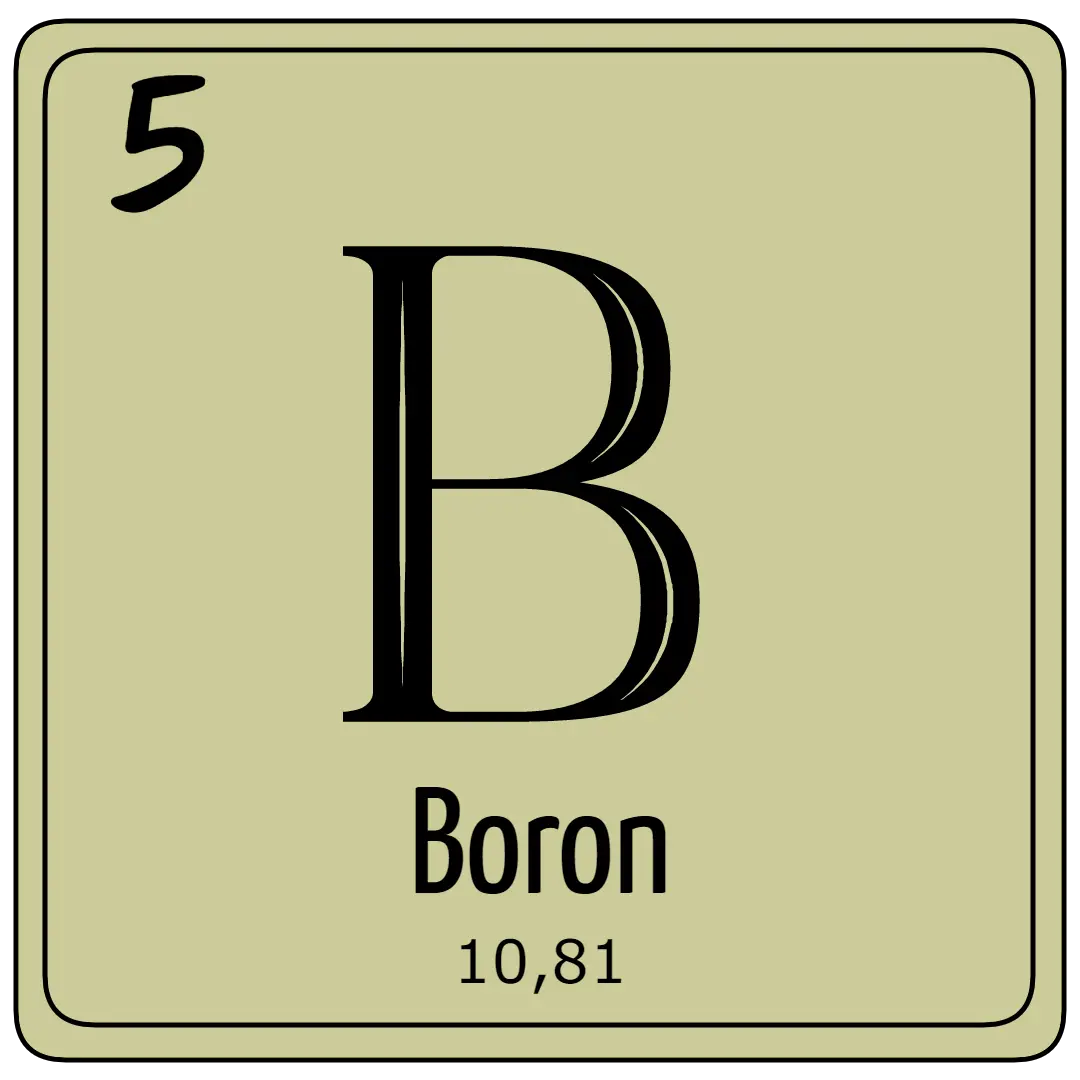
Boron is the chemical element of the periodic table of the elements which has a symbol B and an atomic number 5. Produced entirely by cosmic ray spallation and supernovae and not by stellar nucleosynthesis, it is a low-abundance element in the Solar System and in the Earth's crust.
It is a trivalent semi-metal and is found abundantly in borax. There are two allotropes of boron: amorphous boron, which is a brown powder, and metallic boron, which is black. The largest known boron deposits are in Turkey, the largest producer of boron minerals.
It is used:
- production of insulators (fiberglass) and sodium perborate (bleaches)
- due to its green flame color, amorphous boron is used in fireworks;
- boric acid is an important compound used in textile products and in medicine (in dilute solution) as a mild antiseptic for external use;
- boron compounds are used extensively in organic synthesis and in the manufacture of borosilicate glass;
- other compounds are used as wood preservatives, and are very interesting in this respect because they are not very toxic;
- boron-10 is a neutron absorber used in the control of nuclear reactors such as PWRs, and as a shield against neutron radiation and in the detection of neutrons;
- boron filaments are very strong and lightweight materials, mainly used for advanced aerospace structures;
- it is used for p-type doping of silicon.
Giveaway
The Periodic Table project continues with the free distribution of its tokens with the characteristics of each chemical element. The first 20 who comment on the article with their .wam address will receive a free Borium token.
Soon it will be possible to receive special limited-edition tokens based on the items in your wallet and other fun activities to complement the current distribution. We are studying big news, stay connected.
Link to save
- Market on atomichub for the purchase of NFTs
- Blog on publish0x to be updated
- Giveaways still open (at the writing of the article): Lithium and Beryllium (ends today at 16:00 CEST)





