In both crypto and the stock market, investors often behave in an irrational, emotional manner. They buy at the top because of FOMO and sell at the bottom because of FUD.
Emotional investors can drive market volatility. Volatility in the crypto market is essentially just a more exaggerated version of how the stock market behaves. Considering the nosedive that the crypto market took this week, this topic feels particularly relevant.
Volatility is a measure of how much the price of something moves. Measures of volatility commonly used in the stock market include:
- Beta is an individual stock's volatility relative to the market, specifically the S&P 500 index. Beta greater than one indicates the price of that stock has historically fluctuated more than the S&P 500
- Volatility Index (VIX) is the expected volatility of the entire market over the next 30 days, also anchored to the S&P 500. The higher the value, the more volatile the market is expected to be. This future forecast of market volatility is also referred to as implied volatility
It is important to understand that volatility does not inherently account for the direction of price movements, it only accounts for the size of price movements. Despite this, the most extreme price movements tend to be on the downside -- driven by panicked investors -- which is why VIX is often referred to as the fear index. Higher VIX indicates that larger price movements are anticipated.
Similar to VIX, Coti is working on a Crypto Volatility Index (CVI) which aims to predict the volatility in Bitcoin and Ethereum for the upcoming 30 days. The CVI value ranges between 10-200, where higher numbers imply more volatility.
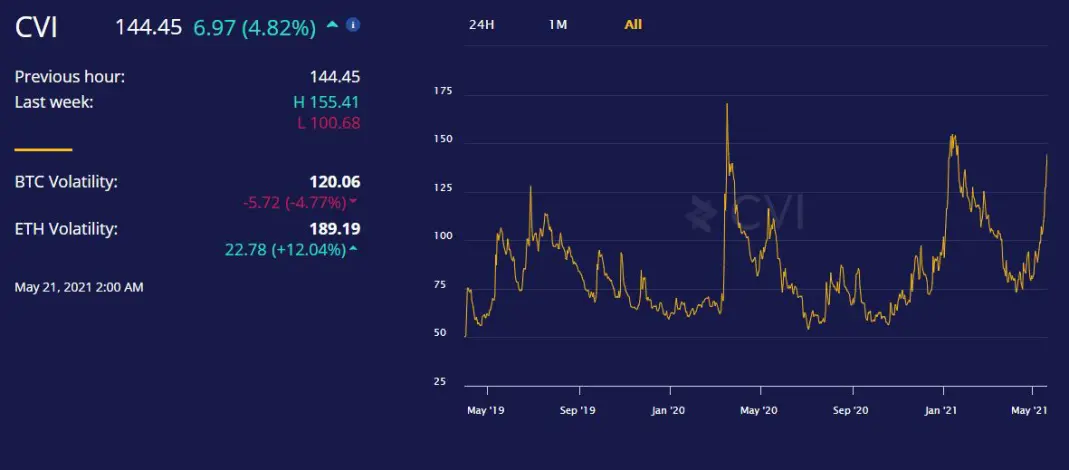
CVI index calculation is performed by the decentralized network of Chainlink oracles. [...] The combined CVI index is a weighted sum of CVI indices calculated for several cryptocurrencies, where weights are set in accordance with the asset market capitalization.
Since high volatility is typically driven by fearful investors, this can indicate a good time to look for opportunities to buy. On the flipside, investors can become greedy during periods of low volatility, which can indicate the market is due for a correction.
“Be fearful when others are greedy and greedy when others are fearful.”
-- Warren Buffet






