Meta description: A clear guide to DAOs: how they differ from companies, how a vote works, the famous 2016 DAO hack, five risks like whale control and a seven-point checklist before you trust one.
Intro
Imagine a community that owns a shared pot of money, where members propose ideas and vote on how to spend it, and the result is carried out by code instead of a boss. That's the idea behind a DAO, a Decentralized Autonomous Organization.
It's one of the most interesting ideas in crypto, and one of the most misused. This guide explains how DAOs work, what went wrong in the most famous early example, and how to spot the risks.
This article is educational only and is not financial advice. Crypto is risky, and you can lose everything you put in.
Company vs DAO
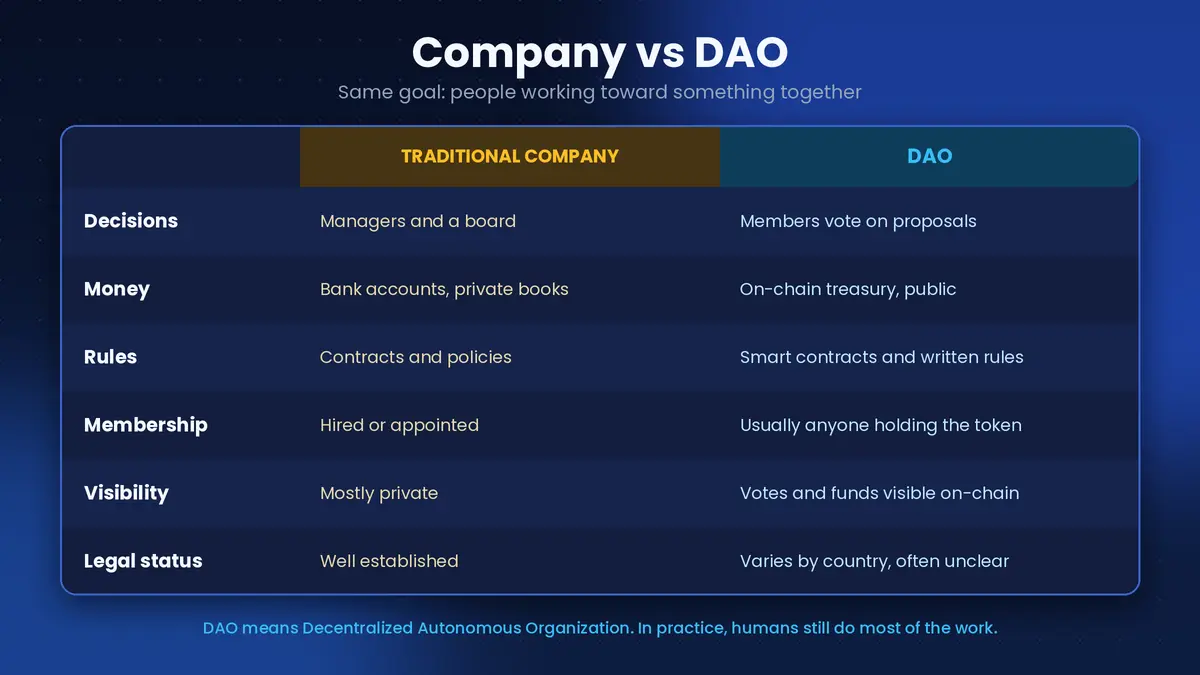
A DAO and a traditional company have the same basic goal: people working together toward something. The differences are in how decisions and money are handled.
Decisions: a company has managers and a board. A DAO has members who vote on proposals.
Money: a company uses bank accounts and private books. A DAO usually holds an on-chain treasury that anyone can see.
Rules: a company relies on contracts and policies. A DAO uses smart contracts and written rules.
Membership: employees are hired. DAO membership usually means holding the group's token.
Legal status: companies are well established. DAOs vary widely by country, and the rules are often unclear.
Despite the name, a DAO isn't fully "autonomous". Humans still write the proposals, argue about them and do most of the work.
What a DAO vote looks like
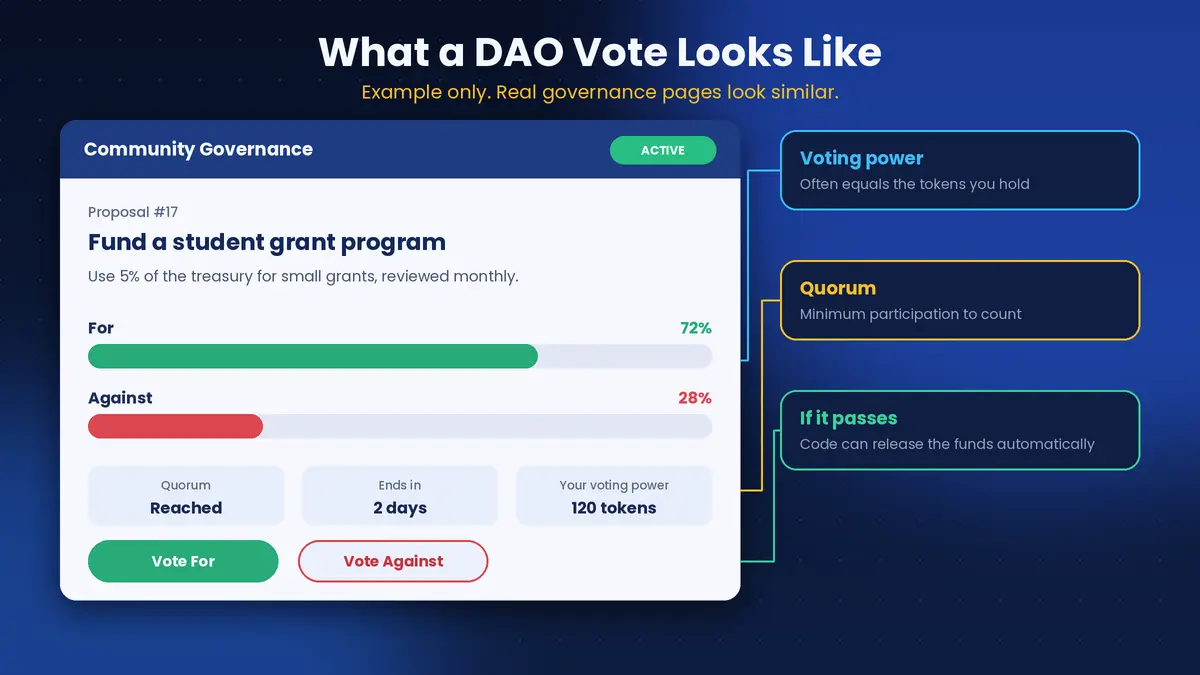
DAOs usually run on a governance page. In the example (made-up data), a member has proposed using 5% of the treasury for a student grant program. Members vote for or against.
Voting power often equals the number of tokens you hold.
Quorum is the minimum participation needed for the vote to count.
If it passes, code can release the funds automatically.
How a decision happens
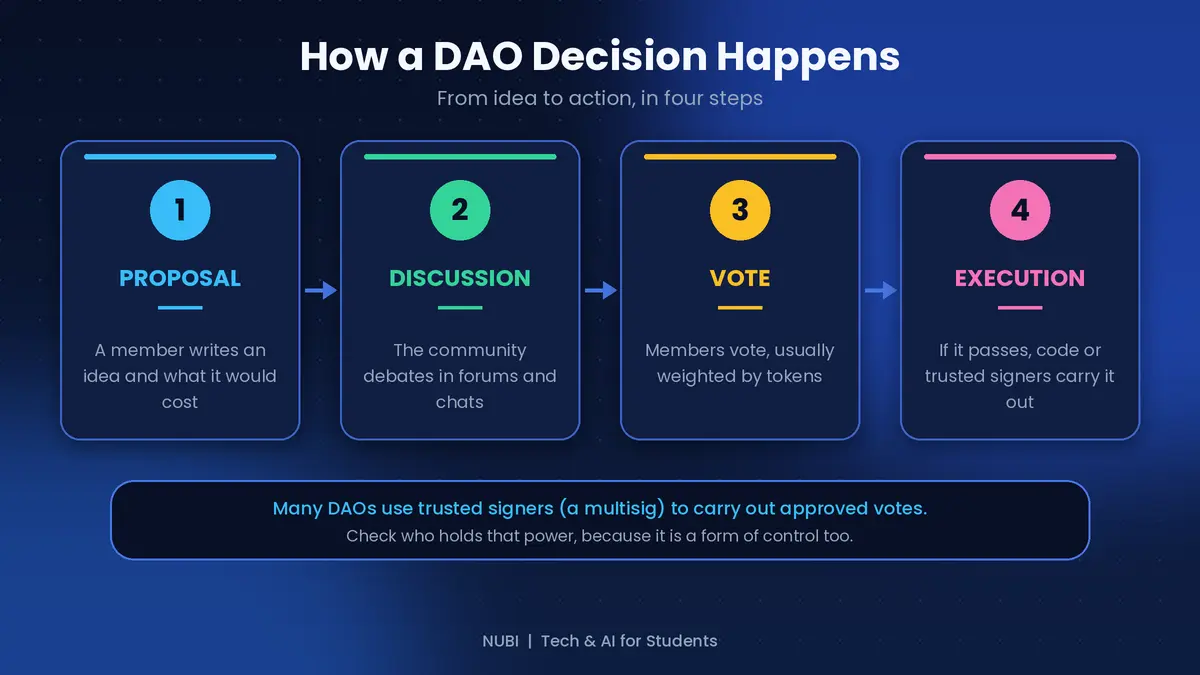
Proposal. A member writes an idea and explains what it would cost.
Discussion. The community debates it in forums and chats.
Vote. Members vote, usually weighted by tokens.
Execution. If it passes, code or trusted signers carry it out.
Many DAOs use a group of trusted signers (a multisig) to carry out approved votes. That's worth checking, because whoever holds that power also holds real control.
Where DAOs can go wrong
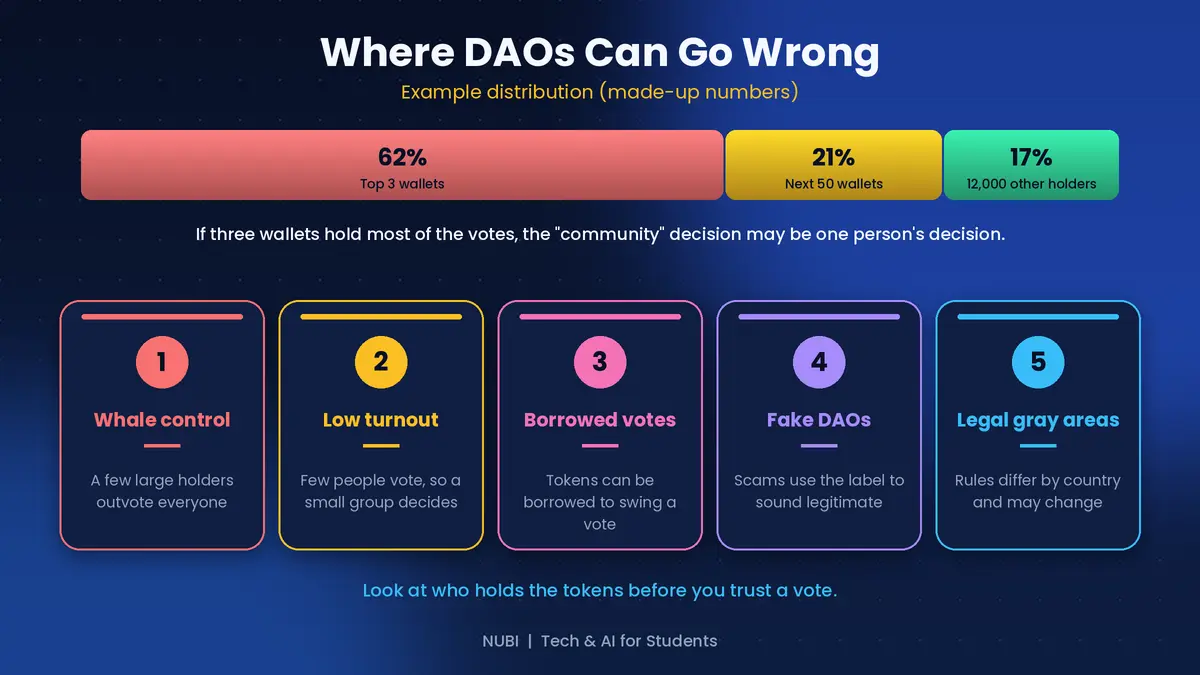
Whale control. If a few wallets hold most of the tokens, they can outvote everyone. In the made-up example, three wallets hold 62% of the votes, so the "community" decision may really be one person's decision.
Low turnout. When few people vote, a small group decides for everyone.
Borrowed votes. Tokens can sometimes be borrowed to swing a vote, a trick known as a governance attack.
Fake DAOs. Scammers use the label to sound legitimate and collect money.
Legal gray areas. Rules differ by country and may change, and members can face unclear legal responsibility.
The DAO (2016): a famous lesson
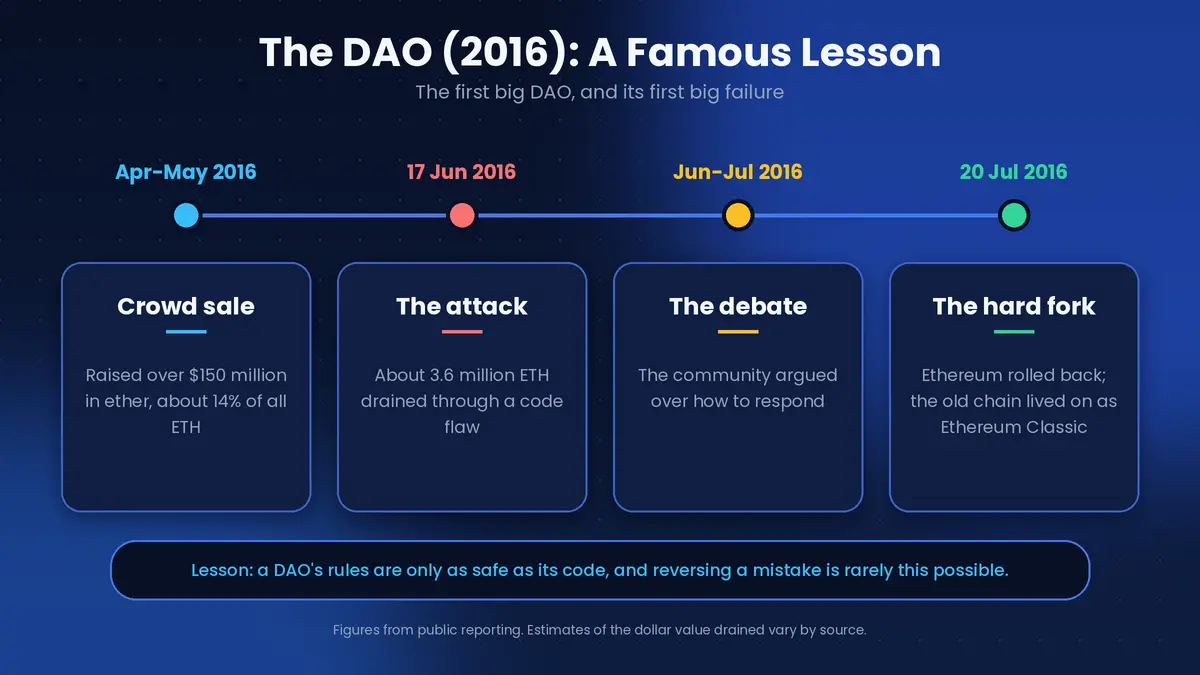
The word DAO became famous because of one project called The DAO. In 2016 it ran a crowd sale on Ethereum and raised more than $150 million worth of ether, nearly 14% of all the ether issued at that point. (wikipedia)
The problem was a flaw in its code. On 17 June 2016, an attacker drained roughly 3.6 million ETH. Estimates of the dollar value differ between sources, but it was tens of millions at the time, a huge sum for a young technology. (theblock)
The community then faced a hard choice: leave the theft as it was, or change the blockchain's history. On 20 July 2016, Ethereum carried out a hard fork at block 1,920,000 that rolled the state back to before the hack, with roughly 85% to 89% of voters in support. Not everyone agreed, and the original chain continued as Ethereum Classic, where the hack stayed on record. (theblock) (theblock)
Two lessons stand out. First, a DAO's rules are only as safe as its code. Second, being able to reverse a mistake was an exception, not something you can count on. In most cases, stolen or lost funds don't come back.
Seven checks before you join or trust a DAO
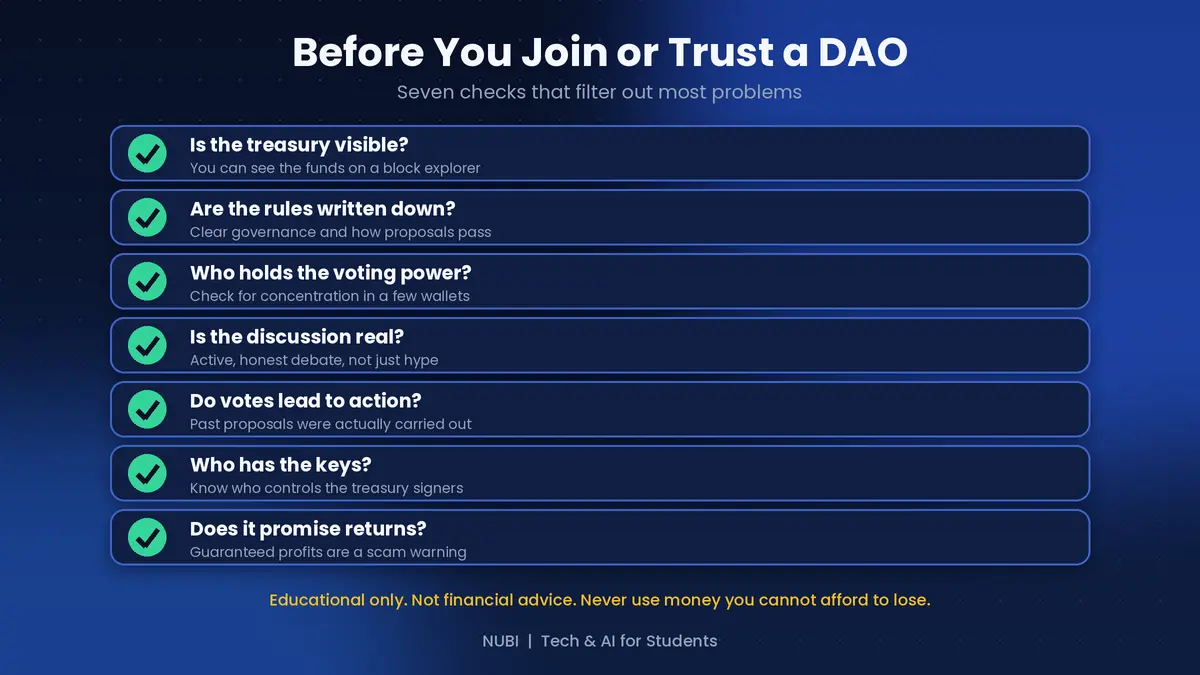
Is the treasury visible? You should be able to see the funds on a block explorer.
Are the rules written down? Look for clear governance and how proposals pass.
Who holds the voting power? Check for concentration in a few wallets.
Is the discussion real? Look for active, honest debate, not only hype.
Do votes lead to action? Check that past proposals were actually carried out.
Who has the keys? Know who controls the treasury signers.
Does it promise returns? Guaranteed profits are a scam warning sign.
Quick recap
A DAO is a community that decides together, often by token-weighted votes
Its treasury and rules live on a blockchain, so they're visible
Humans still do the real work
Risks include whale control, low turnout, borrowed votes, fake DAOs and legal uncertainty
The 2016 DAO shows how a single code flaw can be very costly
Check the treasury, rules, voting power and signers before you trust one
Final thoughts
DAOs are an experiment in running communities differently, and some are thoughtful and well run. Others are just a marketing label. The difference usually shows up in the details: who holds the power, who holds the keys and whether the rules are real. Would you ever join a DAO? Tell me why or why not in the comments, and I'll write about what you'd like to know.
Sources: public reporting on The DAO, including The Block, Wikipedia and the Ethereum Foundation's explainer.
Support this blog
If this guide helped you, you can tip me. Every bit helps me keep creating free guides for students. Thank you!
Next: stablecoins explained, what they are and the risks beyond the name. Follow so you don't miss it.