
A Revelation! Find out what school really means. You will be surprised.
This isn't an article about linguistics. It is an article about why we hate learning things we would otherwise love. It is about the "Barocracy"—the rule of the heavy, the dull, and the tedious—and how it operates by removing the one thing that makes knowledge stick: Curiosity. Stick with this one, it's worth it!

The Fundamental Interconnectedness of Everything
I was trying to construct a word for the unexciting monotony that our rulers impose on us, most likely because they are trying to mold us in their own image. I thought maybe I could make up a word, like Mike Judge's Idiocracy. With help from chat.z.ai, I went through some possibilities and landed on Barocracy.
I was about to be done with that chat session but saw that some of the Baro-related words had been changed to be Varo- instead. I asked why these letters are so often swapped over in so many languages and got a stunning example of barocracy in action. It involved the mechanics of the human mouth, the history of the Greek alphabet, and the concept of "linguistic laziness."
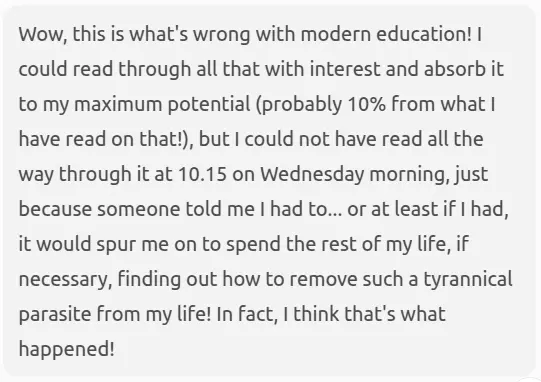
If I had been forced to read it at 10:15 on a Wednesday morning in a school classroom, I probably would have hated it. I doubt I would have absorbed it even if I had read it.
The Curiosity Test
Before we get to the "Barocracy," try this little experiment on yourself.
I asked a simple question earlier: Why do the sounds for B and V get swapped so often in history?
Think about the Spanish language, where Vaca (cow) sounds like Baca. Think about the Greek letter Beta (β), which used to be a hard "B" sound but is now a soft "V" sound. Why did this happen?
If you find that question even slightly interesting, read the box below. If your eyes are already glazing over, feel free to skip it. We won't send you to the principal's office.
THE DEEP DIVE (Optional)
The reason B and V are swapped so often is that they are "acoustic twins."
1. The Location: Both are "labial" sounds, meaning you use your lips. You don't move your tongue to the back of your throat or the front of your teeth. You just adjust your bottom lip slightly. 2. The Buzz: Both are "voiced" consonants. Touch your throat when you say B or V, and you feel a vibration. (Contrast this with P or F, which have no buzz).
To your ear, B and V are almost identical. The only difference is that with B, the buzz is trapped inside the mouth until you "pop" it open. With V, the buzz leaks out continuously.
Over thousands of years, language tends to follow the path of least resistance. It takes more muscle to stop the air for a B than to let it trickle out for a V. So, societies slowly drifted from the hard B to the soft V. It’s not a mistake; it’s linguistic efficiency.
End of Deep Dive.
The Paradox of the Classroom
If you did read the box above, you probably absorbed it. You might even remember it next week. If you skipped it, you didn't miss the point of the article—you just proved it. The difference between learning at 10:15 AM on a Wednesday and learning right now is simple: Ownership.
When I stumbled upon the B/V explanation while looking for a word to describe "boring rulers," I was hunting for a tool. I needed that information to build something I cared about. The information was a key to a lock I was trying to open. I wanted to know why B and V are interchangeable. Nobody instructed me; it was my own interest. It was my own diversion from the original goal, driven only by my own curiosity.
In a classroom, that information is just a brick. It’s handed to you with no context, no lock, and no door. You are just told to hold the brick. And if you drop the brick, you get a bad grade.
The Scholē Scam
This brings us to the ultimate irony of our modern education system.
We were trying to find a word for the "rule of the boring people." We played with words like Barocracy (rule by heaviness) and The Mediocrati (the rulers of the average). But the system that enforces this boredom has a name we already know. We call it "School." Here is the etymological twist that exposes the whole scam:
The English word School comes from the Ancient Greek word scholē.
And what does scholē mean?
It means "Leisure."
To the Greeks, scholē wasn't a place you were forced to go. It was what you did when you weren't working. It was the "leisure" to pursue philosophy, debate, and science for the sheer joy of it. What have our rulers done to us? The ultimate bait and switch!
We have taken a word that represents the ultimate freedom—having the time to think—and turned it into a bureaucratic institution that kills the desire to think. We have created a Barocracy out of Leisure.
Be Your Own Keymaster

So, what is the solution?
Perhaps it is to stop treating knowledge like a prison sentence. If you are reading this, you have already broken out. You skipped the parts that bored you and read the parts that interested you. You engaged in scholē—leisure learning—on your own terms.
The next time you find yourself bored by a textbook or a lecture, remember the B and the V. Remember that the information isn't boring; it's the method of delivery. The "heavy" feeling isn't the weight of knowledge; it's the weight of compulsion.
Find the thing you want to build, and the learning will follow. It’s easy to absorb the "heavy" stuff when you are the one deciding to lift it.
Here's a little after-dinner wafer-thin mint to finish it all off.
"There is nothing on earth intended for innocent people so horrible as a school. To begin with, it is a prison. But it is in some respects more cruel than a prison. In a prison, for instance, you are not forced to read books written by the wardens …"
- George Bernard Shaw






