
A research paper made available on May 12 on open-access research paper repository arXiv has examined the transactions on major blockchains XRP, EOS (EOS) and Tezos (XTZ), with interesting results.
Notably, it states that only 18 accounts were responsible for half of all XRP transactions. For XRP, the researchers looked at the 150 million transactions that were executed from October 1, 2019 to December 31, 2019, which involved 90,000 accounts. That would average out to 1.7 thousand transactions per account, but the transaction activity distributed is highly skewed, according to the paper.
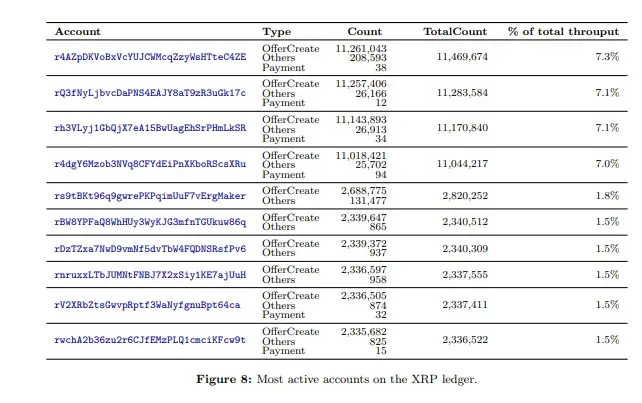
The most active accounts on the XRP ledger for Q4 2019. Source
The majority of the accounts seen above show some pattern, the researchers say, suggesting that the CNY transactions and accounts associated with Huobi make it possible that the accounts are controlled by a single entity related to Huobi. The paper reads,
“The aforementioned similarities, in particular the third one, signal that those accounts are controlled by the same entity, presumably with a strong connection to Huobi. The frequent placement of offers might come from the massive client base of the entity.”
There’s another interesting conclusion that was derived from transaction data. In their own words, “the throughput on the XRP ledger during our observation period appeared to be fraught with zero-value transactions.” Payment volume was calculated to be 360 million XRP per day, but that the top 10 senders accounted for 51% of the volume, and the top 10 receivers 43% of the sent funds.
It summarized the situation as follows, “We learned that both transaction volume and token value on the XRP ledger are highly manipulable.”
The paper also commented on the EOS and Tezos blockchains, which similarly saw little high-value transactions. In EOS’ case, 95% of the transactions were related to the recent airdrop of the EIDOS token, which congested its network. For Tezos, 82% of the transactions were related to block endorsement for network confirmation.
Ripple has had a lively 2020, having filed a lawsuit against YouTube for the existence of XRP scams on the platform, and seeing a sales drop of 87% from Q4 2019.






