
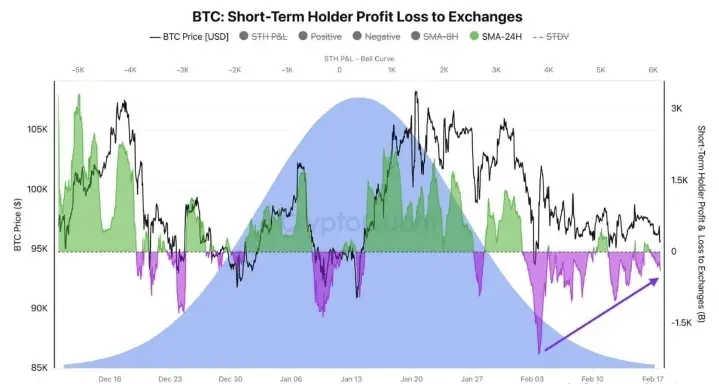
At current market levels, the number of sellers willing to offload their assets at a loss has reached an absolute minimum. This signals a crucial shift in market dynamics—those who were panic-selling have largely exited, leaving behind stronger hands and long-term holders. Historically, when seller exhaustion occurs, liquidity tightens, and the market enters a phase where downside pressure becomes significantly weaker.
The Supply Squeeze Is Real
On-chain data confirms this trend. The percentage of Bitcoin held in loss has dropped below 10%, meaning the majority of investors are either at breakeven or in profit. In previous cycles, such conditions have marked the end of major corrections and the beginning of a renewed uptrend.
Additionally, exchange reserves have hit multi-year lows, indicating that fewer coins are available for immediate sale. Glassnode data shows that Bitcoin balances on exchanges are at their lowest since 2018, suggesting investors are moving assets to cold storage rather than preparing to sell.
Market Manipulation Tactics Are Losing Impact
If certain players wish to exert downward pressure, their options are now limited. The classic strategy of spreading FUD (Fear, Uncertainty, and Doubt)—through regulatory concerns, security breaches, or economic instability—may still generate short-term volatility. However, with fewer weak hands in the market, the impact of such tactics is greatly diminished. The remaining participants are seasoned investors who have weathered multiple cycles and are less susceptible to panic.
The Path of Least Resistance Is Up
With sellers exhausted, liquidity drying up, and demand slowly increasing, the market is now structurally positioned for an upward move. Historically, Bitcoin has surged 50-100% within months after similar supply crunches, as seen in 2017, 2020, and 2023. If institutional inflows continue—especially through ETFs and corporate adoption—supply shocks could drive prices even higher.
At this point, bears are running out of ammunition. Shorting is becoming riskier, and spreading fear won't have the same impact it once did. The only viable direction is upward. Whether through organic buying pressure or forced short liquidations, a market rebound is becoming increasingly inevitable.






