This characteristic tree is probably known to most of the inhabitants of Europe, because it is very common in Europe. You can find this tree growing wild or cultivated to obtain world-renowned hazelnuts.
Mi hazel is associated with childhood and holidays spent in a country house. My grandfather had a house in the so-called colony, it was about 3 km to the nearest village. I loved this place and there were a lot of hazel trees there. These were farmed hazel trees, cared for and pruned appropriately every year.


Nuts are one thing, but I had another use for this tree. For I searched for a long young branch, cut it off, and used it as a fishing rod, for the hazel tree is very flexible.


This tree can be found all over Poland, even up to 1000 m above sea level. It might seem that this plant will grow everywhere - nothing could be more wrong. Hazel belongs to very demanding trees. The soil must be sufficiently fertile, it cannot be wetland. To produce large crops, it must grow in well-sunlit places. It can grow up to 5 m and live up to 80 years. The most valuable product of hazel is its fruit, commonly known as hazelnuts.
Hazel leaves


Hazel leaves are oval, can reach about 10 cm in diameter, are slightly pubescent, single with a sharp tip. The tree loses them in winter.

Hazel flowers


I took these photos in winter and early spring. Around February, the so-called kittens appear. These are fringed male inflorescences, in a characteristic bright yellow color, that hang freely. They are very visible in the forest, where there are no leaves and buds of other trees yet.

Hazel fruit


Hazelnuts, i.e. hazelnuts, contain a lot of magnesium, phosphorus, calcium and iron and are a very healthy food for humans, but they are also food for forest mammals. They are used mainly in the confectionery industry, and chocolate with hazelnuts is a masterpiece.


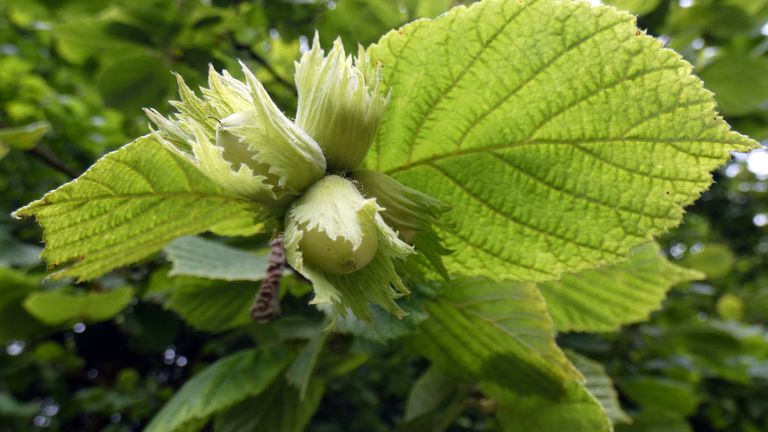
They are enclosed in a hard shell, which when young is greenish-yellow in color. Ripe nuts have a brown shell.


Inside there is a milky cottony mass and a tiny peanut embryo. Often these unripe nuts, a little bigger than in the picture, I ate with my friends. We used to call them "milk babies" back then. Ripe nuts appear in August and September.


They can be single pieces or whole groups. I once managed to break a ball of glued nuts in the amount of 10 pieces. Most often, however, there are 3-4 pieces. Once they are very ripe, picking them is very easy. It is enough to shake the tree intensively and the nuts fall out of the jagged baskets onto the ground. My grandfather called such nuts "łuszczaki".