
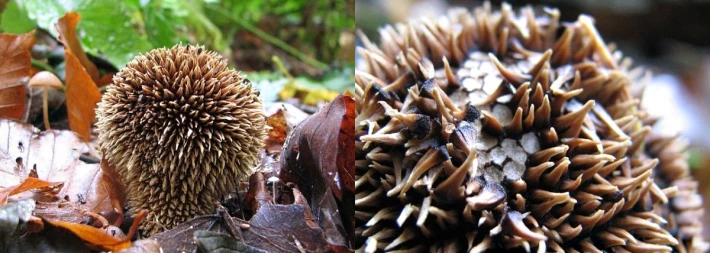
Lycoperdon echinatum - Mushroom shaped pear-shaped or spherical, with a short and narrowed lower part (stipe). Height 20 to 50 (60) mm and and almost the same width. The surface (peridium) of the fruiting body is double-layered. The outer layer (exoperidium) was initially whitish, light brown, later dark brown. It is spiky, spikes up to 6 mm long are dense and sharp, wedge-like, angular, touching each other after several bent peaks, at the base of the fruiting body much shorter. After their fall, the net pattern remains. The inner layer (enderidium) is soft, paper-like, in young fruit bodies white, then light cream, light brown to ocher-brown. A circular outlet for spores is formed at its top. The fruiting body is associated with the substrate with a string of white mycelium strings.
The head is the upper part of the fruiting body, it is spherical in shape, with a diameter of 40 to 50 mm. Its interior (soil) contains spores.
The stem, if it exists, is an extension of the head, forming the lower part of the fruiting body. Its interior (subsoil) is small, composed of chambers containing no spores.
The fruiting body of the fruiting body is compact and elastic, later disintegrating into powdery powder. In white, then olive-yellow, gray-violet to purple-brown. In young fruiting bodies the aroma is mild mushroom and the taste is delicate.
Occurrence: Usually in deciduous forests, especially beech forests, less often in mixed forests, on soils containing calcium. Grows individually or in small groups from July to October. Rare.
Value: Edible fungus, when the fruiting body is white, you can eat it after removing the outer cover.






