
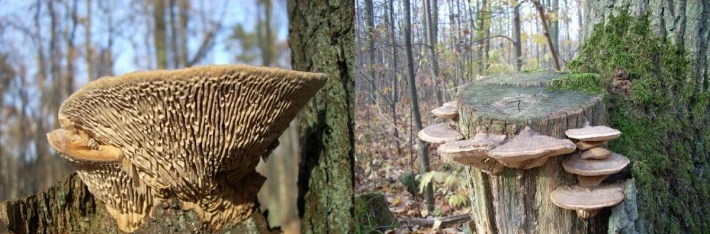
Daedalea quercina - Fungus 40 to 300 mm in diameter, 10 to 80 mm thick, nodular, semicircular, console-like, semi-pilarate, cochlear or irregular, adnate to the side, less often spread out. Surface uneven, rough, nodular, folded, slightly mossy or bare, dull. Gray, ocher or wood, gray-brown. Rare concentrically zoned and furrowed. The edge is quite sharp, sometimes thick, moderately wavy, and futile. Hymenophore tubular, labyrinthine, to lamellar; usually thicker than the pulp layer; wood colors, sometimes with a pink tinge.
Tubes 10 to 30 mm long, in one layer, with thick walls.
Light, round, angular pores, labyrinthine, with blunt blades, elongated, very large, with dimensions of 0.7-1.3 x 5-50 mm.
Lamellae often bent and anastomosing.
Homogeneous pulp, initially elastic, after drying corky, very light; colors of wood or coffee with milk; mushroom smell, tart; spicy taste.
Occurrence: Very common; mainly on oak wood, but also other deciduous trees; mainly in forests, but also on structural timber, beams, columns; annual sporocarps, but very durable and hard, grow all year round; grow out singly or in groups, sometimes fused together.
Value: Inedible mushroom.






