
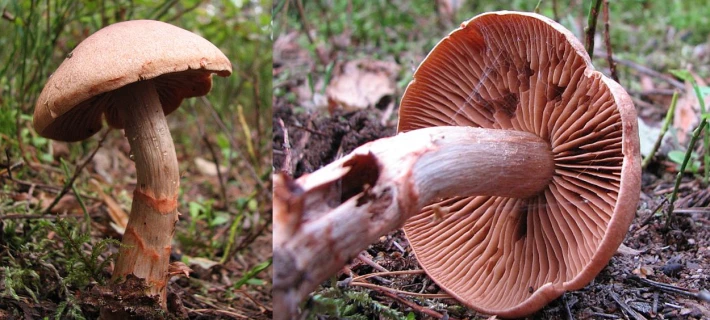
Cortinarius armillatus - Cap 50 to 150 mm in diameter, initially hemispherical or bell-shaped, later arched to squam-shaped, spread with a broad, blunt umbo, fleshy, on a fibreboard surface, with age zoned, covered with delicate scales, rusty brown, cinnamon reddish, ginger, with age fading (hygroscopic) not absorbing), on the long-tucked edge the remains of the red veil.
Lamellae broad, densely set, notched at the stipe and adorned broadly, initially light brown, then cinnamon brown, red brown, blade slightly notched, whitish.
Stem 70 to 160 mm high, 10 to 40 mm thick, rod-shaped, at the base bulb thickened, full, initially whitish, with age gray-brown, lighter than the cap, on a light purple-brown background numerous, clear, cinnamon-red bands, circular rings, tearing towards the base into fragments.
Creamy, yellowish flesh with a reddish tinge, orange-brown under the skin, marbled, unchanging, no or very weak radish, mild taste.
Broadly lipoid spores, slightly papillae; rust-brown discharge. With dimensions of 7-13 x 5-7 µm.
Occurrence: On the ground, on acidic, wet soils, in peat bogs, on the edges of forest roads, in thickets, in deciduous and coniferous forests, always under birch, often in large groups, quite common. From July to October.
Value: Czech authors state that it is edible. However, it is not recommended for consumption - it probably has slightly poisonous properties.






