
Welcome to the first installment of my NBoNA Blog!
jday the New England Naturalist here to begin my dive into the world of native bees!
So, without further delay, let's get started so you can see why I think native bees are an important topic to care about.

Bombus bimaculatus q
Who are these bees and what do they even do?
Firstly, the group of bees that most people are familiar with are the honey bees, specifically Apis mellifera, the European honey bee. Now, there are other species of Apis, however A. mellifera has been the most widely used, mainly for it's use in agriculture and production of honey. Other species that are endemic to Asia, and a whole other tribe of stingless bees (Meliponini), have been observed by natives for centuries and even had their honey harvested. Okay, where am I even going with this? This is not supposed to be about honey bees! Just to give a little bit more background to start, A. mellifera was imported to the Americas by European settlers, looking to bring their agricultural ventures overseas. What they failed to take into account were the long lasting ecological impacts that this decision would cause. Our native bees have been here (including some of those stingless bees I just mentioned) for millions of years, but the honey bee has managed to outcompete and propagate way beyond any sort of natural level of population. Combine this with overdevelopment causing major habitat loss, and the native bees are not looking too hot, especially when one of the main problems is stealing the spotlight.
That's enough about honey bees, the other group that most are familiar with is Bombus, the bumble bees. Above are two pictures of the species Bombus bimaculatus, the two-spotted bumble bee, and two individuals whom are queens working hard to found a nest this spring.
Hold on, let's back up a bit...what IS a bee, anyways??
For those unfamiliar with taxonomy, we attempt to sort life into certain groups and tiers that allow us to easily see how related two organisms are. There are obviously so many shades of gray when it comes to characterizing life, that it is not the best system, but it helps. However, we can look at the fact that we humans, cats, dogs, and insects all fall into the animal group (Kingdom Animalia), but insects are not mammals like the other three. So, once we get down to where insects are (which looks something like this: Animalia->Arthropoda->Hexapoda->Insecta) we have many orders that separate out larger groups, like beetles (Coleoptera) or the bees, ants, and wasps that we are concerned with (Hymenoptera). Quick note that these names are all derived from Latin, so do not worry when they make no sense, I will always try to explain when a translation is good to know. For example, that suffix for the orders "-ptera" refers to the wing of something (pterodactyl, helicopter, etc.), so each order seems to say something about the wings of the group. Going a bit further we can translate "coleo-" to "sheathed" and we get the literal Latin name for beetles as "sheathed wings," which makes sense when you look at how they have to unsheath their wings before flight! To be complete: "hymen-" refers to membranous substances, so our bees, ants, and wasps all have "membranous wings."
Still don't know what a bee is?
Sorry about that, I will stop beating around the bush. In our order Hymenoptera, the majority of diversity comes in the form of wasps, and that actually technically includes ants and bees, who are both just specialized groups of wasps. Think of it like how we humans are considered part of the great apes, but not all apes are considered humans. In the same way, bees are all special wasps, yet not all wasps fall into the specific category to be called "bees." Wasps will primarily use their venom to subdue small prey items (i.e. caterpillars or spiders) and use those to provision the nest. Like I said, there is such great diversity of wasps, that this is simply the strategy most familiar to people, the one that yellow jackets and paper wasps use. It would be much too cumbersome to delve down into that rabbit hole, but I urge the curious to go check out the world of solitary wasps!
Eventually, some group of wasps decided to forgo hunting or parasitoid strategies, in favor of the more easily attainable resources gathered from plants. You see, wasps were already visiting flowers to drink the nectar; this sugar is great fuel for flying insects. This is how pollination works at a basic level, a nectar reward is offered, and the consuming party will contact the pollen producing structures of the flower and thus move pollen from flower to flower, even if accidentally. This group that decided to do otherwise saw that the pollen they were encountering as they foraged had ample nutrients to replace the protein found while hunting. Over time, the wasps that used a strategy of eating nectar and pollen, and feeding this to their young, did just fine. This led to plants responding by changing the pollen and nectar they made available, even leading to some plant and bee species developing such a close bond that no other insects can successfully pollinate that flower (co-evolution).
Again, I want to reiterate how evolution is such a slow and gradual process, that us trying to draw boxes around different groups is haphazard at best, and cannot accurately portray what actually happens out in nature. But hey, we have to try to understand our beautiful world somehow!
I know this is a lot of information, but bear with me!
Melissodes desponsus f
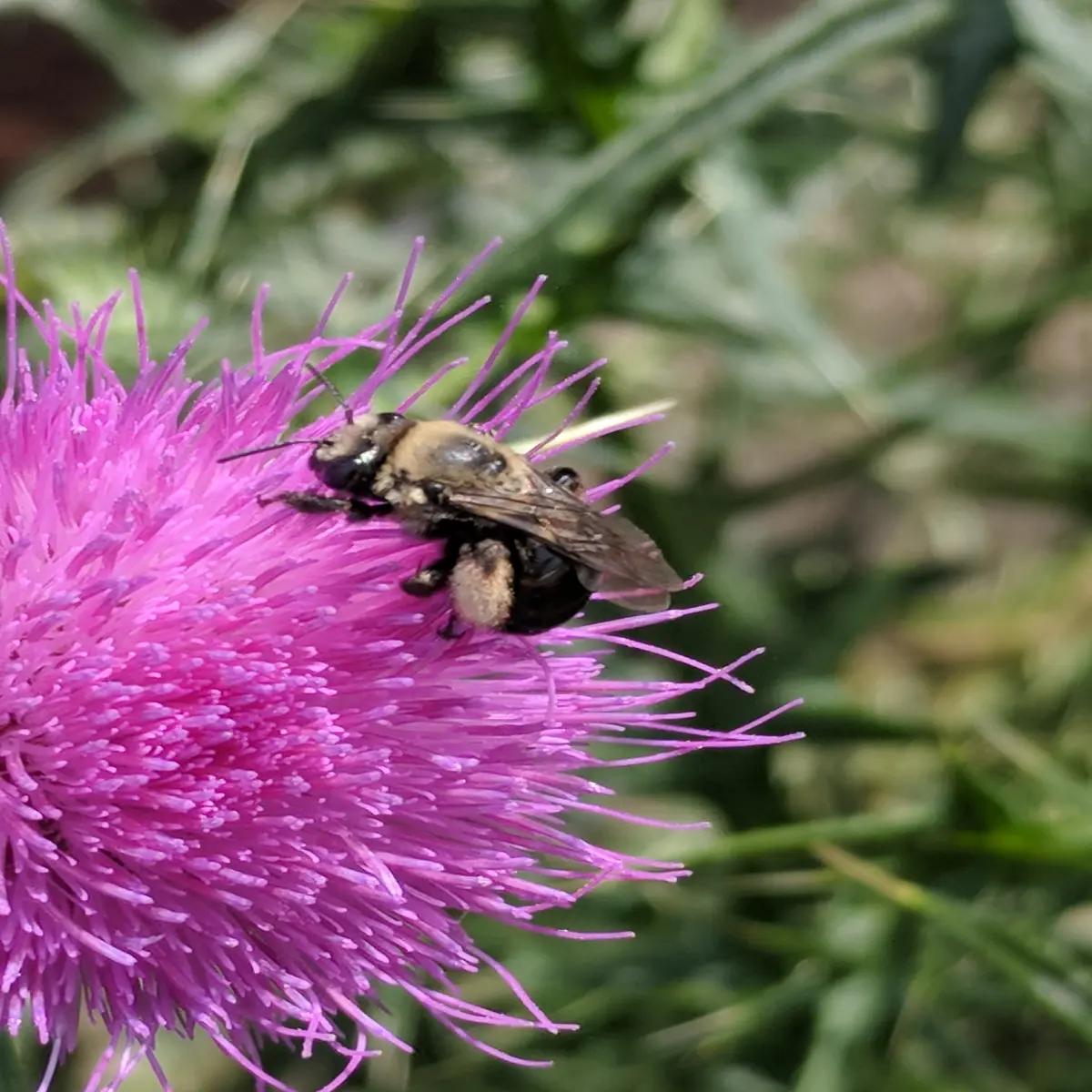
Before wrapping up, I would like to thank you for reading, and hope you enjoy learning about bees with me! I just want to quickly run through a few native bees, to showcase the variety of looks and strategies that exist. First, we have a Melissodes desponsus female, also known as the "thistle longhorned bee," pictured here on none other than a thistle! This is an example of a bee that evolved a very specific strategy, to the point where she will only collect the pollen from thistles, and that is all she will feed to her babies. An adjective we use to describe bees such as this is "oligolectic," or essentially meaning she is a specialist bee. This is in contrast to "polylectic" bees which are colloquially known as generalists. A large portion of the bees you see (honey bees, bumble bees) are polylectic, they do not have much preference for what type of flower they visit.

Agapostemon virescens f
All the bees I have shown before this reside in the family Apidae, a group of larger, more robust bees, like the bumbles and even the Melissodes desponsus, too. Here, we have another family to look at, the sweat bees (Halictidae). If you are in the eastern USA, this is a lady that you can find all the time, and easy to pick out with here green plus black and white look unique to her. Another polylectic bee, but one that introduces a weird case once I start to talk about nesting strategies and the sociality of bees. We know that honey bees and bumble bees live in a large colony, with a queen and many many workers helping keep the nest going. Most bees do not use this strategy, something called "eusocial" behavior, as they prefer to build smaller nests and work on their own. However, there is growing evidence of these bees actually utilizing a primitive sort of eusocial nesting. Not on the same scale as honey or bumble bees, but seeing evidence of "workers" in a nest that we traditionally thought was a solo operation is very cool! It also speaks to how our groupings can sometimes be problematic, and there will be overlaps and discrepancies throughout.
I do not want to go on too long, but next time I will start to go more in depth into nesting strategies of various bees.
I am also thinking of starting another blog alongside this one to act as a "bee spotlight" where I will give a detailed report on just one species of bee.
Let me know what you think! Also, if you have any questions or comments, feel free to reach out or leave them below!
Thanks for reading! Stay tuned!






