
Let me explain why art can fetch millions, even billions of dollars.
It’s not as simple as it seems. Where does cryptocurrency fit into this?
The Mona Lisa is worth around a billion dollars. So who determines the value of this art?
Is it the artist’s fame? Is it the rarity of the work? Is it the materials used? Or maybe it’s the story behind it — just as a piece that once belonged to a famous person becomes irresistible to collectors willing to spend millions of dollars.
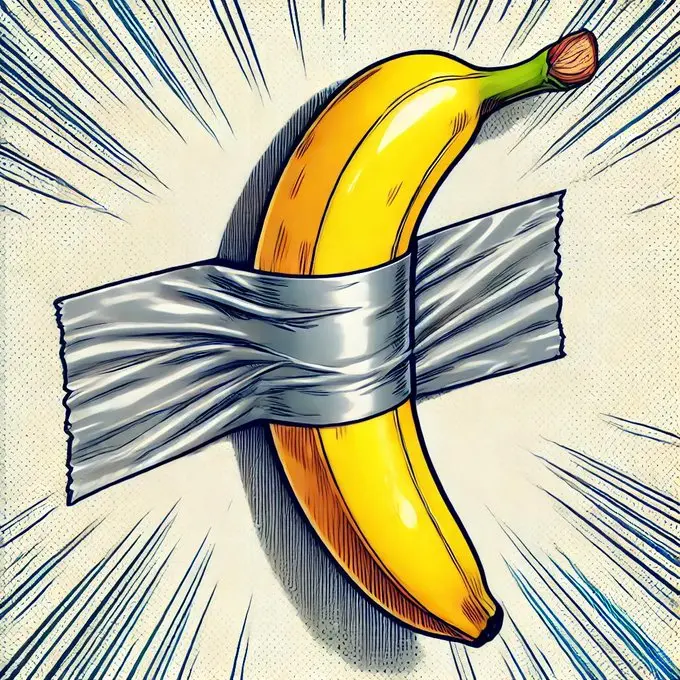
But none of this logic applies to ‘The Comedian,’ or as you probably know it, the ‘taped banana.’ This cheeky piece by Italian artist Maurizio Cattelan is not exactly what you’d call classic art. It’s literally a banana taped to the wall with silver tape. Yet it sold for a whopping $6.2 million at Sotheby’s. Yep, you read that right.
Think about it. The banana itself probably cost 35 cents at a fruit stand outside Sotheby’s on auction day. If you do the math, its value has increased by an absurd 18 million percent!
So how did this happen, you might ask?
If you look at it through the eyes of Justin Sun, the buyer of the $6 million “banded banana” and founder of the cryptocurrency Tron, it wasn’t just art. It was an idea. For him, the banana represented the connection between art, meme culture, and the crypto community. Conceptual art is meant to question how we think about value.
The banana can show that value is not fixed, but shaped by culture. Since memes highlight the absurdities of modern life, associating them with art makes it relatable to younger, more tech-savvy people. For the crypto community, it’s a way to show that something as unusual and intangible as Bitcoin or even Tron can have incredible value.
Does that sound weird?
Of course. But here’s the thing. Sun didn’t just buy bananas, he also bought attention. Tron’s popularity skyrocketed after the acquisition, its value increasing by 10% and reaching an all-time high since its launch in 2018. Its market cap (the total value of Tron coins in the market) reached an incredible $18 billion. That’s more than $1 billion added in just a few days!
But wait, that’s how it looks from the outside. What no one talks about is how artworks can double or even triple in value, generating millions or even billions of dollars in the shadowy world of art laundering.
The truth is that the skyrocketing prices of artworks often have little to do with subjective value, abstract concepts, or prestige. Instead, the art market provides a convenient loophole for wealthy individuals to launder money or hide the origins of illicit funds. It works like magic.
For starters, there is no universal method for pricing artworks. Everything is subjective, meaning you can buy or sell art for whatever price you want. This lack of standards creates the perfect cover for moving suspicious money around.
But that’s not the only advantage of the art world. It’s also surprisingly unregulated, meaning you can buy a piece of art with a bag full of cash and do it all anonymously.
Why? Because collecting art is like owning a treasure. If people know you own it, the likelihood of theft increases. So, to protect identities, the art world offers complete anonymity. Auction houses and galleries won’t reveal the names of buyers or sellers unless they have express permission or have enough money to keep their identities under tight lock and key.
This is where things get even murkier. Imagine a money launderer using $10 million in dirty money to buy a painting—anonymously, of course. They don’t have to hang it in their living room to make it legitimate. Instead, they can ship it to a ‘freeport’. For those who don’t know, these are storage facilities near airports for goods in transit or items sent by a seller but not yet received by the buyer.
But in the art world, these have become loopholes. Since these areas don’t fall under the jurisdiction of a specific country, they’re essentially tax-free zones. So the money launderer parks the painting there and waits. Eventually, another buyer—real or not—purchases the work at an inflated price. Ownership changes hands, but the art doesn’t budge an inch.
Suddenly, that $10 million is “clean” money, and no one asks any questions. This game can be repeated forever, with the art skyrocketing in price each time.
And that, my friends, is how art magically acquires its so-called “subjective” value.
That’s why countries are scrambling to enact anti-money laundering laws and are keeping a close eye on suspicious activity in the art world.
Take Mexico, for example. In the early 2010s, the government passed a law requiring greater transparency about buyers and limits on how much money can be spent on a single work of art. The result? The art market has plummeted. Sales have fallen by 70% in less than a year, largely because Mexican cartels have become one of the biggest buyers in the market.
More recently, the US enacted the Anti-Money Laundering Act of 2020 (AMLA 2020), which forces antique businesses to identify the rightful owners of artworks, keep records of transactions, and regularly monitor compliance.
The European Union’s 2020 Anti-Money Laundering (AML) Directives also require art dealers to conduct due diligence on clients and report all transactions over €10,000. If they’re trading or storing art worth more than that, they have to follow strict rules.
So yeah, hopefully with laws like this, the days of money laundering in the art world will be numbered.
But having said that, I know what you’re thinking. Could this taped-up banana also be part of a clever, shady deal?
Well, we can’t say for sure, especially considering Cattelan made three editions of Comedian .
Note: Conceptual art is about ideas, not just physical pieces. So in the case of Comedian , what the artist is selling is not a taped-up banana, but a certificate of authenticity and a set of instructions to the owner on how to preserve or recreate the artwork — like how to tape the banana, where to place it, how high off the ground it should be hung, and of course, how often to replace the banana, because, you know, it’s going to rot eventually.
Here’s where it gets interesting. If you look closely enough, the version that Justin Sun bought for $6 million has a pretty long ownership journey. It was originally sold to an anonymous buyer by Galerie Perrotin in New York in 2019, then passed to White Cube gallery, and eventually reached Sun via Sotheby's, where he received a commission to make the sale happen.
Now, I'm not saying this version of the Comedian is involved in some kind of art money laundering scheme. :)
But let's be honest. When there's a bit of mystery surrounding the ownership, no matter how weird or crazy the artwork is, they have a knack for driving up prices.






