
Cryptography, the science of secret messages, has been around for thousands of years. Already the ancient Greeks used encryption techniques, and Julius Caesar used his own cipher to protect his confidential documents from prying eyes.

Emperor Julius Caesar reading an encrypted document, pencil drawing
One of the greatest achievements in the history of cryptography was breaking Enigma - the German cipher used during World War II. Polish mathematicians, Henryk Zygalski, Marian Rejewski and Jerzy Różycki broke Enigma by devising ingenious methods that allowed German messages to be read.
But don't think that cryptography is just historical facts.
Nowadays, cryptography is an integral part of our digital life. Secure online transactions, using e-mail or logging into bank accounts all require the use of cryptography.

World War II Enigma cipher machine, drawing
Do you know how asymmetric cryptography works?
Imagine you want to send a secret message to your friend, but you don't want anyone else to read it. You can use a public key and a private key for this purpose. The public key is available to everyone, while the private key is known only to you and your friend. When you encrypt a message with the public key, only your friend can read it using the private key. And someone else? No chance!
In the past, the development of cryptography was mainly related to military needs. In many countries, such as the USA, Great Britain or Germany, there were government agencies that dealt with the development of military cryptography, for example the US National Security Agency (NSA), which developed many innovative cryptographic technologies.
One of the first outstanding cryptographers to work for the US Army during World War II was Claude Shannon, who is considered the father of modern cryptography.
Claude Shannon (1916-2001) was an American mathematician, electrical engineer and cryptographer.
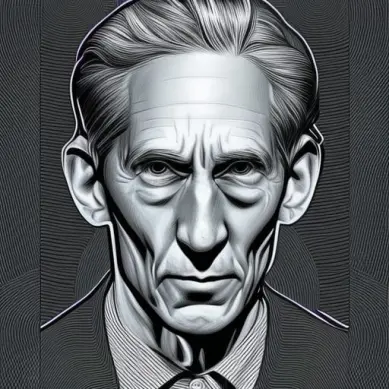
Claude Shannon, pencil drawing
Shannon was born in Petoskey, Michigan in 1916. He studied mathematics and electrical engineering at the University of Michigan in Ann Arbor, where he received his master's degree in 1937. He then transferred to the Massachusetts Institute of Technology (MIT), where he continued his doctoral studies and received his PhD in mathematics in 1940.
While working on the encryption and decryption of military messages, he developed a number of innovative techniques that revolutionized the field of cryptography.
In 1948, he published the pivotal work "A Mathematical Theory of Communication", which is considered the beginning of information theory. In this work, he formulated the basic concepts of information theory, such as entropy and redundancy, which are widely used in engineering and computer science today.
After the war, Shannon returned to MIT where he continued his research in cryptography and information theory. In the 1950s and 1960s, he dealt with, among others, corrective coding, game theory and artificial intelligence.
His work had a huge impact on the development of computer science, electronics and telecommunications, and his contribution to the field of cryptography is invaluable.
In the 21st century, many countries still maintain government agencies responsible for the development of cryptography. In the United States, the NSA still remains one of the most important research institutes in the field of cryptography, but there are also other government agencies such as the National Institute of Standards and Technology (NIST) that develop cryptographic standards for various applications.

Neural networks, pencil drawing
Similarly in Europe, government agencies such as GCHQ in the UK and BND in Germany continue to play a key role in the development of military and civilian cryptography.
Many private crypto companies have also sprung up. These companies develop various cryptographic technologies, including data encryption, electronic signature and network security solutions. Their goal is to ensure data protection and user privacy in the digital age.
These are primarily cybersecurity companies, as well as companies producing security software, such as antiviruses or data encryption systems. Many companies in the financial industry, such as banks and cryptocurrency exchanges, also use cryptography in their systems to secure transactions and customer data.
There are also private organizations and foundations, such as the Electronic Frontier Foundation or the International Association for Cryptologic Research, which research and develop cryptographic technologies and educate about their applications and importance for data privacy and security.
Thus, the development of cryptography in the 21st century is led by various institutions, both public and private, for different reasons and purposes. However, in any case, the key goal is to ensure the safety and privacy of users.

A Mathematical Theory of Communication, pencil drawing
So what was the impact of cryptography on the creation of cryptocurrencies?
Undoubtedly crucial and foreground.
It is worth noting that Bitcoin was not the first digital currency project, but it was the first digital currency to become successful and popular.
Earlier projects, such as David Chaum's DigiCash or e-Gold, had their flaws and limitations that prevented them from achieving success.
It is Satoshi Nakamoto who is considered the father of the first digital currency, as he created the innovative concept of digital currency that revolutionized the world of finance and technology.
But would it be possible without cryptography?
First, cryptography made it possible to ensure the security of transactions made on the Bitcoin network. In order to make a transaction, Bitcoin users must digitally sign a message that contains information about the transaction. This signature ensures that the transaction has been authorized by the owner of the Bitcoin wallet, while preventing others from altering the content of the transaction.
Secondly, cryptography was key to creating a mechanism that makes it possible to ensure the security of the Bitcoin network through the use of so-called. "proof-of-work". This mechanism requires network users to perform complex mathematical calculations that ensure that transactions are recorded securely and unchanged. Cryptography is key here because it ensures the security of the mathematical algorithms that are used to verify the correctness of the calculations.
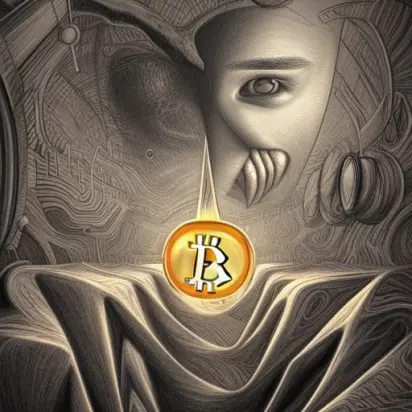
Cryptography, surreal pencil drawing
In this way, cryptography has become a key element for the creation of cryptocurrencies and their secure operation. Without cryptography, it would be impossible to ensure the security of transactions on the Bitcoin network or create a mechanism that protects the network from attacks and fraud.
Sources:
https://pl.wikipedia.org/wiki/Cryptology
https://en.wikipedia.org/wiki/Claude_E._Shannon
https://en.wikipedia.org/wiki/Public-key_cryptography
Graphics:
digital art, own creation






