I was (probably) too late to the dot-com boom, but have witnessed two buzzes. One promises to revolutionize money and finance; the other promises to revolutionize…everything. Now you could build a working SaaS product without ever knowing how to code and transfer money to your nephew in the Himalayas without ever visiting a bank. Anyone in their mid-to-late twenties remembers when both were plain imaginations in the “cities of tomorrow” section in magazines.
It’s hard to think of a more impressive 21st-century innovation (than these two); maybe IVF (in vitro fertilization) or self-driving cars. The former can go toe-to-toe with any innovation in human history, so; not a fair comparison.
I’ve experienced the crypto and AI boom firsthand as a user and a worker in both sectors. For crypto enthusiasts, the rush to pivot from crypto to AI is in vogue, while outsiders negotiate between both…
To Crypto or To AI?
Now more than ever, humans are aware of their dispensability. If this isn’t the case for you yet, I predict it will be in a few product updates. I’m just not sure who this will come from: Anthropic, DeepSeek, Meta, XAI, OpenAI, or a random wrapper.
While crypto successfully disrupted finance and the idea of ‘money’ forever, it didn’t challenge the mere existence of humans and traditional institutions like AI has in the past half-decade. Hard take, but traditional finance came out on top, while crypto had a few winners: Bitcoin, stablecoins, memecoins, and RWA…in view. Each of these winners has moved from ‘disruptive’ to conformable; and complementary, in many cases. This is the main reason why governments and institutions aren’t so stern on blockchain technology anymore.
With AI, it is different. It promises to disrupt, has done exactly so, and is only getting started. The techno-cynics have an array of arguments against “…only getting started”, but it will be fun to revisit each one by 2030. The basis of “AI is a bubble” is the assumed overvaluation of AI firms and the errors made by models, spelling doom for the whole discipline. In reality, these discussions form the basis of the next training routine and get solved with the next model release, while model developers snoop for the next challenge.
AI companies being overvalued and the compute requirements being unsustainable are quite interesting points. The latter in particular is a tough challenge for the industry; models need all the compute. However, I don’t believe that relevant AI companies are overvalued, considering how useful they already are and will be in the future.
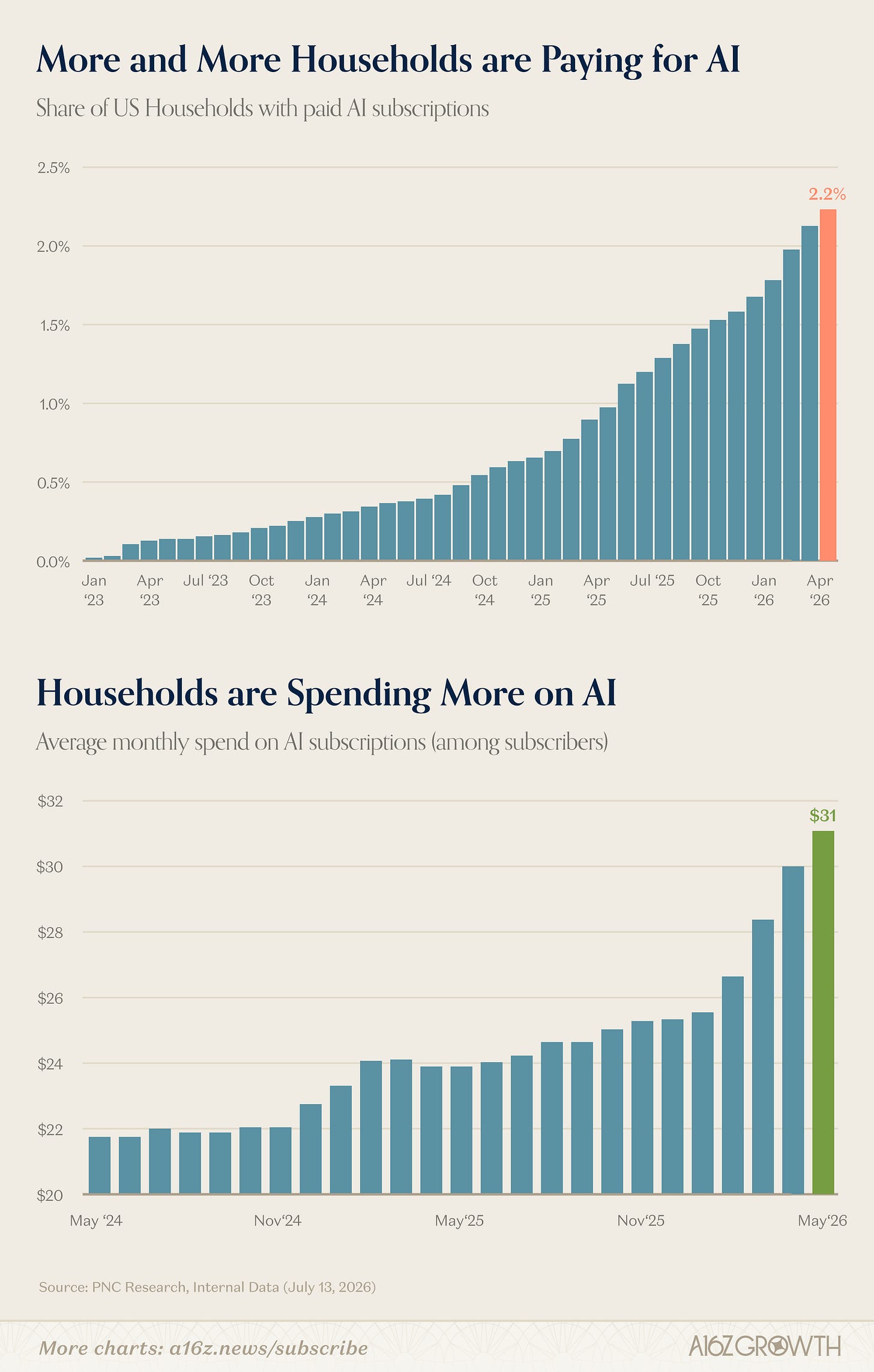
The truth is, AI solved computing. The right model, wrapper, and/or third-party product turns your device into an autonomous system that can automate tasks you used to pay top dollar for. Recent statistics suggest that only 2% of the American population pays for this advantage yet. I’d expect lower figures in most countries.
For the antis, this means few people are interested in paying for AI. Meanwhile, this figure has grown since it was reported in April. And here is the bigger picture;
-
Over 95% of the American population still has limited usage of AI; they will discover more possibilities with paid plans.
 Source: https://www.a16z.news/p/state-of-markets-ii
-
AI companies’ current revenue scope has yet to capture over 90% of the global population. As this scope broadens, narratives surrounding valuation and profitability could shift. CapEx is expected to rise in response to increased infrastructure demand, however.
-
US expense statistics are usually higher than the rest of the world; therefore, these projections could even be higher in a worldwide context.
I wouldn’t say you’re still early. I’d say, “AI is still early and has grown rapidly”; crypto too.
If you consider the highs and lows in the past 15 (fifteen) years, about $10 trillion in value has moved through the crypto markets. The biggest beneficiaries aren’t completely appealing; nevertheless, this idea has changed the way we look at finance forever. And I think government-controlled stablecoins will keep growing, no matter how “uncrypto” they are. Also, Bitcoin will find a footing at $100,000, if Satoshi’s wallet doesn’t wake up one day and dump on everyone.
An unspoken advantage for AI is that it attracted the brightest and most intentional minds early enough. Crypto, on the other hand, has endured mismanagement, manipulation, and fraud from the sector’s so-called custodians…and influencers. The early “anti-government” stance didn’t help; unfortunately, it didn’t stick either.
To take a stab at the raging question. Career-seekers should focus on a single sector; for anyone else, both systems are meant to co-exist…
To crypto is to embrace the most seamless and sovereign financial system ever built. Here, it is simple: explore crypto products that make your spending and investing easier. The only recommendation is to avoid gambling and mind the complexity of crypto security (keep your keys safe and hope your wallet provider doesn’t mess things up).
To AI is to accept that machines have moved from GIGO to Super Intelligence, and the only way from here is up. This one could be complex, and for everyone, the questions are many;
-
Does AI spell doom for humans?
-
How many jobs are safe?
-
What will AI’s impact be on human abilities, given the law of use and disuse?
-
Can a model spiral out of control, and how many AI conspiracy theories will prove true?
For a chance to attain god-level accuracy, I wish I could answer these questions. But even the absolute leaders in AI cannot answer them; neither are they 100% aware of the possible repercussions of what they are building.
Moreover, positive innovations never slow down to avoid negative results. The telephone wasn’t slowed down to save the Mailman and postal office workers’ jobs. The most remarkable outcome is life finding a way.
Unarguably, AI is markedly different, and I also think there should be a regulatory framework to at least, prevent the scare of the third question. Still, staying anti-AI because it is too productive is like counting on your fingers to avoid using a calculator.