Bienvenidos a la saga de historias, en este caso ha toca al antecesor de Linux, Unix. Espero que lo disfruten
¿Qué es Unix?
Unix es un sistema operativo creado en los años 70 por Dennis Ritchie y Ken Thompson en los laboratorios Bell de AT&T Fue diseñado para ser un sistema operativo portátil, versátil y flexible para su uso en diferentes plataformas de hardware. En los años 80, Unix se convirtió en un sistema operativo popular y fue ampliamente utilizado por empresas y universidades en todo el mundo.
Los problemas de Unix
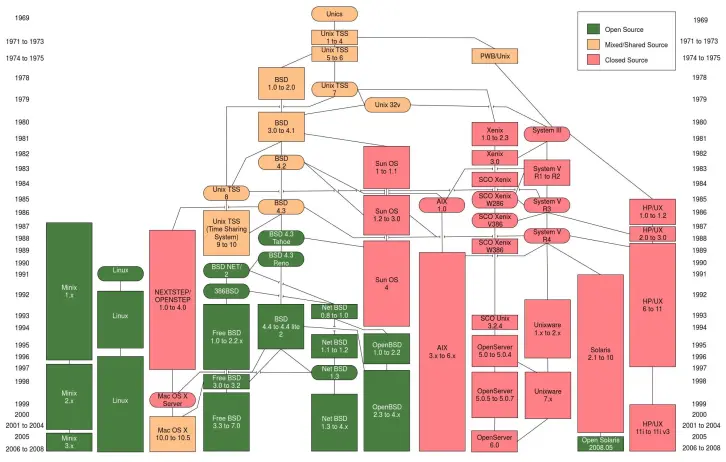
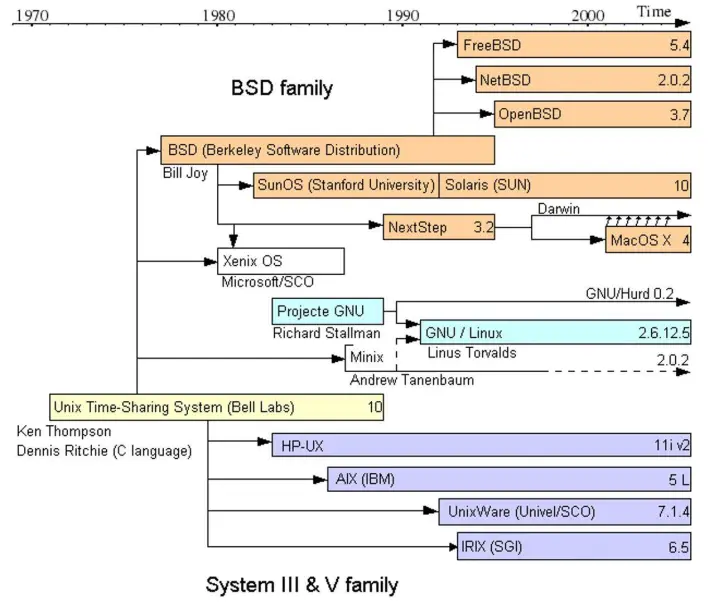
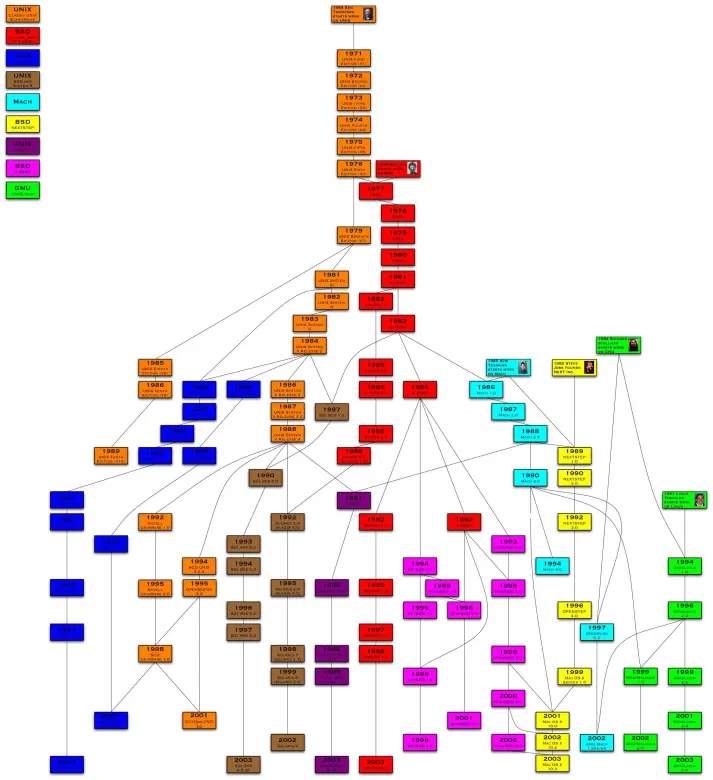
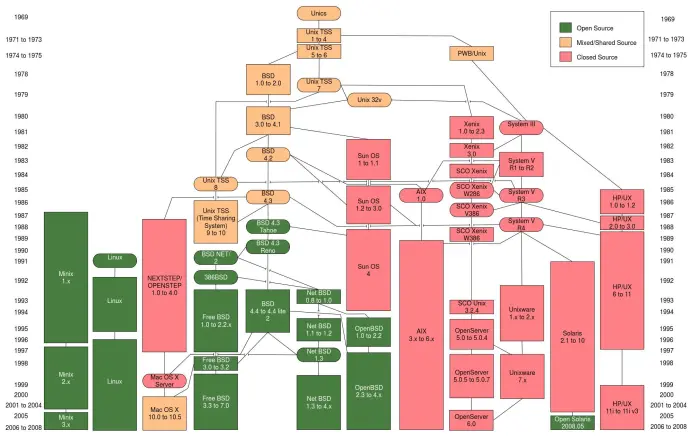
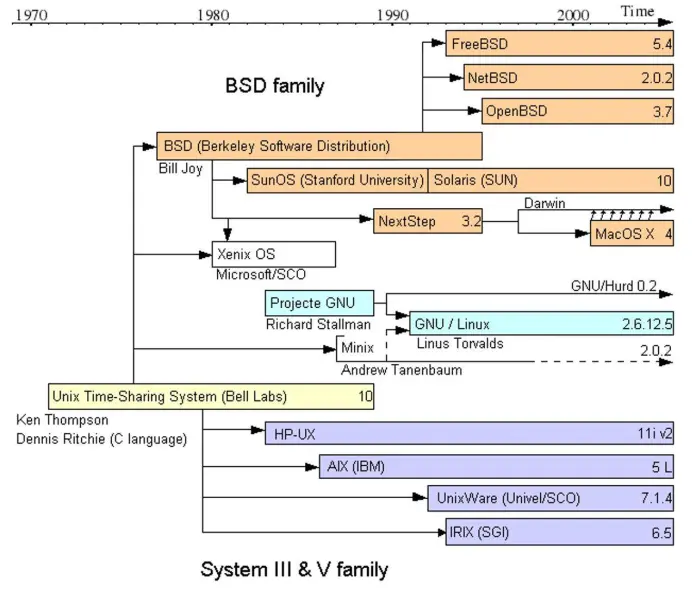
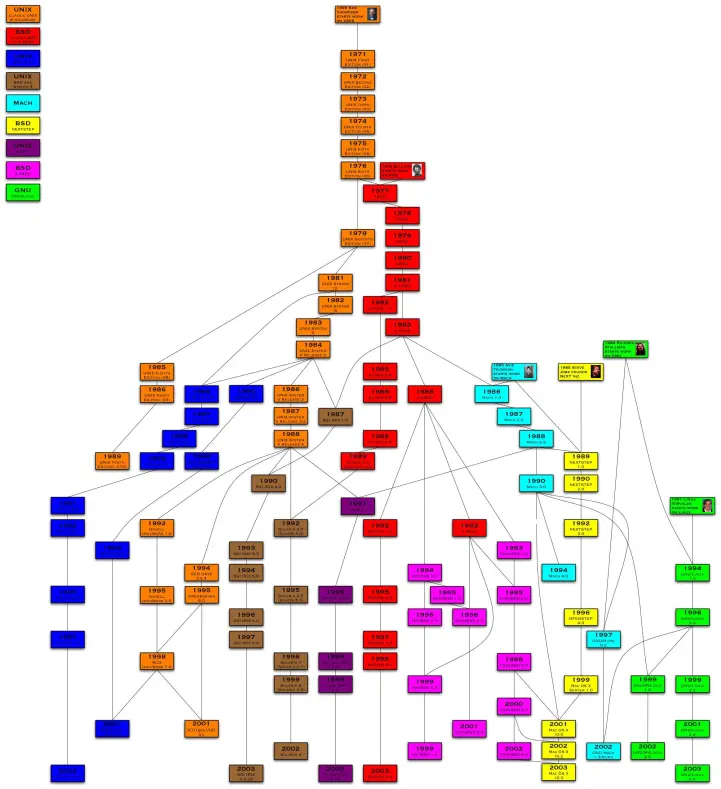
En un principio no había ninguna restricción para el uso del código fuente de Unix, este venía gratuitamente con la adquisición de los equipos de computo en aquel entonces; de manera que cualquier programador podía adaptarlo a sus necesidades, y por esta razón surgieron una gran cantidad de variantes (véase las imágenes que se adjuntan al final del articulo).
Pero todo cambio cuando los laboratorios de AT&T comenzaron a cobrar regalías para aquellas distribuciones que tenían carácter comercial o como en el caso de las universidades donde el código fuente se estudiaba libremente, esto provocó que ya no pudiera enseñarse en las universidades porque ahora el código fuente era de carácter comercial.
La llegada de MINIX
En 1987, Andrew S. Tanenbaum creó un sistema operativo tipo Unix llamado MINIX para su uso en educación y para enseñar la estructura interna de un sistema operativo. MINIX fue desarrollado como un sistema operativo modular, seguro y compacto con un núcleo en la memoria principal del sistema, y con los controladores y aplicaciones ejecutándose en modo de usuario. Sin embargo, MINIX no era libre y redistribuible como el software libre, lo que llevó a problemas legales en torno a su uso como material educativo.
Y Llega Linux
Esto llevó a Linus Torvalds, un estudiante finlandés, a crear su propio kernel de sistema operativo en 1991, inspirado en MINIX pero con la idea de crear un sistema operativo completamente libre. Este sistema operativo se convirtió en lo que hoy conocemos como Linux.
Linux comenzó como un proyecto de principiantes, pero rápidamente se convirtió en un proyecto de múltiples desarrolladores. A través de una comunidad de desarrolladores y usuarios comprometidos, Linux se convirtió en un sistema operativo completo y funcional. La idea de licenciar Linux bajo el modelo de copyleft, lo que significaba que era posible su distribución y desarrollo gratuito y libre, impulsó su popularidad en todo el mundo.
En definitiva, Unix es un sistema operativo ampliamente utilizado y fue influenciando significativamente el desarrollo de otros sistemas operativos, como Linux y MacOS. La creación de MINIX destaca la necesidad de libertad en el código fuente de sistemas operativos en el software educativo y la enseñanza; y el nacimiento de Linux demuestra cómo la comunidad de desarrolladores puede trabajar juntos en un sistema operativo completamente libre y entregar un producto final de alta calidad. Los problemas legales en torno a la redistribución y el uso de MINIX llevaron a la creación
Para que quede más claro, les presento la imagen proporcionado por esta página https://sites.google.com/site/nikos3194rfcindex/home/old-school/unix en el que aparece no solo los años sino también como fue desarrollándose Unix hasta dar con el nacimiento no solo de Linux sino también de MacOS. Espero que con eso aprendamos que así como es que por medio de Unix ha generado cambios en la historia de los Software y hardware que manejamos hoy en día. Dejen sus comentarios sobre estos datos tan interesantes. Hasta luego.
Welcome to the saga of stories, in this case it is the ancestor of Linux, Unix. I hope you enjoy.
What is UNIX?
Unix is an operating system created in the 1970s by Dennis Ritchie and Ken Thompson at AT&T Bell Laboratories. It was designed to be a portable, versatile, and flexible operating system for use on different hardware platforms. In the 1980s, Unix became a popular operating system and was widely used by companies and universities around the world.
Unix problems
At first there was no restriction for the use of the Unix source code, it came free with the acquisition of computer equipment at that time; so that any programmer could adapt it to their needs, and for this reason a large number of variants arose (see the images attached at the end of the article).
But everything changed when the AT&T laboratories began to collect royalties for those distributions that were commercial in nature or, as in the case of universities where the source code was freely studied, this meant that it could no longer be taught in universities because now the source code It was commercial in nature.
The arrival of MINIX
In 1987, Andrew S. Tanenbaum created a Unix-like operating system called MINIX for use in education and to teach the internal structure of an operating system. MINIX was developed as a compact, secure and modular operating system with a kernel in main system memory, and with drivers and applications running in user mode. However, MINIX was not free and redistributable like free software, which led to legal issues surrounding its use as educational material.
And Linux Arrives
This led Linus Torvalds, a Finnish student, to create his own operating system kernel in 1991, inspired by MINIX but with the idea of creating a completely free operating system. This operating system became what we know today as Linux.
Linux started out as a beginner's project, but quickly became a multi-developer project. Through a community of committed developers and users, Linux became a fully functional operating system. The idea of licensing Linux under the copyleft model, which meant that it was possible to freely and freely distribute and develop, boosted its popularity around the world.
In short, Unix is a widely used operating system and has been significantly influencing the development of other operating systems, such as Linux and MacOS. The creation of MINIX highlights the need for freedom in the source code of operating systems in educational software and teaching; and the birth of Linux demonstrates how the developer community can work together on a completely free operating system and deliver a high-quality end product. Legal issues surrounding the redistribution and use of MINIX led to the creation
To make it clearer, I present the image provided by this page https://sites.google.com/site/nikos3194rfcindex/home/old-school/unix , which shows not only the years but also how Unix was developed until give birth not only to Linux but also to MacOS. I hope that with this we will learn how Unix has generated changes in the history of the Software and hardware that we handle today. Leave your comments on these interesting facts. See you later.