
Gacha Machines - A Brief Overview
Gacha machines, or gachapon, are coin-operated toy dispensers that are filled with a large selection of limited edition goods that vary in value and quality and are typically sought after by collectors. These toys are not just meant for children, as they can contain content related to favorite anime and manga, video game franchises, or even pop idols. You insert a coin, spin the crank, and out comes something pseudo-random; it could be a duplicate of something you already have, or maybe even something super rare and valuable, you never really know until you give it a whirl. The fun is not knowing what you will get, and it remains fun so long as you are financially responsible that is.
DokiDoki.Finance - An Ecosystem
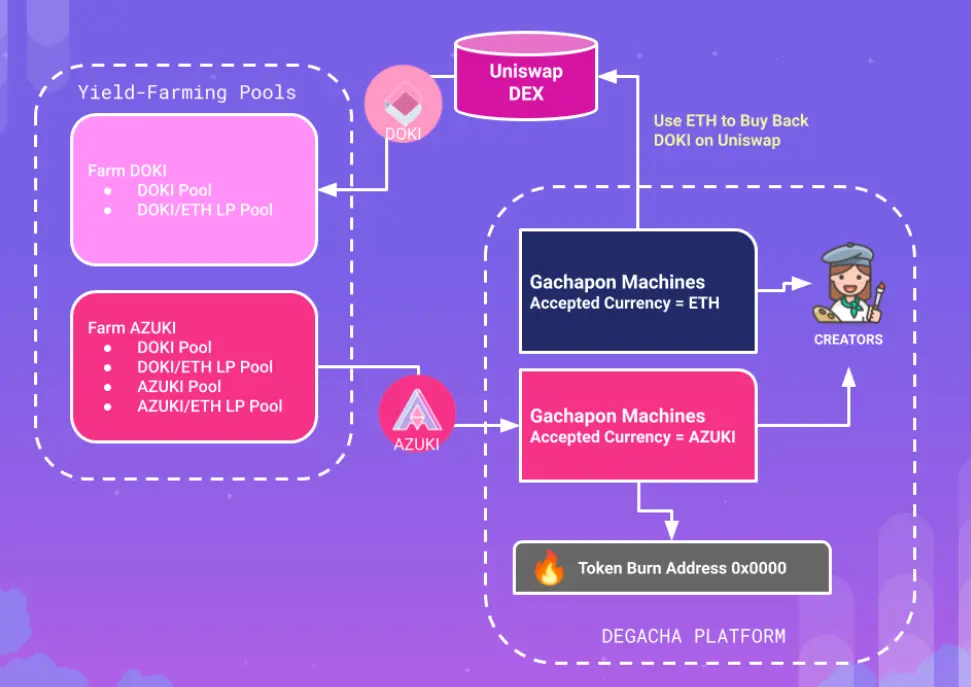
Degacha is taking the concept of gachapon to its next level, bringing it to the digital age via the technological revolution of Decentralized Finance (DeFi), encapsulating the spirit of gachapon in a Decentralized Application (Dapp). Instead of dispensing toys, degacha dispenses Non-Fungible Tokens (NFTs), which are ERC-721 tokens that are each individually unique with respect to each other, in contrast to fungible tokens such as Ethereum or Bitcoin. Recently, artwork has been represented via these NFTs to ensure both authenticity of the art, such as ensuring that they are minted, or created from a genuine source, and ensuring that each individual minted piece of artwork remains unique. These NFTs typically store metadata that hold the name, description, and the Universal Resource Identifier (URI) to an image or video associated with the NFT. To ensure that the media associated with the NFT will never expire, they are not hosted on a centralized server, but instead on the InterPlanetary File System (IPFS), which serves as a peer-to-peer (i.e. decentralized) network that provides many advantages over your standard solutions, such as the elimination of duplication of content and providing longevity from not having a single point of failure, i.e. as a centralized server would. This ensures that even long after DokiDoki.Finance is gone, assuming it ever was to go anywhere, your NFTs remain safe. Ultimately, DokiDoki.Finance is providing a Gacha-as-a-Service (GaaS) model to allow artists to monetize and 'gachify' their artwork through these degacha machines. NFTs are being used in a wide variety of domains, from artwork to virtual game assets and property, to even fractionalized real estate, and so the sky is the limit when it comes to just how much utility the GaaS model can provide.
Tokenomics
DokiDoki.Finance provides two tokens, $AZUKI and $DOKI, each serving its own purpose. Both tokens are ERC-20, and are therefore fungible, hence 1 $DOKI = 1 $DOKI and 1 $AZUKI = 1 $AZUKI. Degacha machines can accept either $AZUKI or $ETH, which is decided by the artist, with the exception that official DokiDoki branded degacha machines will always use $AZUKI.
$DOKI [Medium]
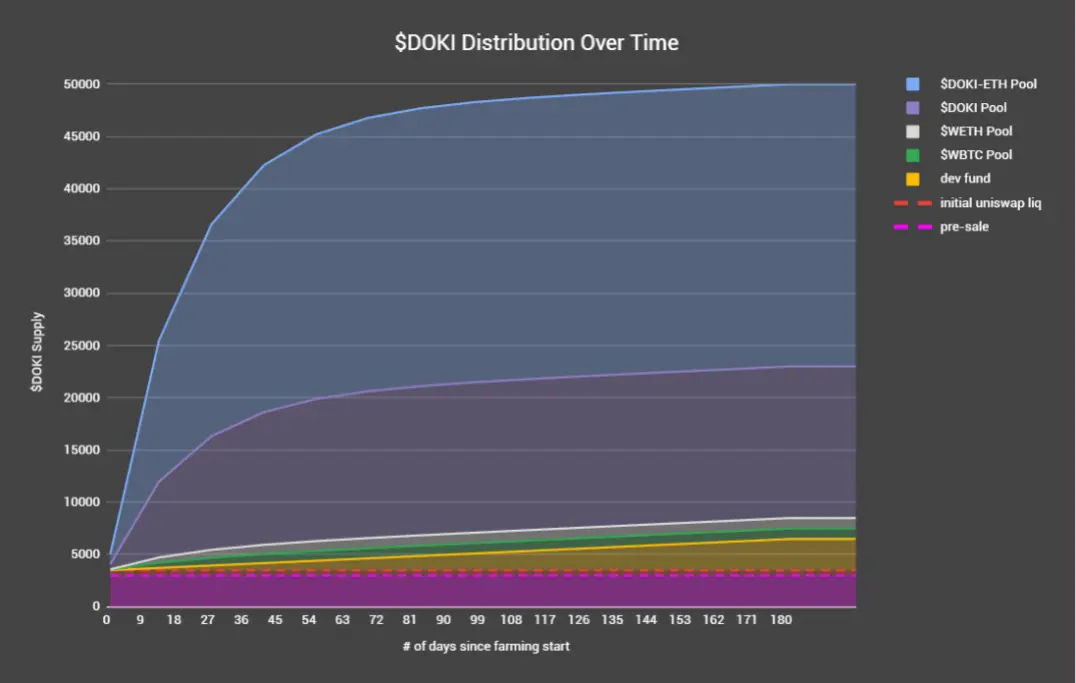
$DOKI has a total supply of 50,000, which would make it extremely valuable in the future. 3000 $DOKI were distributed evenly among 200 pre-sale investors, with 500 $DOKI provided as Uniswap liquidity. 3000 $DOKI were vested over the span of 6 months for development funds. From here, the remaining 43500 $DOKI are minted via staking in the official pools, in which the rewards are halved every two weeks.
$DOKI has additional intended functionality but is not yet implemented. One such feature is governance, or the ability for the community to vote using their $DOKI tokens, where 1 $DOKI constitutes one vote. While this gives an advantage to early investors, it is typically the way to ensure the project is run entirely by the community and can become a Decentralized Autonomous Organization (DAO). Another unimplemented function is the buy-back of $DOKI tokens, which does not leave much utility in holding on to $DOKI other than for the potentially rising price and potential scarcity as DokiDoki.Finance grows in size.
$AZUKI [Medium]
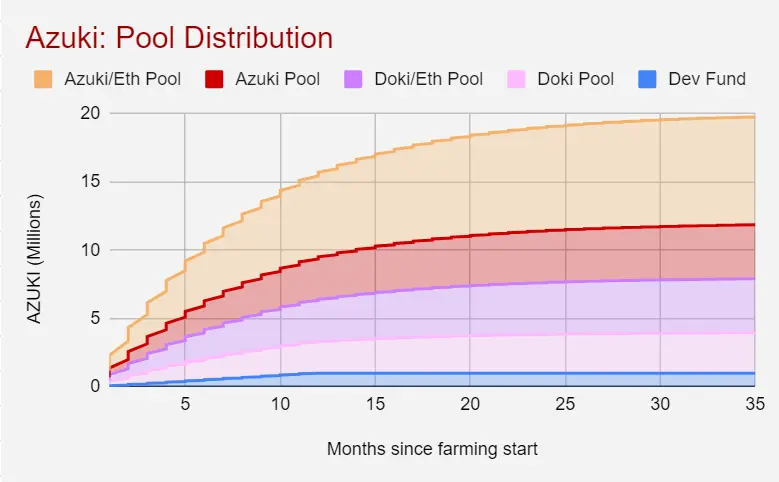
$AZUKI has a total supply of 40,000,000, with 1,000,000 $AZUKI to be vested over 1 year for development funds, 20,000,000 $AZUKI reserved for marketing, collaborations, and partnerships, and the remaining to be distributed via staking rewards over the span of 2 to 3 years, decreasing by 6% every two weeks. $AZUKI is deflationary in that 5% is burned on transfers (swaps, transfer between wallets, etc.), and 50% of $AZUKI is burned when used in the degacha machine.
NFT Rarity

The NFTs available from the degacha machines have their own rarity, which influences the number of the NFT stored in the machine, as well as the potential value based on its scarcity. Some artists prefer to use Common, Uncommon, Rare, and Very Rare, but this article will focus on the official DokiDoki.Finance rarity. Unlike your typical 5 star rating, there are 6 stars that an NFT can have that dictate its rarity, starting with 'rare' being the most common, going all the way up to 'legendary rare'.
Note: To view the animations of the NFTs, you may need to click/tap on them.
Rare [R] (Animated)
Super Rare [SR] (Animated)

Ultra Rare [UR] (Animated)

Mystic Rare [MR] (Animated)

Ethereal Rare [ER] (Animated)

Legendary Rare [LR] (Animated)

Layer 2 Overhaul on the Matic Network
Due to excessive gas fees on the Ethereum mainnet (Layer 1), the Degacha machines were overhauled to operate on the Matic network (Layer 2), bringing a reduction in overall gas fees by 100,000x
Also, brought with it, is a new rendition to the degacha website.
Degacha Machine Contents - NFTs
Pixelated Retro Japan by Eiko
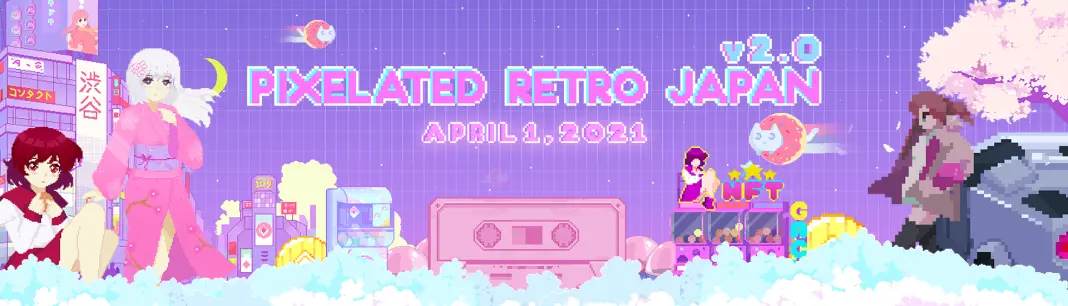

The original and official machine, which was originally launched back on December 14th, 2020, and locked until DokiDoki.Finance migrated over to Layer 2 via the Matic network. The masterful artwork is produced by Eiko, an in-house artist and part of the DokiDoki Team. Not much is known about Eiko other than their amazing talent, but they are responsible for most of DokiDoki.Finance User Experience (UX). These machines cost 20 $AZUKI, about $30 per spin at the time of launch. These machines are filled with more common variety, which makes it extremely unlikely to obtain the extremely rare NFTs. Despite being open for almost a week, and also having been released in the past, there are still Legendary Rare 'LR' NFTs available. Still, a large portion of the machine has been bought up already, and it will undoubtedly empty slowly but surely. New NFTs were added to the re-release as well, such as the second set of NFTs in the showcase below. More information can be seen here.
Showcase [Animated]

Loyalist by Eiko
Produced by Eiko again, these NFTs are given, in various ranks, based on loyalty points, rewarded through the loyalist program. Essentially, the loyalist program is a way for enthusiastic members of the community to earn brownie points- err, I mean loyalty points, by reporting things you did, from retweeting, creation of memes, screenshots of feedback/suggestions to improve the community, to even, you guessed it, writing an article! Based on the rewarded points, you can be eligible for exclusive Loyalist NFTs, such as showcased below.
Showcase [Animated]

CryptoChibis by Meowyen [Instagram, Pixiv, DeviantArt, Twitter]
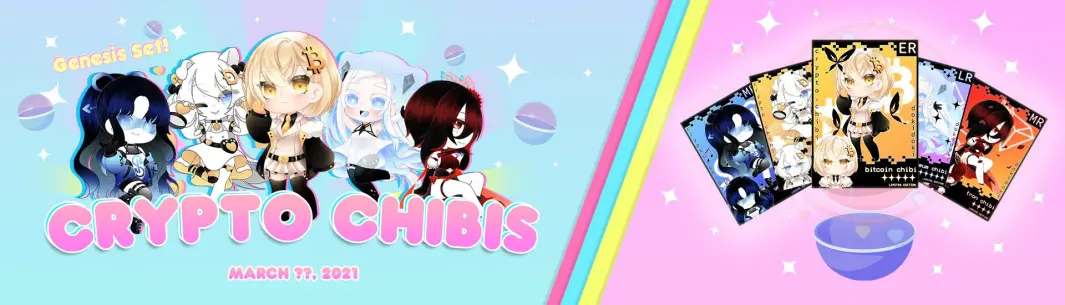


CryptoChibis, created by Meowyen, features chibi anime personifications of some, or all, of your favorite cryptocurrencies, such as Ethereum, Dogecoin, Bitcoin, Yearn.Finance, and Tron, all embedded in cards with variety. Unlike the official DokiDoki NFTs, the less rare variants of cards do not have as much animation as the more rare ones, makes the distinction more obvious in terms of their value. CryptoChibis was released spontaneously one Saturday morning (10 AM EST) with only 1-hour of an announcement, and yet still sold out within 3 hours. Over 2510 NFTs were sold, for 60 $AZUKI a spin, which at the time was about $100 per spin, racking up $250,000+ in sales for the artist. A quarter-million in the span of 3 hours!
Showcase [Animated] (Lossy Conversion from mp4 to a 2MB gif; visit `Source` for full resolution/frame rate)
LofiDreams by SeerLight (Coming Soon) [Twitter, Card]
Liquidity Mining (a.k.a. Yield Farming)
The DokiDoki Finance ecosystem is still in its early stages, and so liquidity mining, also known as yield farming, is still relatively lucrative. Liquidity mining requires the user to provide what is known as liquidity, which is the ease with which one asset, such as $AZUKI, can be converted into another asset, such as $ETH, without impacting the price. Tokens are generally paired, such as $AZUKI and $ETH, denoted as $AZUKI-$ETH, where liquidity is provided by depositing equal values of the pair in a liquidity pool. For example, if 1 $ETH is worth 1500 $AZUKI, then both 1 $ETH and 1500 $AZUKI can be deposited into the liquidity pool to provide that much liquidity, thereby becoming a liquidity provider (LP). In return for providing liquidity, a proportional amount of LP tokens are minted, or created, and returned that keep track of the overall share of the liquidity pool that the LP holds. The number of LP tokens is proportional to the overall liquidity, that is the amount of liquidity being added to the pool relative to the overall liquidity already available in the pool, and so, generally, the earlier you provide liquidity the more LP tokens you receive in return. These liquidity pools are typically managed by automated market makers (AMM) such as Uniswap or Sushiswap, which also algorithmically determine the prices of assets and enforce a small liquidity pool fee on each interaction with the liquidity pools, i.e. 0.3% on Uniswap, in which gets distributed to LPs based on their overall share of the liquidity pool (LP tokens).
There are risks to providing liquidity, especially for a growing project, which occurs if the prices of the tokens in the pair happens to change relative to each other, i.e. if the price of $AZUKI increases relative to the price of $ETH. The local prices of $ETH and $AZUKI are determined, algorithmically, by their ratio in the pool (x * y = k i.e., x is the amount of $ETH and y is the amount of $AZUKI and k is a fixed constant) not by the external market price, opening the door for arbitrage, which is the exploitation of the differences in prices between different markets. Arbitrage can result in funds being drained from the liquidity pool, which is called impermanent loss. To offset these risks and incentivize being an LP, projects typically provide high annual per year (APY) returns on staking LP tokens. This not only helps in easing the minds of the more cautious members from suspecting the project of being a rug pull, which is what happens when an individual or group provides all of the liquidity and removes it, preventing anyone from making trades, but also tends to significantly increase the amount of liquidity available and limits the financial burden on the project developers and maintainers. Liquidity mining of $AZUKI is available in multiple places, and when done right can yield some absurd levels of profits that may even constitute a new passive income, albeit with a large upfront cost.
Comethswap [Medium]
Cometh is a strategy game where players control spaceships (NFTs) with the intention to steer their vessel towards "smart astroids", which are smart contracts that can be mined for Ethereum and ERC-20 tokens once near enough. As part of Cometh's ecosystem, it comes with its own Layer 2 DEX called Comethswap. Liquidity mining is available for $AZUKI-$WETH and $AZUKI-$MUST pairs for weekly distributed rewards in $MUST, the governance and utility token of the Cometh ecosystem used to purchase spaceships, perform in-game actions, and more. In the future, as well, unique variants of Cometh spaceships will become available via a degacha machine as part of this DokiDoki.Finance and Cometh partnership.
Quickswap [Medium]
The first Layer 2 DEX's to feature $AZUKI was Quickswap, a signature of Matic network. Quickswap provides liquidity mining events. Currently, there are pools for $AZUKI-$ETH and $AZUKI-$QUICK, rewarding users in $QUICK, the governance token for Quickswap.
Linkswap [Medium]
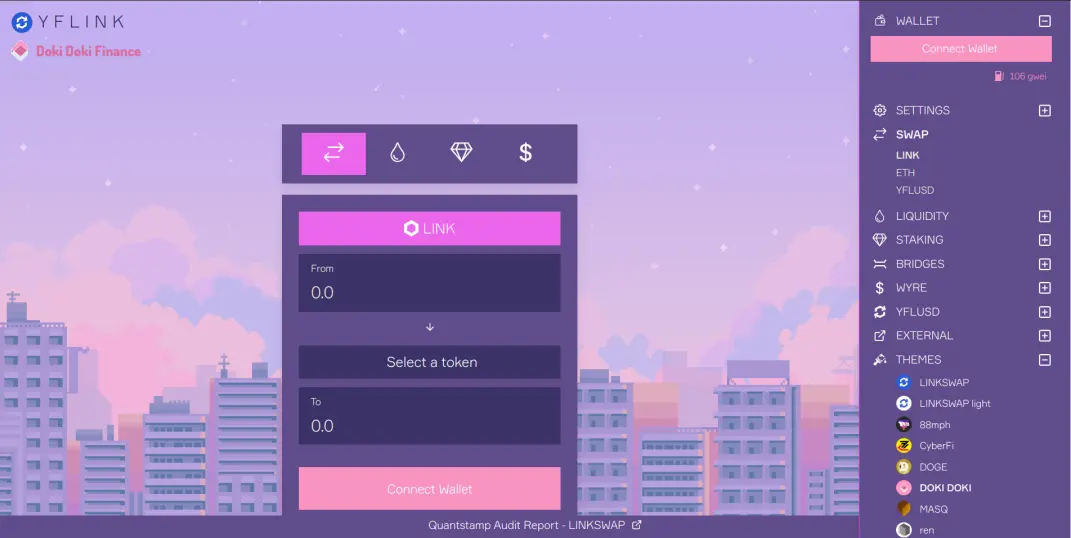


One of the early collaborations, this time between DokiDoki.Finance and YFLink, providing $AZUKI-$LINK and $DOKI-$LINK liquidity mining awards, and unlike others, provides $AZUKI as a daily reward. This partnership resulted in both a unique theme and (animated) NFTs. The rewards are more lucrative than staking directly through the DokiDoki Finance Dapp.
NFT Marketplaces
OpenSea.io [Ethereum Network, Matic Network]
OpenSea.io is the largest NFT marketplace, with a large variety of projects, including DokiDoki's. So far, there has been a total of 86.719 $ETH traded, estimating around $200,000, with the highest sale being 2.5 $ETH, estimated around $5,000, from the Pixelated Retro Japan degacha machine, which has an estimated $30 per spin. Transferring NFTs from the Matic network to the Ethereum network will cost some gas, but batched transfers can cut down this cost. As well, DokiDoki NFTs can directly be sold on OpenSea on the Matic network, eliminating most of the fee required.
NFT20.io [Ethereum Network]
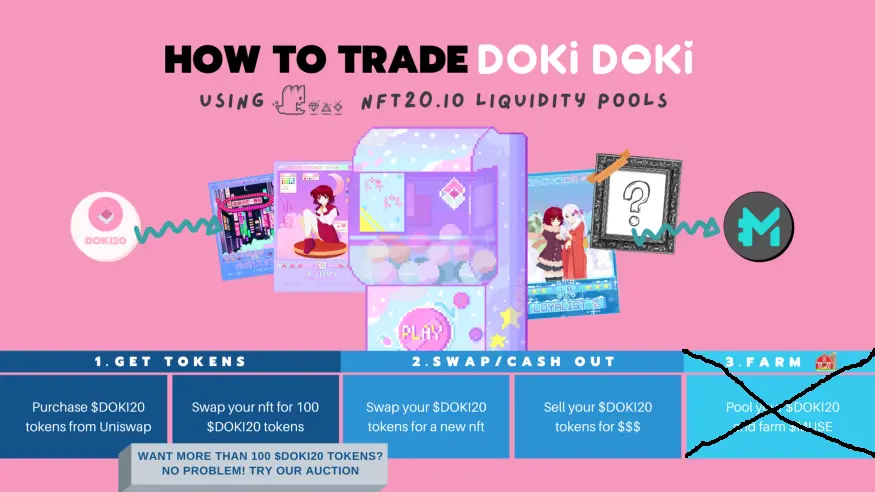
NFT20.io is a DEX for tokenizing the value of individual non-fungible ERC-721 tokens, in this case being DokiDoki NFTs, as fungible ERC-20 tokens, in this case being $DOKI20. The idea is to swap your NFT for an equivalent amount of $DOKI20 tokens, which can then be exchanged elsewhere, such as on Uniswap, for other tokens such as $ETH. This has the effect of making your NFTs more liquid and can be especially handy for scrapping NFTs of the more common variety. NFTs can be directly scrapped for 100 $DOKI20, which is depending on the degacha machine, may be far cheaper than what was actually paid in $AZUKI. NFT20.io provides the ability to hold an auction for specific NFTs, where users can bid on your NFT using $DOKI20, making it useful for selling the less common variety for more $DOKI20.
Prior to a recent proposal, it was once possible to provide liquidity for $DOKI20-$ETH and stake those LP tokens for $MUSE, NFT20.io's governance token, but due to limited resources, this right has been reserved for only the top projects. This has lead to a massive loss in liquidity at the posting of this article, as much as 80%, and in price, as much as 66%, in a single day (March 30th, 2021 to March 31st, 2021), which is slowly recovering. It is the author's hope that the DokiDoki development team provides their own incentive for providing liquidity for $DOKI20-$ETH, perhaps with its own liquidity mining campaign, as the utility provided by $DOKI20 or equivalent is invaluable.
Causes for Concern
As with all good, there is some bad, although quantifying just how 'bad' something varies from person to person. There are a few things that I hope that DokiDoki.Finance will eventually address, as I believe it has a significant amount of potential.
Anonymous Development Team
Currently, the only thing known about the development team is just the names they go by, and that a majority, if not all of them are located in Japan. Typically, I would pass on a project where the developers of the project are not known, but there is clearly enough passion behind the project to at least make it appear that the development team is authentic. Potential investors may be put off by the lack of accountability if the project were to go awry in any way.
Lack of Audits for Smart Contracts
The developers are rather adamant about avoiding obtaining proper auditing of their smart contracts for a very long time now, which is a major red flag for me.
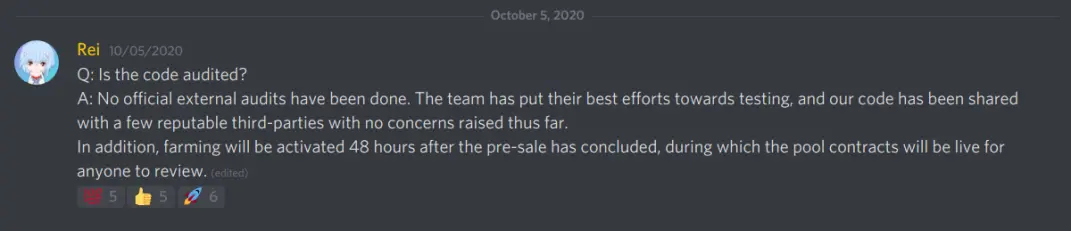
Official auditing has been 'planned' but it is unclear if there is a timeframe for when this happens. I genuinely hope that this is due to the programmer's pride in their code, which hopefully will goeth away before a fall, i.e. an exploited smart contract.

Curation of Content Creators
There are some questionable picks in content creators that, in my humble opinion, do not fit the theme of DokiDoki.Finance, at all, and, to me, are of low-quality. I genuinely like DokiDoki.Finance and want it to see it grow, and so I will be frank and honest when I say this: Allowing the community to curate the content can prevent low-quality NFTs from being produced, as low-quality NFTs only bring down the entire quality of the project and make it difficult to take the project seriously. I hope that once $DOKI governance tokens are implemented, the token holders are able to curate and determine who makes it and who doesn't. A list of all NFTs so far can be found on OpenSea. There are some potentially redeeming events, such as the "DokiDoki NFT Series Contest", which is a competition among artists to compete for top prizes: 1st place receives $6,500 and gets a Degacha Machine; 2nd place receives $2,500; Community-Vote for $2,000; Maximum of 5 semi-finalists to receive $200. Each participant is judged by both the team and the community based on oh well they fit the theme 'heartbeat' (hint: 'Doki Doki' is the sound a heart makes), originality, style, animations, and on the lore of the artwork. Contests like this not only make artists work for a degacha machine but also ensures that only the best and most talented make it, essentially solving the issue of low-quality NFTs. It is with the hope that such curation and competition will ensure that DokiDoki.Finance becomes known solely for top-quality degacha machines.
Conclusion
Despite some potential red flags, I am still extremely confident, and dare I say bullish, on DokiDoki.Finance in the future, and in particular for its Gacha-as-a-Service model. The perks of having a degacha machine of your own, as an artist, is both publicity and monetary gain. I hope to remain a part of the DokiDoki.Finance community for at least a while longer and to see it grow, helping wherever I can. Interested folk can visit the following resources:
Degacha: https://degacha.com/
Application for Artists: https://share.hsforms.com/1iYLdmZrlSnuMooI6YTPBlw5mlic
Collaboration Information for Artists: https://docs.google.com/presentation/d/1AoKn84QLoJ0evHO1ZoV79HaZpS7l33GA2L4Z-oLwvbM/edit






