
I promised a part two from Mark Wilham on the GoVoteX Infinity project, so here it is.
Part Two: The Mechanics, Money, and the Questions Ahead
If GoVoteX Infinity is ultimately going to accomplish what its creator envisions, the most important question is no longer whether people want greater government accountability. The question is whether the proposed system can translate that desire into a functioning, secure, and legally viable mechanism.
The project’s answer begins with technology.
GoVoteX Infinity proposes using a decentralized directed acyclic graph, or DAG, rather than relying exclusively on conventional centralized election infrastructure. Its documentation describes a system in which a user account would correspond to a single voting identity, with cryptographic keys used to establish authenticity and help identify fraudulent or duplicate accounts.
The intended result is a voting system designed to be difficult to manipulate while providing a transparent record of activity.
Artificial intelligence would also play a supporting role, according to the project's documentation. AI would monitor voting activity for unusual patterns and potential anomalies, but would not control the voting process itself. In the project's philosophy, technology is the tool; authority remains with the people.
The more controversial component, however, may be what happens **after** a vote.
GoVoteX Infinity proposes allowing the public to initiate a process that could ultimately remove a government official from office based upon majority support. The project's revised model adds a preliminary stage, including a community-funded opening fee and a pre-vote process intended to establish whether sufficient public interest exists to move forward.
That requirement reflects an apparent attempt to balance two competing concerns: giving citizens meaningful power while preventing an individual or small group from repeatedly triggering removal proceedings without substantial community support.
The financial model is equally unconventional.
The project proposes an initial application fee, limited free voting, and subsequent per-vote charges. It also envisions Millix (MLX) as a payment mechanism within the ecosystem. According to the project, these funds would help finance administration and other services associated with the system.
That creates another major question: **Can a system intended to democratize political accountability remain independent when money is required to operate it?**
GoVoteX Infinity argues that even modest fees can give participants “skin in the game” while providing the financial resources necessary to maintain the infrastructure. Critics, however, could reasonably ask whether fees might discourage participation or create unequal access.
There is also the larger legal and institutional challenge.
The project openly acknowledges that government itself may not voluntarily adopt a system capable of removing its own officials outside established procedures. Its proposed answer is essentially to build public adoption first.
That is an ambitious strategy.
For GoVoteX Infinity to become more than a technological experiment, it would need to demonstrate not only that its voting infrastructure works, but that its accountability mechanisms can withstand questions involving identity, cybersecurity, privacy, election law, constitutional protections, jurisdiction, political opposition, and public trust.
Those are formidable obstacles.
Yet they also reveal what makes the project unusual. GoVoteX Infinity is not simply asking whether electronic voting can be made more secure. It is asking whether citizens can be given a more continuous role in determining whether the people occupying public offices should remain there.
Whether that vision is practical, legal, or ultimately scalable remains to be demonstrated.
But the central question is difficult to dismiss:
**What would government look like if public officials knew that accountability did not begin at the next election—and could not simply wait until then?**
by Mark Wilham
Author & Futurist
[email protected]
PLEASE COMMENT YOU THOUGHTS AND IDEAS.
Want to learn more about the GoVoteX Infinity project, visit: https://govotexinfinity.org
Original article post: https://michaelsoneffect.blogspot.com/2026/08/govotex-infinity-testing-accountability.html
Read part one: Is Lady Liberty in trouble?
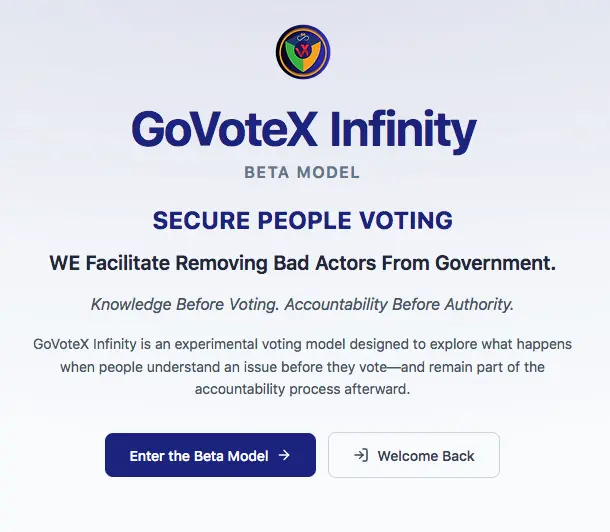
This article takes a look at GoVoteX Infinity and what they're trying to build.






