
AI is becoming cheaper, more accessible, and easier to use.
Recently, B.AI, launched by Justin Sun, has drawn attention as a unified API service that allows developers to access different AI models through a single interface instead of integrating with each model provider separately.
The rise of AI API aggregation platforms points to a rapidly emerging market:
Access to AI is becoming a business of its own.
But beyond API fees, another potentially more valuable resource is being generated with every AI interaction:
Data.
1. Every Time You Use AI, You Are Also Creating Data
We usually think of AI as a service.
You enter a prompt, and AI returns an answer. You call an API, and a model completes a task.
But from a data perspective, every interaction can generate valuable information:
- Prompt Data: What are people asking for, and what do they need?
- Behavioral Data: How do people use AI and complete tasks?
- Preference Data: Which answers are accepted, modified, or rejected?
- Professional Data: What high-value knowledge is being generated across industries, professions, and real-world use cases?
This means there is another, less visible value chain behind every interaction between users and AI:
User → AI Interaction → Data → Model / Application → Commercial Value
As AI models become more powerful, compute may not be the only scarce resource.
Authentic, continuous, high-quality data is also becoming a critical resource in the AI economy.
That raises a bigger question:
If data is generated by real people, should the value created from that data also belong, at least in part, to the individuals who contributed it?
2. The More AI Depends on Data, the More Data Sovereignty Matters
Today, most users have become accustomed to a familiar model:
Use a Service → Generate Data → Platform Manages Data → Platform Creates Value
Users are the source of the data, yet they often have limited visibility into how that data is used — and even less ability to participate in the value it may ultimately create.
As AI expands further into search, work, education, healthcare, finance, consumer services, and AI Agents, this issue will only become more important.
The question of the future may no longer be simply:
How do we protect data?
It may also include:
- Who owns the data?
- Who can authorize its use?
- How can privacy be protected?
- Who shares in the value it creates?
This is where Data Sovereignty takes on a deeper meaning in the AI era.
True Data Sovereignty is not simply about keeping data hidden. It is about giving individuals greater control over the identity, consent, privacy, and value participation associated with their data.
3. If Data Creates Value, Can Contributors Share in It?
This could give rise to an entirely different model for the data economy.
The traditional data value chain often looks like this:
Individual → Platform → Data → Commercial Value
In the future, it could evolve toward:
Individual → Consent → Privacy-Preserving Data → Authorized Usage → Value Distribution
The key difference is that individuals are no longer merely passive sources of data.
With appropriate privacy and compliance mechanisms, users could decide whether their data may be used. Developers and applications could access processed, de-identified, or privacy-preserving data. And when that data creates real economic value, contributors could potentially participate in how that value is distributed.
But one critical piece of infrastructure is still missing:
How can we verify that data comes from a real, unique, and verifiable person without exposing that person’s sensitive identity information?
This is where decentralized digital identity can play an important role.
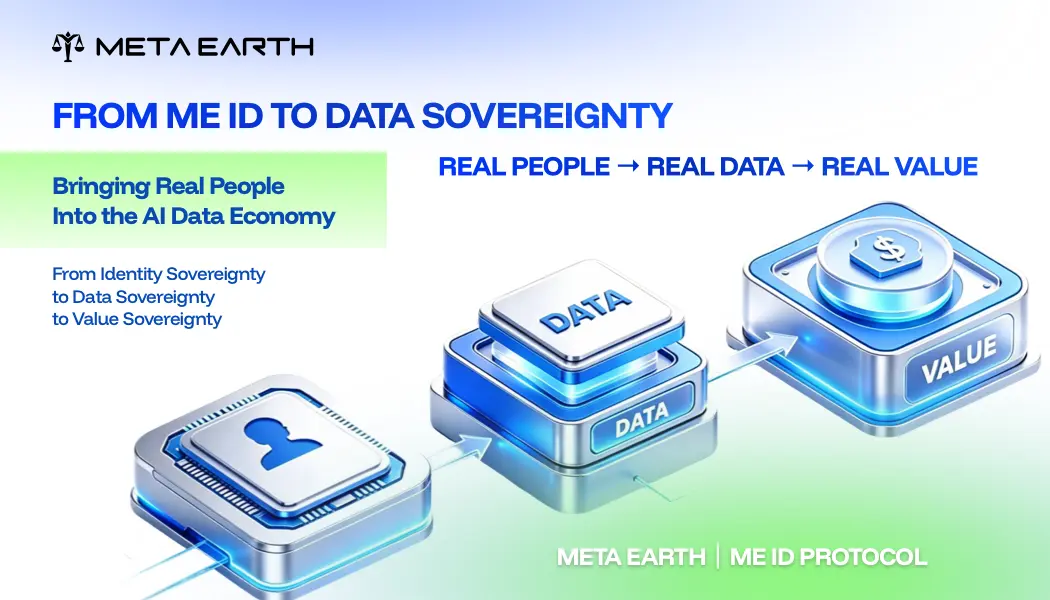
4. From ME ID to Data Sovereignty: Bringing Real People Into the AI Data Economy
This is also one of the potential areas of value that Meta Earth is exploring through ME ID Protocol.
ME ID Protocol combines DID, Proof of Personhood (PoP), KYC, Verifiable Credentials (VC), and privacy-preserving technologies, allowing digital identity to become more than a way to prove “who I am.”
It can serve as a trusted identity layer connecting real individuals with the digital world.
Built on this identity foundation, developers can further explore new types of data applications:
ME ID → Proof of Personhood → User Consent → Privacy-Preserving Data → Authorized Usage → Value Distribution
For example, with explicit user consent, applications could process data through de-identification or other privacy-preserving mechanisms before making it available for AI training, model optimization, research, or other legitimate data use cases in a secure and compliant manner.
ME ID Protocol can help establish an important foundation:
Proving that data comes from a real person does not have to mean revealing who that person is.
If that data ultimately creates real economic value, developers could further design contribution-based value distribution mechanisms, giving individuals the opportunity to move from being simple data providers to becoming participants in the value their data helps create.
The AI era is redefining many things.
Models are redefining productivity. Agents are redefining human-machine collaboration. And the next thing that may need to be redefined is the relationship between individuals and their data.
The most important question of the future may not simply be:
How much more data does AI need?
But rather:
When everyone’s data can create value, who owns it, who authorizes its use, and who should share in the value it creates?
From Identity Sovereignty to Data Sovereignty, and ultimately to Value Sovereignty, Meta Earth aims to use ME ID Protocol to bring real people back to the center of the digital economy’s value chain.





