
How Jane Street Built a Financial Empire and Why the World Finally Learned Its Secrets
In the world of finance, traditional brands reign supreme: Goldman Sachs, JP Morgan, Morgan Stanley. Meanwhile, in the deep shadows of the world's stock exchanges, a trading machine was born that outearns them all, handles every tenth stock transaction in North America, and dictates liquidity conditions for virtually every asset on Earth. This is the story of Jane Street Group-a financial giant that avoided newspaper headlines for a quarter of a century until secret leaks, record lawsuits, and international political scandals dragged it into the light of day.
Born from Poker and Math: Roots in Susquehanna (1987–1999)

Traditional Wall Street in the late 1980s relied on instinct, floor shouting, and so-called "market feel." In 1987, a small firm called Susquehanna adopted the exact opposite premise: gut feelings and emotions were a flaw, not a virtue. It pioneered a culture where every trade was treated like a hand of poker. Newly hired analysts, instead of reading stock charts, spent weeks playing poker with firm partners, learning risk discipline and probability estimation under pressure. During Black Monday in October 1987, when the Dow Jones plunged by 22%, Susquehanna made a fortune.
Three young traders trained in this unique school: Rob Granieri, Tim Reynolds, and Michael Jenkins. After more than a decade, they concluded that they had mastered the method to perfection and no longer needed their employer. On August 31, 1999, they left Susquehanna to set out on their own.
Architecture of Invisibility and the OCaml Foundation (1999–2005)
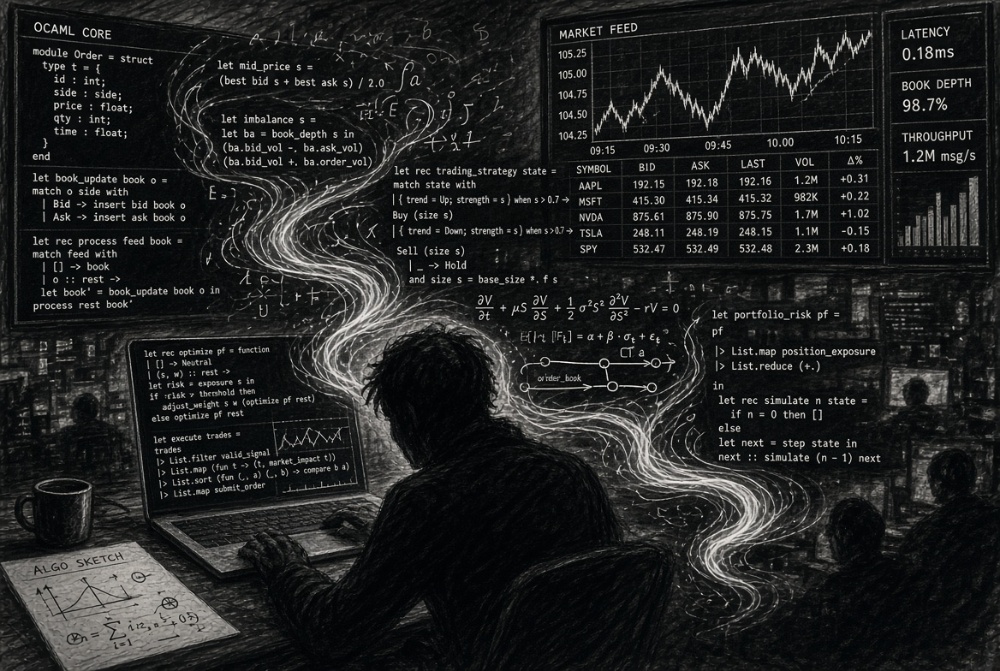
A fourth partner joined the trio-IBM programmer Mark Gerstein. In 1999, making a software engineer a full equity partner was unprecedented on Wall Street. It signaled a fundamental shift: technology would become the trading itself. The firm was deliberately given a neutral name-Jane Street-without the creators' names on the letterhead. The goal was making money, not gaining notoriety.
Initially, the firm made a living collecting fractional price differences on American Depositary Receipts (ADRs)-buying cheaper in New York and selling higher in local markets. Scraping penny margins repeated thousands of times a day turned into millions. However, the entire operation was held together by handshakes and relied on complex Excel spreadsheets.
In 2003, Dr. Yaron Minsky, a scientist from Cornell, joined the team. He made a radical decision: he abandoned traditional programming languages and rewrote Jane Street's entire architecture in OCaml, a niche academic language. OCaml eliminated entire categories of code bugs and was so rigorous that it resembled mathematical notation. Jane Street became the largest commercial user of OCaml in the world, gaining two advantages: its systems were blisteringly fast and stable, and competitors couldn't steal their code because no one else knew how to run it.
The ETF Revolution and the 2008 Crash: Proprietary Tollbooths
When ETF (Exchange-Traded Funds) popularity exploded in the 2000s, Jane Street saw them as the ultimate gold mine. Every ETF has two price dimensions: the market price of the fund itself and the combined market value of the underlying stocks held within it. These two values constantly drift apart. As an Authorized Participant, Jane Street stood right in the center of this mechanism: it bought the cheaper basket of stocks, created new ETF shares, and sold them at a premium. In doing so, they built a primitive yet extremely lucrative tollbooth servicing the entire financial world.
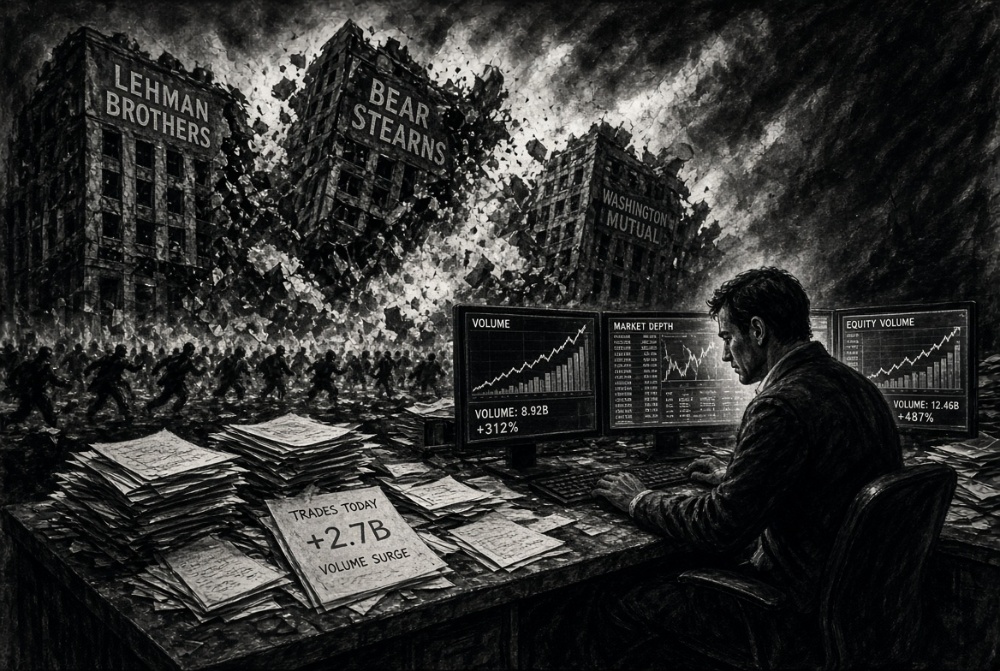
When the subprime crisis struck in 2008 and Lehman Brothers collapsed, traditional investment banks teetered on the brink of bankruptcy due to massive leverage. Jane Street-operating with its own capital and strictly controlled risk-quietly absorbed the trading volumes of retreating banks.
An Anarchist Commune and Brain Recruitment: The SBF Case (2012–2013)
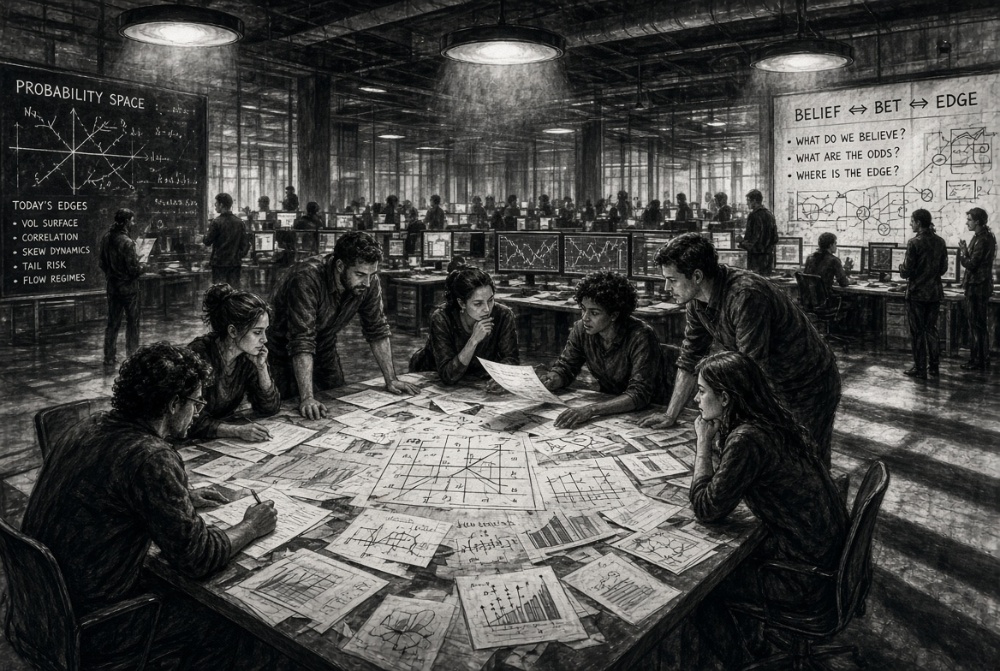
When co-founder Tim Reynolds left the company in 2012, Jane Street opted against appointing a new CEO. Instead of a single dictator, power was assumed by an informal group of 30 to 40 senior partners, and the management structure began to resemble-as analysts describe it-an "anarchist commune." All employees were compensated from the pool of total company profits rather than individual trades, eliminating any incentive to take reckless bets.
The recruitment process resembled a televised quiz show: candidates solved complex probability puzzles and played decision-making games. Intern salaries reached $16,000 per month. In 2013, Rob Granieri recruited a standout physics student from MIT-Sam Bankman-Fried (SBF).
A Lesson in the US Election (2016)
During the 2016 US presidential election, Jane Street built an advanced system to collect raw voting data from individual counties in real time. Data from Florida flowed into their models 5 minutes ahead of official CNN announcements. They quickly wagered billions of dollars on sharp stock drops in anticipation of a Donald Trump victory.
When Trump actually won that night, the market initially tanked, but by morning it unexpectedly reversed course and surged on hopes of tax cuts. Jane Street lost roughly $300 million that night-the largest single-night loss in its history. They succeeded in predicting the election outcome, but were completely wrong about the market's irrational reaction.
The Pandemic Crash and Federal Reserve Intervention (2020)
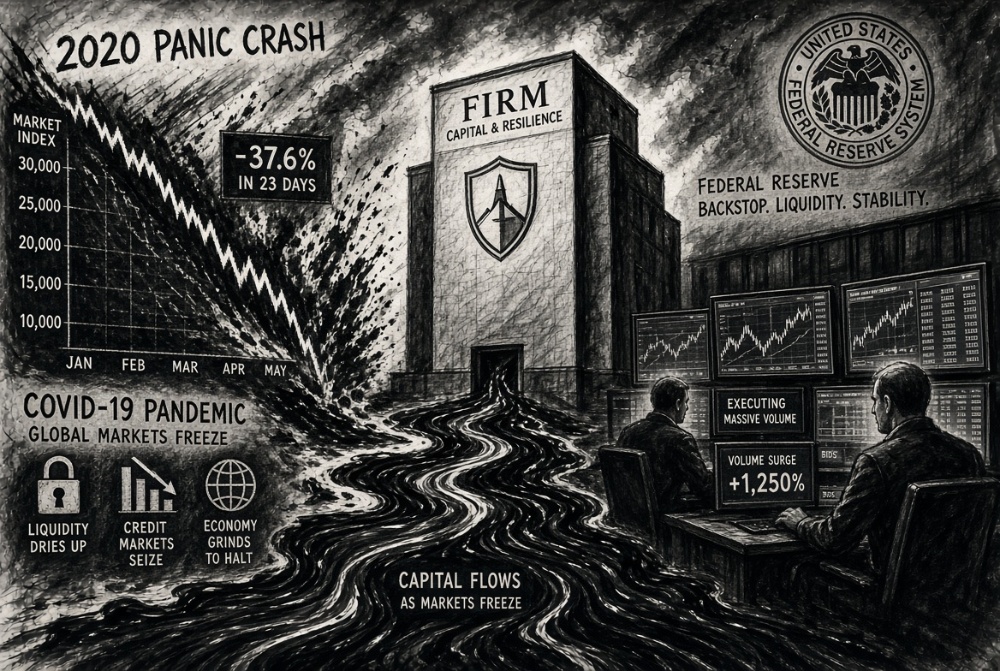
Every year, Jane Street set aside $50 million to $75 million to buy put options-insurance against a market cataclysm. During bull market years, this money simply went down the drain, drawing condescending smiles from competitors.
When the COVID-19 pandemic broke out in February and March 2020 and markets experienced the fastest sell-off in history, that insurance policy paid out immensely. While the rest of the market froze in fear, Jane Street possessed the capital to trade at full scale. In the first half of 2020 alone, they generated $8.4 billion in revenue.
Furthermore, when the US treasury and corporate bond markets became paralyzed, the Federal Reserve officially included Jane Street in an elite group of just four entities executing emergency asset purchases to preserve national liquidity. A private firm without a banking license had become the technical beating heart of the US financial system. They closed out 2020 with $11.4 billion in revenue and $17 trillion traded in securities.
The Fall of FTX and Ghosts of the Past (2022)
In 2017, Sam Bankman-Fried left Jane Street, taking Caroline Ellison with him, among others. Together, they founded the FTX exchange and Alameda Research. They deployed the same arbitrage strategies in the crypto world that they had learned at Jane Street, but stripped out the single most critical element: rigorous risk management.
When FTX went bankrupt in November 2022 with an $8 billion hole in its balance sheet, global media began dissecting SBF's and Ellison's pasts in search of answers. Although Jane Street had no involvement in the fraud, the shadow of the scandal fell over the firm, forcing its leaders to speak out publicly. Invisibility was no longer an option.
Failure at the LME and Quiet Dominance of Bitcoin ETFs (2022–2024)
In March 2022, following Russia's invasion of Ukraine, nickel prices on the London Metal Exchange (LME) experienced a massive surge. Just as Jane Street's winning positions were worth huge sums, the LME took the unprecedented step of canceling an entire day's worth of trades to protect sitting Chinese tycoons from catastrophic losses. In response, Jane Street-traditionally known for avoiding courtrooms-sued the exchange publicly for $15.3 million to signal that it would not allow the rules of the game to be changed mid-match.
Rather than trying their luck on unregulated crypto exchanges, Jane Street waited. When the SEC approved the first spot Bitcoin ETFs in the US in January 2024, Jane Street was named in filings as a key anchor market maker for almost every fund, including BlackRock's massive iShares Bitcoin Trust (IBIT).
Intelligence War in India and a Massive SEBI Fine (2024–2025)
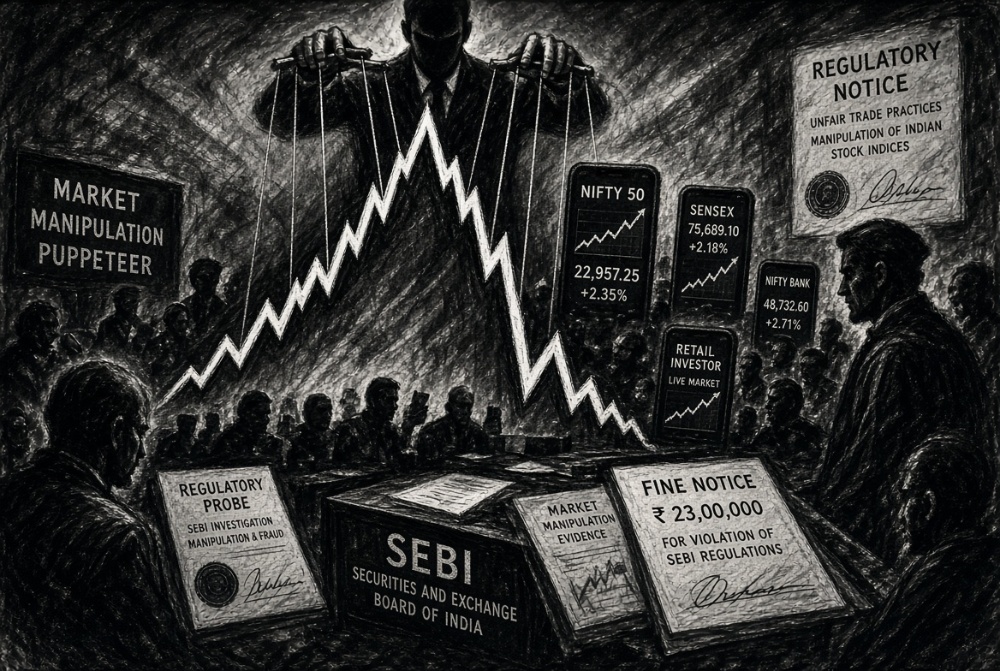
A real conflict erupted in the world's hottest derivatives market-India. Millions of retail investors were trading weekly index options on their smartphone screens. Jane Street cracked the structure of this market and created an ultra-profitable strategy that brought the firm approximately $1 billion in profit in 2023 alone.
In February 2024, two key architects of this strategy-Douglas Shadawalt and Daniel Spottiswood-handed in their resignations and moved to rival fund Millennium Management. For the first time, Jane Street broke its practice of avoiding non-compete disputes and sued Millennium in Manhattan federal court for trade secret theft. Open court proceedings revealed the exact sums involved, sending shockwaves through the Indian regulator (SEBI).
SEBI's Allegations and the Mumbai Exchange Raid
On July 3, 2025, SEBI published a damning, 105-page report and ordered Jane Street to pay 48.4 billion rupees (approx. $566 million) as disgorgement of alleged illegal gains, while simultaneously banning its entities from entering the Indian market.
The regulator described a repeating pattern of market manipulation on the BANKNIFTY index. On a sample day-January 17, 2024-Jane Street artificially inflated valuations in the morning by buying equities and futures for a staggering 4,370 crore rupees. Once the market bought into the rally, the firm aggressively dumped its positions in the second half of the day, triggering an index collapse right before option expiration. Despite incurring a 61.6 million rupee loss on cash market transactions, their hidden, massive short options positions yielded 735 crore rupees (approx. $85 million) in net profit in a single day. SEBI demonstrated this exact pattern across at least 21 trading sessions, accusing the firm of preying on millions of retail digital investors. Jane Street deposited the required funds into an escrow account and filed an appeal, maintaining that its actions were pure arbitrage.
The South Sudanese Coup Scandal (2024–2025)
While the firm was battling in New York and Mumbai courtrooms, another PR bombshell dropped in the June 2025 issue of Bloomberg. It was revealed that the last remaining co-founder of Jane Street, billionaire Rob Granieri, had been drawn into an international military plot.
In February 2024, Granieri met in his Manhattan apartment with Peter Biar Ajak-a former South Sudanese activist and Harvard fellow. Granieri provided $7 million for what he believed was a foundation supporting human rights. In reality-as a federal investigation demonstrated-the money was used to purchase Stinger missile launchers, AK-47 rifles, grenade launchers, and millions of rounds of ammunition stored in an Arizona warehouse to stage a military coup and overthrow the government of South Sudan. Ajak was arrested and sentenced by a US court to 46 months in prison, while Granieri's lawyers proved that he had fallen victim to manipulation by a supposed activist.
Finale: A Record $39.6 Billion (2025–2026)
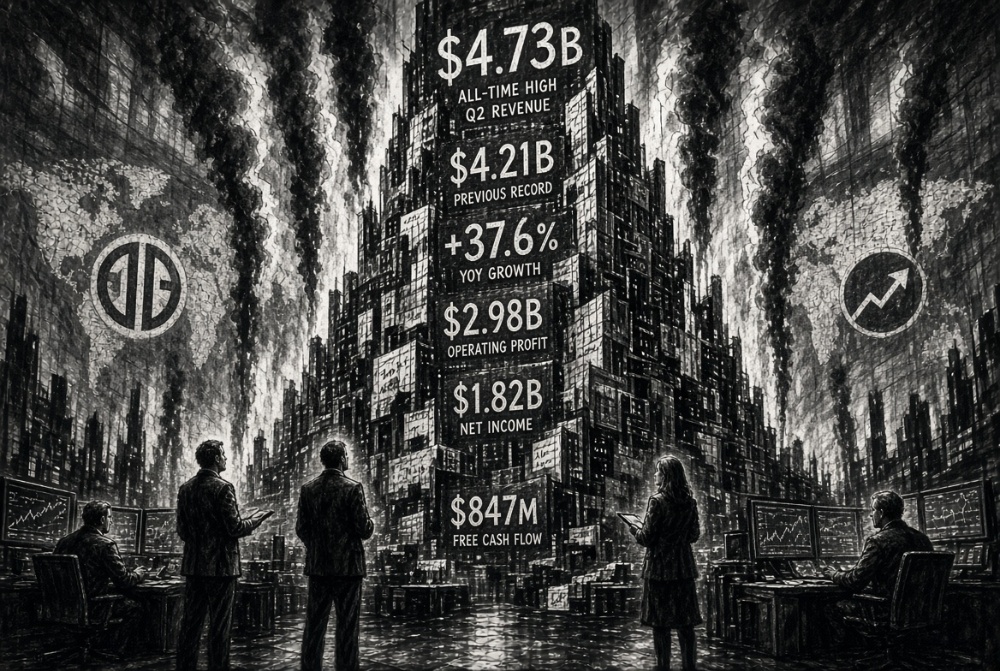
Despite manipulation charges in India, lawsuits in New York, and the arms scandal in Sudan, Jane Street's financial engine generated results in 2025 that stunned all of Wall Street.
The firm's net trading revenue reached a staggering $39.6 billion. That figure is nearly double its 2024 earnings and higher than the total trading revenues of America's largest bank, JP Morgan, across its global operational network.
Most astonishingly, this astronomical result was achieved by a team of just roughly 3,000 to 3,500 employees, yielding an unbelievable metric of over $11 million in revenue per employee. The total compensation pool for employees in 2025 reached $9.4 billion, producing an average compensation package of around $2.7 million per person.
Conclusion
Jane Street remains the most profitable and secretive machine in the history of capital markets. Built without a CEO, without a traditional brand, and without a desire for the spotlight, it challenged the entire banking sector.
Although the case before the Indian SAT tribunal remains unresolved, and the boundary between aggressive, ultra-fast arbitrage and ruthless price manipulation remains blurred, Jane Street's story has proven one thing: in the 21st century, the world's most powerful bets do not take place on trading floors, but inside quiet loops of computer code.






