
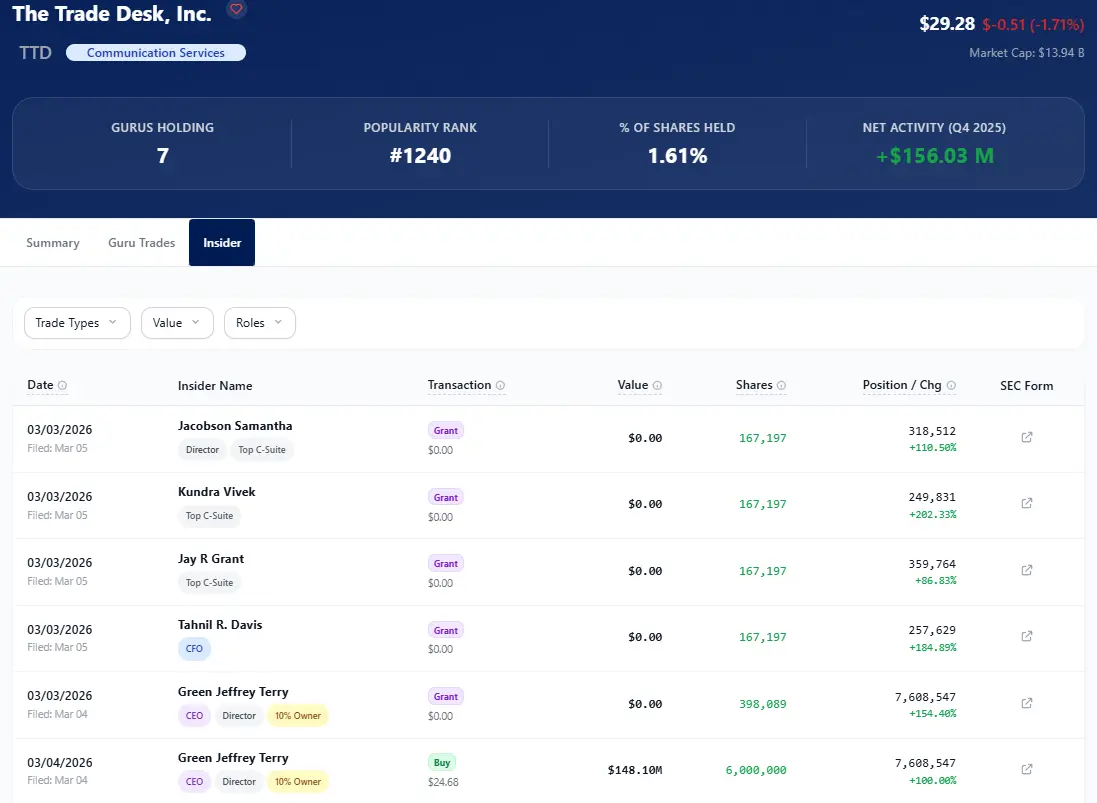
For months, the programmatic advertising sector has been treated like the forgotten stepchild of the tech world, overshadowed by semiconductor giants and generative AI hardware. But this week, the narrative completely flipped. When The Trade Desk’s CEO Jeff Green aggressively slammed $148 million of his personal wealth on the table to buy over 600,000 shares of his own company, the market had no choice but to wake up. This wasn't a scheduled corporate buyback or a token gesture of confidence; it was a violent, nine-figure accumulation that immediately sent the stock surging 18%, proving that nothing screams "undervalued" louder than a billionaire founder emptying his pockets into the open market.
🚀 The Catalyst: Defying the Sector's Liquidation Trend
What makes this historic purchase so explosive is the glaring contrast it creates against the rest of Silicon Valley's current behavior.
Recent Form 4 filings show a noticeable increase in executive sales across major tech companies, as founders and early investors scramble to lock in profits after a prolonged index rally. While the rest of the C-suite universe is busy cashing out and diversifying into safer assets, Jeff Green is actively hoarding his company's equity. This massive behavioral divergence is heavily fueled by swirling market rumors of a deeply integrated partnership with OpenAI. By front-running the public confirmation of potentially game-changing AI ad-delivery infrastructure, leadership is essentially telegraphing a massive upcoming expansion in their market dominance.
The Psychology of the Apex Buyer
Retail investors are notoriously reactive, often buying into momentum long after the real money has been made. However, apex executives operate on a completely different timeline, pricing in product launches, unannounced partnerships, and forward earnings quarters before the public catches on. In the brutally competitive attention economy, proprietary data is the ultimate moat. The magnitude of this specific transaction suggests that the company’s internal modeling has identified a monumental shift in how digital advertising will be monetized in the AI era. When you see a founder double down at this scale, it usually means the underlying business fundamentals are drastically outpacing Wall Street's often conservative consensus.
Tracking the Footprints Before the Breakout
You don't need to be a Wall Street insider to capture these explosive moves; you just need to know exactly where to look. The key to anticipating the next 20% gap-up is to rigorously monitor these regulatory disclosures the second the ink dries. While a single massive purchase sets the floor, analyzing the historical context and ongoing TTD insider activity provides the ultimate roadmap to management's true conviction levels. If you want to stop getting trapped by lagging analyst downgrades and start trading alongside the architects of the industry, tracking real-time executive capital flow is the sharpest weapon in your arsenal.






