
The Media Pivot: Decoding Berkshire Hathaway's Shocking New York Times Stake
Every quarter, Wall Street analysts eagerly await regulatory filings to reverse-engineer the strategies of financial titans. Usually, the moves are predictable adjustments to existing legacy positions. However, the Q4 2025 13F filing delivered a genuine surprise that has left media analysts and value investors scratching their heads: a massive, brand-new bet on a legacy newspaper transitioning into a digital subscription juggernaut.
The Headline Maker: Initiating a Stake in NYT
In a quarter defined largely by selling, Berkshire Hathaway made a highly targeted acquisition, initiating a brand-new position of nearly 5.1 million shares in The New York Times Company (NYT). Why would a notoriously old-school value investor buy a newspaper in 2026? The answer lies in the company's successful pivot to a sticky, high-margin digital bundle (combining News, Games, Cooking, and Wirecutter). It is no longer just a media company; it is a recurring-revenue software business disguised as a newspaper.
The Untouchable Pillars: Amex and Coca-Cola
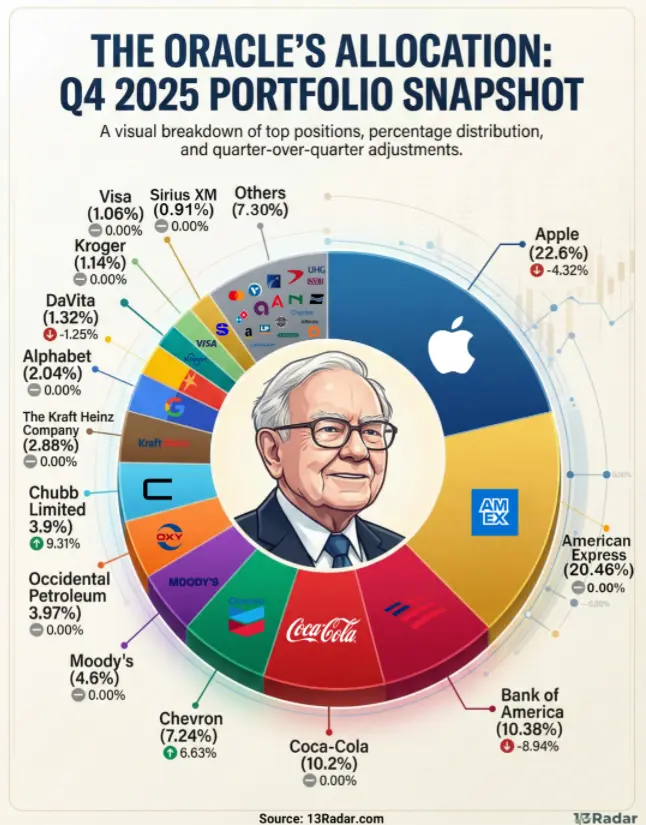
While the NYT purchase captured the headlines, it is equally important to look at what Berkshire explicitly refused to sell. The portfolio's historic backbone remains entirely intact. American Express (AXP) and Coca-Cola (KO) represent a combined 30.6% of the entire equity portfolio, with absolutely zero shares sold in the fourth quarter. These "forever assets" provide the impenetrable moat and the massive dividend yield that allow Berkshire to take calculated risks on new ventures like the Times.
🔥 THE SUBSCRIPTION MOAT: Why Content is the New Value Play 🔥
Evaluating the broader Warren Buffett portfolio Q4 2025 exposes a refined definition of what constitutes a modern economic moat. The addition of NYT signals that consumer habituation is the ultimate competitive advantage.
The investment logic behind the NYT acquisition:
- Pricing Power: Loyal subscribers are highly tolerant of annual price hikes for premium, exclusive journalism and lifestyle content.
- Zero Churn Addiction: Products like NYT Games (Wordle, Crossword) create daily, unbreakable consumer habits.
- Capital Efficiency: Unlike manufacturing, scaling digital subscriptions requires virtually zero marginal cost, leading to explosive free cash flow generation.
The lesson is clear: in an era of AI-generated commodity content, deeply trusted human brands with loyal subscriber bases are severely undervalued by the broader market.






