When we talk about investing in stocks, one market immediately comes to mind:
The United States.
And it's easy to understand why.
Wall Street is home to many of the world's most valuable companies, while the Nasdaq and NYSE attract enormous amounts of global capital. Technology, artificial intelligence, healthcare, finance and consumer companies make the U.S. market almost impossible to ignore.
But here's the interesting part:
The global stock market is much bigger than the S&P 500.
Europe, China, Japan, South Korea, India, Mexico and commodity-rich economies such as Canada and Australia all offer completely different combinations of growth, value, dividends, currencies and geopolitical risk.
So, if you are looking at global equities in 2026, where are the most interesting opportunities — and what should you be careful about?
Let's take a quick tour around the world.
United States: Still the Heavyweight
Let's start with the obvious one.
The U.S. remains the world's dominant stock market and the natural home of global technology giants.
Artificial intelligence, semiconductors, cloud computing, software, digital advertising and biotechnology have created an extraordinary concentration of capital and innovation.
The biggest advantage isn't simply the companies themselves.
It's the ecosystem around them.
The United States has deep capital markets, a powerful venture-capital industry, a strong entrepreneurial culture and an enormous consumer economy.
For many investors, having no exposure to the U.S. would therefore be a very unusual choice.
But there is a catch.
American stocks can become expensive, particularly when investors concentrate heavily on a relatively small group of mega-cap technology companies.
Other risks include:
-
High valuations
-
Concentration in a few companies
-
AI-related speculation
-
High public debt
-
Interest-rate sensitivity
-
Dollar fluctuations for euro-based investors
That last point is particularly important for Europeans.
If you invest in a U.S. stock, you are effectively exposed to two variables: the stock and the dollar.
The U.S. may therefore remain the global heavyweight, but being the strongest market doesn't mean every American stock is automatically attractive.
Europe: The Value Alternative?
Cross the Atlantic and the picture changes dramatically.
European markets generally have less exposure to mega-cap technology and much more exposure to banks, industrial companies, pharmaceuticals, luxury brands, energy and automotive businesses.
London, Paris, Frankfurt, Milan and the broader Euronext network form an important part of the global financial system.
The main attraction?
Different valuations and different economic exposure.
European companies have historically traded at lower valuations than many comparable U.S. companies.
That can potentially create opportunities if earnings improve or investors decide that the valuation gap is excessive.
Europe also has world-class companies in luxury goods, industrial automation, engineering, pharmaceuticals and aerospace.
But the disadvantages are equally clear.
Economic growth has generally been slower than in the United States, energy costs remain strategically important and European companies are heavily exposed to international trade.
In other words:
Europe can offer value and dividends, but usually with less explosive growth.
For a European investor, however, there is another advantage.
You are investing in companies and currencies much closer to your own economic environment, potentially reducing the need to rely exclusively on U.S. assets.
China: The Biggest Question Mark
China is probably the market that divides investors more than any other major economy.
The potential is enormous.
So are the risks.
Shanghai, Shenzhen and Hong Kong provide access to companies operating in technology, manufacturing, consumer goods and other strategic industries.
China has enormous industrial capacity, a huge domestic market and leadership in several important sectors.
But investors must accept a reality that is difficult to ignore:
Government policy can have a huge impact on companies.
Regulation, technology restrictions, property policy and access to capital can change the investment landscape much faster than traditional financial analysis might suggest.
The property crisis and weaker consumer confidence are also important issues.
At the same time, China's long-term transition toward a more consumption-driven economy could create significant opportunities.
So China represents an unusual combination:
Potentially attractive valuations + enormous economic scale + unusually high political risk.
That can be interesting for investors who understand the risks.
It can be dangerous for those who don't.
Japan & 🇰🇷 South Korea: Asia's Industrial Powerhouses
Japan and South Korea deserve to be considered together because both provide something very different from the U.S. technology-heavy market.
Japan
Japan is particularly strong in robotics, machinery, electronics, industrial technology and automotive manufacturing.
The yen is a crucial variable.
A weaker yen can support exporters, while a stronger currency can make Japanese products less competitive overseas.
Japan also faces structural challenges, including an aging population, slow economic growth and enormous public debt.
But something interesting has been happening inside Japanese corporations: greater attention to shareholders, capital efficiency and corporate governance.
That could make Japan increasingly interesting for investors looking for quality and value rather than pure growth.
South Korea
South Korea is much more cyclical.
Semiconductors, electronics, batteries and automotive companies dominate the investment narrative.
The country's technological expertise gives it enormous global importance, but it also creates volatility.
When the semiconductor cycle is strong, Korean stocks can benefit dramatically.
When demand weakens, the opposite can happen.
Then there are geopolitical risks involving North Korea and the country's strong economic relationship with China.
South Korea therefore offers a compelling growth story — but investors need to be comfortable with significant volatility.
India & 🇲🇽 Mexico: Two Emerging-Market Stories to Watch
If the U.S. represents mature global capitalism, India and Mexico represent two very different emerging-market opportunities.
India
India's investment story is based on demographics, digitalization, infrastructure and rising domestic consumption.
A huge population combined with economic development creates a potentially powerful long-term growth engine.
Technology and digital financial services are already transforming the economy.
But India isn't without problems.
Bureaucracy, inequality, infrastructure limitations and potentially demanding valuations can all create risks.
The opportunity is enormous.
The question is how much investors are willing to pay for that growth.
Mexico
Mexico has a different advantage:
Geography.
Its proximity to the United States makes it a natural beneficiary of the global nearshoring trend, as companies look to move parts of their supply chains closer to the American market.
Manufacturing, logistics and industrial infrastructure could benefit.
But political uncertainty, security issues and heavy dependence on the U.S. economy remain important risks.
Mexico may be an exciting diversification opportunity — but "nearshoring" alone isn't enough reason to buy a stock.
Canada, Australia & Brazil: The Commodity Markets
Not every interesting market is driven by technology.
Canada, Australia and Brazil remind us that the global economy still depends heavily on energy, agriculture and raw materials.
Canada has significant exposure to energy and mining, giving its market a value and commodity-oriented profile.
Australia is similarly rich in natural resources, but its strong economic relationship with China adds another layer of risk.
Brazil offers exposure to agriculture, energy and commodities, alongside a huge domestic market and long-term development potential.
The problem?
Commodity economies are cyclical.
When prices rise, profits can surge.
When commodity prices collapse, the same exposure can become a major weakness.
Political and economic instability can also amplify volatility, particularly in emerging markets.
So, Which Stock Market Should You Choose?
And now comes the difficult question.
Which market is actually the best?
There isn't one universal answer.
The U.S. offers technological leadership and some of the world's strongest companies.
Europe offers industrial expertise, global brands and potentially cheaper valuations.
China offers enormous scale, but with significant political risk.
Japan offers quality companies and a corporate transformation story.
South Korea provides exposure to semiconductors, batteries and advanced technology.
India offers demographics and long-term growth.
Mexico could benefit from the restructuring of global supply chains.
Canada, Australia and Brazil offer exposure to commodities and natural resources.
The important thing isn't finding the country that will magically outperform everyone else.
It's understanding what you are buying and what risks come with it.
The Biggest Mistake Investors Make
I believe one of the biggest mistakes is becoming emotionally attached to a single market.
Americans can become too bullish on America.
Europeans can become too comfortable with European stocks.
Crypto investors can become convinced that traditional markets no longer matter.
And investors discovering an exciting emerging market can suddenly believe that its future is guaranteed.
Nothing is guaranteed.
A geopolitical crisis can move oil prices.
A semiconductor shortage can affect car manufacturers around the world.
A stronger dollar can change global capital flows.
A slowdown in China can hurt companies thousands of kilometers away.
And an AI breakthrough in California can completely reshape industries in Europe and Asia.
Global diversification is therefore not simply about owning more countries.
It is about owning different economic engines.
The Bottom Line
The stock market isn't one market.
It's a collection of economies, currencies, industries and political systems connected by global capital.
The United States may remain the heavyweight champion.
But that doesn't mean the rest of the world should be ignored.
For investors willing to study beyond the headlines, there are very different opportunities across Europe, Asia and emerging markets.
The key is not to ask:
"Which country will make me the most money?"
A better question is:
"Which markets do I understand, and which risks am I actually willing to take?"
Because the most dangerous investment isn't necessarily the riskiest one.
It's the one you don't understand.
Do your research. Understand the business, the country, the currency and the risks.
And never invest in something simply because everyone else seems to be doing it. 📈
This article is for educational purposes only and does not constitute financial advice. Always conduct your own research and consider your personal financial situation, investment objectives and risk tolerance before making any investment decision.
💎 Free Crypto Opportunities I Personally Follow🔥
1. GRASS — (DePIN/AI)
Grass is a decentralized network that lets you turn your unused internet bandwidth into crypto rewards!
Just install the browser extension, desktop app (2× rewards) or mobile app (3× rewards) — and start farming Grass Points automatically while you browse.
🔥 At the end of each season, your Grass Points are converted into $GRASS tokens — and Season 1 has already rewarded thousands of users (including me!).
👉 Farm Grass airdrop now: https://app.grass.io/register?referralCode=lNAoYuHQUPN22mF

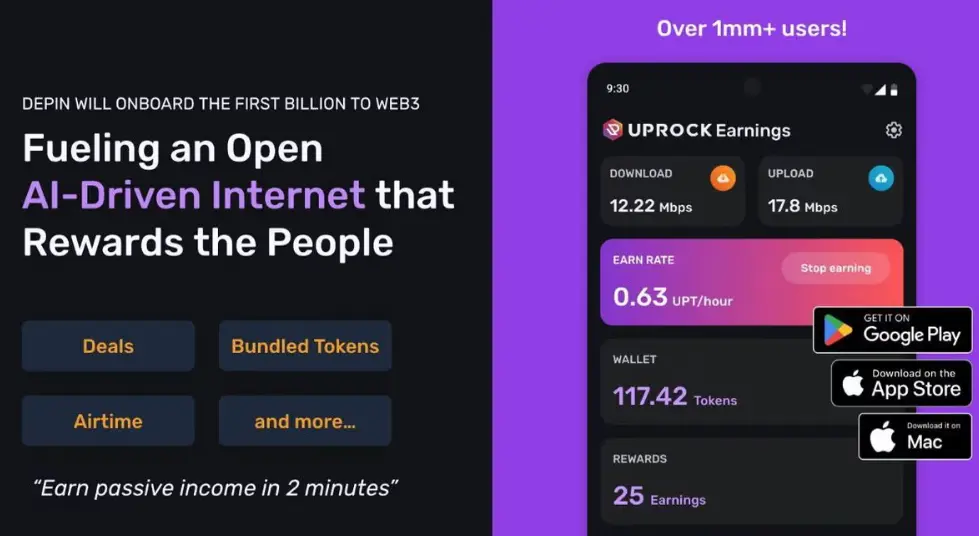
2. UPROCK — (DePIN/AI)
AI needs real-world data. UpRock is building the decentralized network that powers it — and participants earn $UPT rewards.
Help power the next generation of AI by contributing to a global decentralized data network while earning $UPT rewards through the UpRock ecosystem. You can also earn more $UPT sharing your unused internet (desktop & mobile), watching videos (mobile only), playing games, answering surveys and completing simple tasks.
👉 Start earning $UPT now: https://link.uprock.com/i/f38853d4