I didn’t expect it.
One moment ZCash was just another “old school” privacy coin, quietly doing its thing in the background… and then boom: Q4 2025 arrived, Black Friday mania hit the markets, and ZEC became one of the most talked-about assets in the entire crypto space.
If you’ve been scrolling through crypto Twitter lately, you’ve probably noticed it too: ZCash is trending again, and everyone suddenly wants to understand how this coin went from “forgotten veteran” to “privacy superstar”.
Today I want to break down exactly what’s going on — in plain English, without hype, and with the perspective of someone who’s been watching ZEC’s ecosystem evolve for years.
Let’s dive into what makes ZCash so unique, why it’s exploding right now, and what you need to know before you jump in.
What Exactly Is ZCash?
ZCash (ZEC) is one of the world’s most established privacy coins. While Bitcoin exposes every transaction publicly, ZCash was built to do the exact opposite: protect sender, receiver, and amount with zero-knowledge cryptography.
The core idea is simple:
If you pay someone, it should be your business — not something anyone can track on a blockchain explorer.
And that’s where ZCash earned its nickname: “the private Bitcoin.”
How ZCash’s Privacy Actually Works (The Simple Version)
ZCash uses a powerful cryptographic technique called zk-SNARKs. In short:
-
You can prove a transaction is valid
-
Without revealing anything about it
This allows the network to stay secure while keeping user activity private.
What I didn’t realize until I tested ZCash wallets myself is that you can choose between two types of addresses:
-
Z-Addresses (shielded) → private
-
T-Addresses (transparent) → public
And yes, you can send funds between these two worlds seamlessly.
Most modern wallets — especially Zashi, which is quickly becoming the ZCash “MetaMask” — default to full privacy, reflecting what the community wants.
One underrated detail: even mining rewards can be shielded. That means miners can receive block payouts without exposing their wallet on chain — a huge plus compared to Bitcoin.
A Quick Journey Through ZCash’s Origins
It all started in 2013, when a group of cryptographers from Stanford tried to solve a problem Bitcoin could never fully escape: its lack of privacy.
Their original plan wasn’t to create a new blockchain.
They wanted to upgrade Bitcoin using a protocol called Zerocoin.
But the tech was too complex to bolt onto BTC… so a new chain was born.
Enter Electric Coin Company (ECC) — the team behind ZCash — in 2015, followed by the ZCash Foundation in 2017.
The launch was so unique it became crypto folklore:
A multi-party ceremony, each participant generating part of a master key, which was later destroyed. Rumor has it that Edward Snowden himself participated.
Whether myth or truth, it underscored the project’s mission: privacy is a human right.
Technical Evolution: From Plant Names to NU Updates
ZCash’s upgrades are known as “Network Upgrades” (NU), each improving privacy, security, or scalability.
Over the years, two goals have dominated development:
-
Make privacy faster and cheaper
-
Scale the network for real-world use
And here’s where things get interesting…
During late 2025, while markets were heating up for Black Friday, ZCash suddenly started pushing 70k–90k transactions per day — a huge spike for a privacy chain.
The community isn’t celebrating for nothing:
NU7 is on the horizon, and it will introduce private tokens, creating an entire ecosystem of “ZCash-style anonymity assets”.
Think of it as a new wave of programmable privacy.
ZCash Tokenomics: The Good, the Bad, and the Controversial
ZEC mirrors Bitcoin in several ways:
-
Maximum supply: 21 million
-
Proof-of-Work consensus
-
Halving every four years
Blocks are mined every 75 seconds, which makes the chain feel far more dynamic than Bitcoin’s 10-minute rhythm.
But the part everyone argues about?
Founders’ Rewards.
Originally planned only for the first four years, they were extended — and this created friction in the community.
Today:
-
8% of block rewards go to development, R&D, communication, etc.
-
12% goes into a locked “community chest” to be allocated via governance.
Whether you see this as a tax or a sustainable model depends on your philosophy.
But one thing is clear: ZCash has never needed ICOs, pre-mines, or venture allocations.
The trade-off?
Founders and institutions accumulate a significant portion of the supply.
Adoption: Still Niche, but More Relevant Than Ever
Let’s be honest: privacy coins will always have regulatory pressure hovering above them — especially in Europe.
That means ZCash will never match the adoption levels of Ethereum, Solana, or even Bitcoin.
But here’s the part people underestimate:
In a world that’s becoming more surveilled every year, privacy becomes a premium.
And with Monero facing growing scrutiny, ZCash’s selective-privacy model feels like a solution that regulators may eventually tolerate more easily.
ZCash is not built for everyone.
But the people who need it… really need it.
Final Thoughts: Why ZCash Is Suddenly Exploding Again
ZCash didn’t pump in late 2025 by accident.
A combination of factors hit at once:
-
renewed attention on financial privacy
-
a major surge in network usage
-
anticipation for NU7 and private tokens
-
a growing narrative around “Bitcoin but private”
-
Black Friday’s usual market volatility and hype
ZCash has always been a quiet giant.
Now, for the first time in years, it’s acting like one.
Whether you're bullish or skeptical, one thing is clear: ZCash is shaping the conversation around privacy in crypto — again.
And if this trend continues into 2026, this might be the beginning of a very different privacy-focused narrative cycle.
🔥 HERE'S MY PASSIVE EARNINGS LIST:🔥
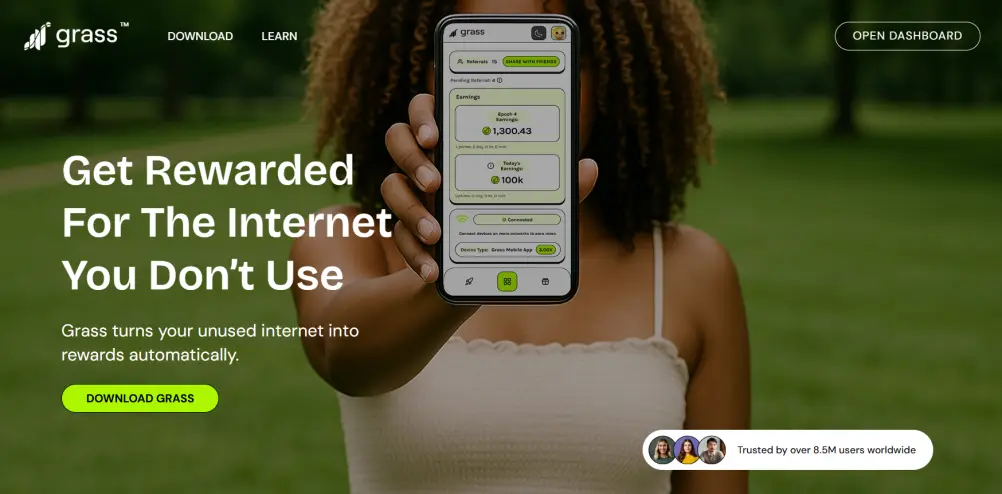
1. GRASS — (DePIN/AI)
Grass is a decentralized network that lets you turn your unused internet bandwidth into crypto rewards!
Just install the browser extension, desktop app (2× rewards) or mobile app (3× rewards) — and start farming Grass Points automatically while you browse.
🔥 At the end of each season, your Grass Points are converted into $GRASS tokens — and Season 1 has already rewarded thousands of users (including me!).
👉 Farm Grass airdrop now: https://app.grass.io/register?referralCode=lNAoYuHQUPN22mF
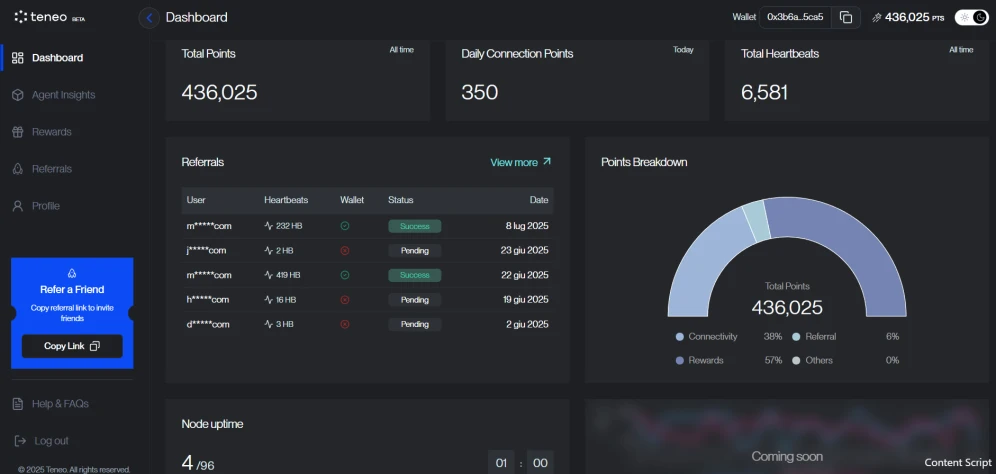
2. TENEO — (DePIN/AI)
Teneo lets you earn passively with a lightweight browser extension that hosts an Autonomous AI Agent powering a decentralized AI network. Just reconnect the extension after restarting your PC to keep earning Teneo Points, which will be convert into tokens at TGE!
👉 Farm Teneo airdrop now: https://dashboard.teneo.pro/auth/signup?referralCode=tNwVw
🧩 Install the extension: https://chromewebstore.google.com/detail/teneo-community-node/emcclcoaglgcpoognfiggmhnhgabppkm
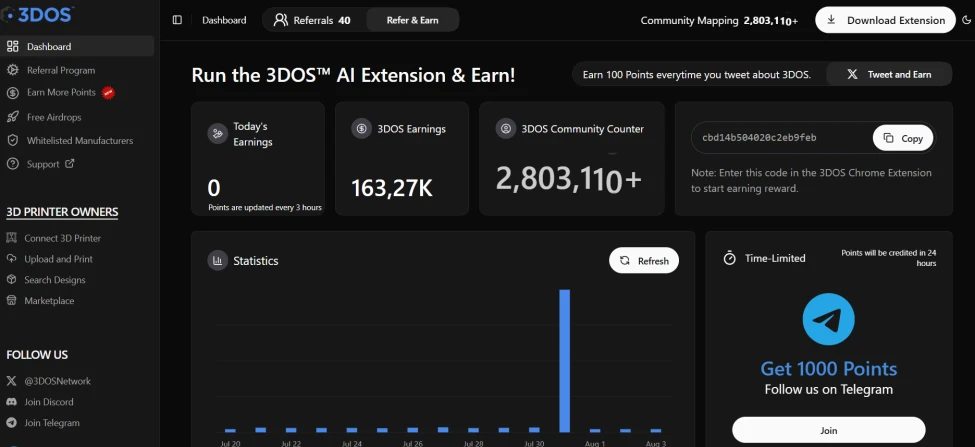
3. 3DOS — (DePIN/OS)
3DOS is creating the world’s first decentralized OS for Web3, mapping global manufacturing capacity to power a massive network. Run their browser node, stay online, and earn $3DOS tokens on the SUI blockchain. 3DOS points will be converted into tokens after TGE and listing.
👉 Farm 3DOS airdrop now: https://dashboard.3dos.io/register?ref_code=f00654
🧩 Install the extension: https://chrome.google.com/webstore/detail/3dos-network/lpindahibbkakkdjifonckbhopdoaooe
🔗 Copy your key from the dashboard, paste it into the extension, start the node, and watch your rewards grow!
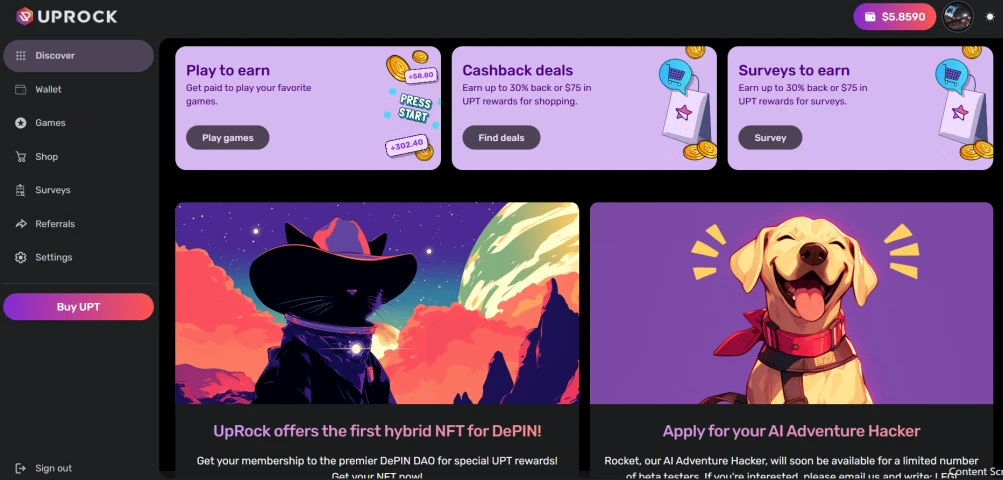
4. UPROCK — (DePIN/AI)
Earn $UPT in multiple ways: share your unused internet bandwidth via desktop app or smartphone, play games and answer surveys!
👉 Start earning $UPT now: https://link.uprock.com/i/f38853d4