The AI boom has a problem that money alone cannot solve: there simply isn't enough infrastructure to keep building at the speed the industry wants.
For years, Texas looked like one of the biggest winners of the artificial intelligence revolution. Cheap energy, available land and a business-friendly political environment made it an ideal destination for massive data centers.
But something has changed.
Following growing public opposition and political pressure after the US midterm elections, new data center projects in Texas could face delays. And just as investors begin questioning whether the AI infrastructure race can continue at its current pace, Elon Musk has raised an idea that sounds like science fiction: putting AI data centers in space. 🚀
It might sound crazy today, but there are some interesting reasons why this idea is attracting attention.
Texas Was Supposed to Be AI's Next Big Capital
Texas has been positioning itself as a major hub for artificial intelligence infrastructure.
The logic was straightforward: build enormous data centers, secure access to electricity, install thousands of advanced processors and provide the computing power needed by the next generation of AI models.
However, local opposition is becoming a serious obstacle.
Concerns about electricity consumption, water usage, environmental impact and pressure on local power grids have created political difficulties for projects that previously enjoyed strong support.
Even Republican Governor Greg Abbott, who had promoted Texas as an AI powerhouse, has faced pressure to reconsider the pace of new development and the permitting process.
The potential consequences are significant.
Estimates suggest that permitting delays or restrictions could put roughly 10–15 gigawatts of planned data center capacity for 2027 at risk of being delayed.
And this is where the problem becomes much bigger than local politics.
Imagine being an investor who has already ordered expensive AI processors, financed the construction of a facility and signed contracts promising computing capacity to customers.
If the building is ready but the electricity connection is delayed, the financial damage starts accumulating immediately.
Interest payments continue. Hardware loses value. Customers may look elsewhere.
In the AI industry, where technology evolves incredibly quickly, a delay of even twelve months can make a huge difference.
Elon Musk Is Looking Beyond Earth
Against this background, Elon Musk has suggested that space-based data centers are suddenly becoming much more attractive.
His reasoning is connected to a long-term vision he has discussed before: as artificial intelligence becomes more powerful, an increasingly large share of the computing infrastructure needed to support superintelligence could eventually operate in space.
This is not simply another futuristic statement from Musk.
There is a genuine infrastructure argument behind it.
On Earth, AI companies must deal with several increasingly difficult constraints:
Electricity availability and rising energy demand.
Land acquisition and construction permits.
Cooling requirements for increasingly powerful processors.
Competition for access to electrical grids.
Local communities increasingly opposing massive data center developments.
Space could potentially remove or reduce some of these limitations.
And one resource is particularly interesting: sunlight.
Google's Project Suncatcher: The Sun Could Power AI in Orbit
One of the most interesting developments in this area is Google's Project Suncatcher.
The concept involves building networks of satellites equipped with solar panels and AI computing hardware.
Instead of constructing enormous facilities on Earth and connecting them to increasingly congested electrical grids, these satellites would generate their own electricity directly from sunlight.
According to the research behind the project, solar panels operating in suitable orbital conditions could potentially generate up to eight times as much energy as comparable panels on Earth.
That is an enormous theoretical advantage.
There is also another benefit: space-based infrastructure could eventually operate without the same geographical limitations affecting terrestrial data centers.
However, there is a very important detail that investors should not overlook.
Free sunlight does not mean free computing power.
Launching satellites, maintaining orbital infrastructure, transferring data between satellites and Earth, and replacing damaged or obsolete processors would involve enormous expenses.
And this is where I think an interesting comparison emerges.
What AI Data Centers Can Learn From Bitcoin Mining
Anyone who has followed Bitcoin mining understands that electricity costs are only one part of the profitability equation.
A mining operation doesn't become profitable simply because it has access to cheap energy. Hardware costs, operational expenses, network difficulty and the value of the rewards all matter.
The same principle applies to orbital AI infrastructure.
Even if a satellite can generate enormous amounts of solar energy, the real question is how much it costs to deliver one hour of useful computing power to a paying customer.
In other words, the metric that matters isn't how much electricity the satellite produces.
It's the final cost of computation.
If launching and maintaining an orbital data center costs more than operating a comparable facility on Earth, the technological achievement might be impressive without being commercially viable.
This is why I wouldn't rush to assume that space-based AI infrastructure will replace terrestrial data centers anytime soon.
But it could eventually become an additional option, particularly if launch costs continue falling and demand for computing power keeps accelerating.
The AI Infrastructure Race Is Entering a New Phase
What makes this story particularly interesting is the contrast between two completely different developments.
On one side, political pressure and infrastructure limitations are threatening to slow down some of the biggest AI investments on Earth.
On the other, companies and technology leaders are exploring ways to move computing infrastructure beyond traditional geographical boundaries.
I see an important lesson here: the next major bottleneck for artificial intelligence might not be better algorithms or more powerful chips. It could be the infrastructure required to run them.
And this has implications far beyond AI companies.
Energy providers, semiconductor manufacturers, data center operators, satellite companies and even the space industry could all become part of the same investment ecosystem.
For now, terrestrial data centers remain essential, and orbital alternatives still face enormous engineering and economic challenges.
But imagine a future where some of the world's most powerful AI systems are trained and operated by computing infrastructure orbiting Earth, powered directly by the Sun.
It sounds like science fiction.
Yet a few years ago, the idea of spending hundreds of billions of dollars on AI infrastructure would also have sounded extraordinary.
Perhaps the real question isn't whether AI data centers will eventually reach space, but how long it will take before the economics make it worthwhile. 🚀
What do you think? Will space-based data centers become a serious part of the AI industry, or will launch and maintenance costs keep them on Earth for decades?
💎 Free Crypto Opportunities I Personally Follow🔥
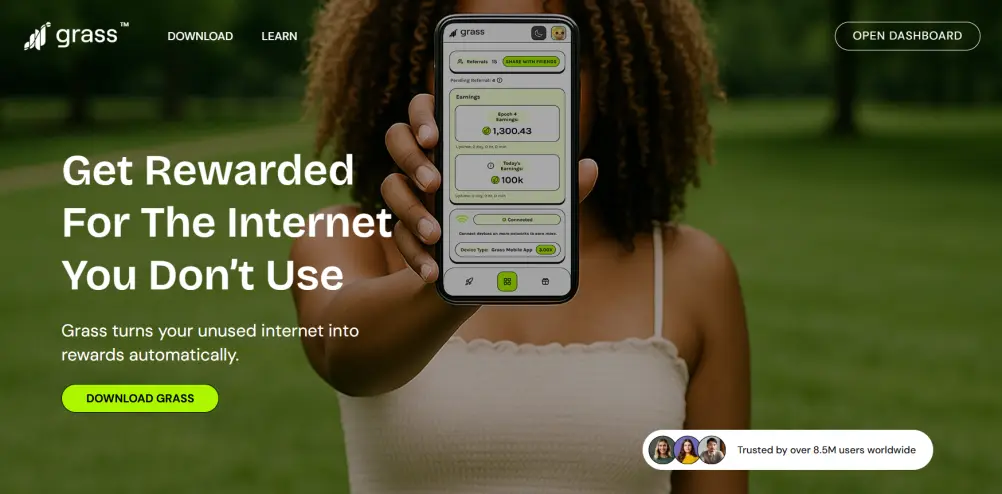
1. GRASS — (DePIN/AI)
What if your unused internet bandwidth could help you earn crypto rewards?
Grass is a decentralized network that allows users to share their unused internet bandwidth and earn Grass Points in return.
Getting started is simple:
🌐 Browser extension: automatically earn points while browsing.
💻 Desktop app: up to 2× rewards.
📱 Mobile app: up to 3× rewards.
🔥 Season 1 and Season 2 rewards have already been distributed! I've personally participated in Grass and received my Season 1 and Season 2 allocations. Now, Season 3 is underway, offering another opportunity to accumulate Grass Points and potentially benefit from future rewards.
The earlier you start, the more time you have to participate. Why not put your unused bandwidth to work?
👉 Farm Grass airdrop now: https://app.grass.io/register?referralCode=lNAoYuHQUPN22mF