
Welcome to my series on EOS Learn and Earn. I have decided to name my experiment as "Learn and Earn" rather than simple "HODL experiment". There was a nice response for my previous post and there were few comments that suggested to also "stake" my EOS coins. They claimed that this way I can make extra money due to the interest received on staking. As I am new to cryptocurrency, specifically EOS, I decided to spend my last 15 days knowing more about staking.
What is staking?
The word "staking" comes from the idiom "stake your claim", which means to formally say or show that you have a right to it. "It" in this case means earning profit from mining.
Staking is to lend your cryptocurrency to receive some interest in return. From the lender's perspective is it is similar to a loan, however the main difference is how the "borrower" uses these cryptocoins. Staking only works in blockchain which implements "Proof of Stake" (PoS) algorithm to achieve distributed consensus. In PoS, the creator of the next block is chosen by various combination of age and wealth of the creator. You can read more about PoS algorithm in this wikipedia article. In essence, the chances of node creating a the next block is approximately equal to the amount of the currency they hold. So if the node holds 5% of the total cryptocurrency, they have 5% chance for solving the next block. Therefore the nodes are interested to accumulate more coins and in return they are willing to share the coins that they make from the mining fees as interest to you. Some popular crptocurrencies that implement PoS algorithm are EOS (EOS), Tezos (XTZ), Digital Cash (DASH), NEO (NEO) to name a few.
EOS uses a special implementation of Proof of Stake, called delegated Proof of Stake (dPoS). In dPoS, the users vote for "delegates" how have the power to earn profit from mining by running a full node. It is considered by many as the most democratic way of distributed consensus. The number of votes that the user have depends on the amount of cryptocoins the person is controlling. Therefore many organizations are willing to "borrow" your coins so that they effectively get more votes for the delegation process. In return, they provide you some of the delegation fees that they receive for creating a new block as well as marketing the EOS blockchain. EOS currently has 21 delegates who are responsible for producing a block.
Is staking beneficial?
Whether staking is beneficial to an user or an organization really depends on what their interests are in being invested in EOS. If you are invested in EOS as a trader to make money then obviously you are not interested in voting rights as long as you get positive returns on your investment. In these cases, staking is certainly beneficial as interest earned is an increase to your bottom line. However, if you hare invested in EOS for increasing the footprint of EOS blockchain then you do not want to lose the voting rights which gives you the power to choose your own delegates to increase the adoption of the EOS blockchain.
This is it for the learn part of this series. Now lets move to the earn part.
My HODL experiment
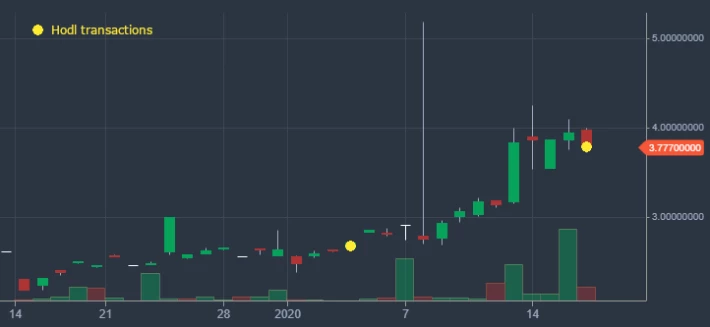
This was a good period for my EOS holdings. My previous purchase is up by 39.23%. With my today's purchase of 5.28200282 at USD 3.77700000, my net holding of EOS is 12.65458198 with an average cost of USD 3.160910417. This brings my net gain to 19.49%.
Net gain/loss per transaction:
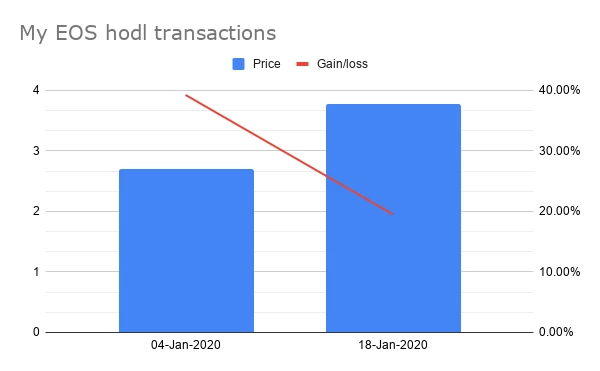
All my transactions:

PS: For those who are wondering about the cover image, they are stakes in the ground connected by a rope to form a chain. It is a play on "staking" in EOS blockchain.
I hope you found this post interesting and you too were able to learn something from it. So long, and watch out this space for the next post in this series after 15 days.
Links to the posts from this series:
Part 1: EOS - One year HODL experiment (Part 1)
Part 2: EOS Learn and Earn - Staking
# Cover image: Credit to jackmac34 from pixabay.com






