
Cyber Perpetual Contracts have recently gained public attention, having reached a trading volume of 9.64 billion USD and 287 million Open Interest in 24 hours according to Coin Market Cap, this is an impressive 218% increase with Perpetual Contracts now sitting in the top three with Bitcoin and surpassing Ethereum as one of the largest increases in trading volume history!
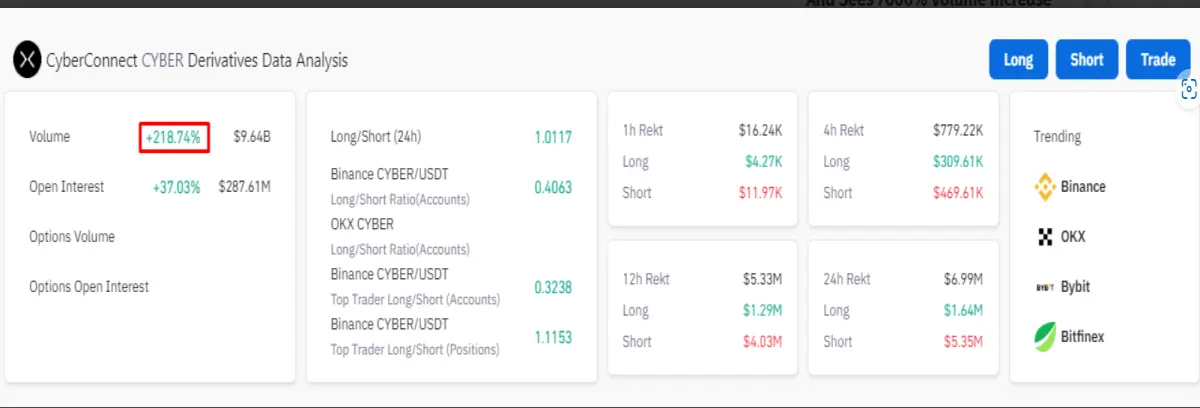
STATS COURTESY OF COINGLASS
With that being said, the increase has many crypto enthusiasts perplexed and many wondering exactly what a Perpetual Contract is. If you are curious about Perpetual Contracts and how they function in the Cryptocurrency ecosystem, then you have come to the right place!
The easiest way to explain a Perpetual Smart Contract in an organized manner is to follow the flow chart below:
A Perpetual Contract Is a ⟶ Derivative that is a type of ⟶ Smart Contract à Specifically a Futures Contract → that has no expiry date ⟶ Where transactions are conducted on a ⟶ Cryptocurrency Exchange platform that utilizes ⟶ The “spot” tactic to optimize the success of trading cryptocurrency
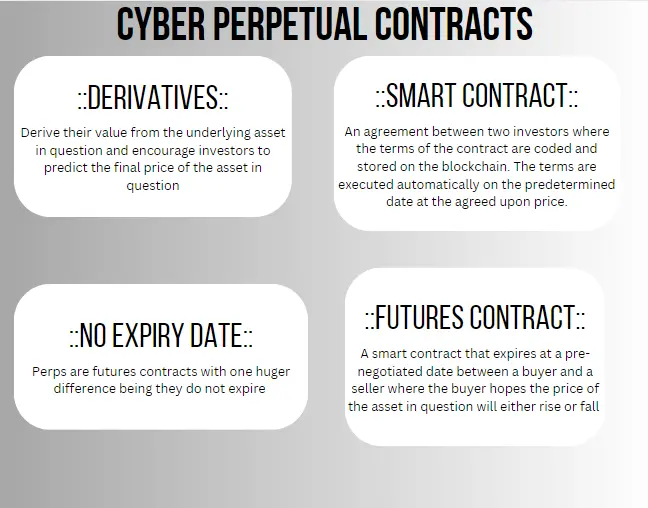
Crypto Derivatives Explained:
The first place to start in understanding Cyber Perpetual Contracts is understanding Crypto Derivatives, as Perps are future contracts and future contracts are Derivatives.
Crypto Derivatives are contracts between two investors that permits and encourages traders to predict the price fluctuation of cryptocurrencies without having to truly and fully own any of the underlying asset, yet still adopting the underlying assets value. The buyer will then either gain or lose profit contingent upon the decrease or increase in price of the underlying asset.
Crypto Derivatives Tactics Explained:
Derivatives can be utilized in many ways, primarily they are used for speculation, hedging, and leverage.
Speculation Explained:
Speculation requires the investor to decide upon a price movement of the cryptocurrency at hand in hopes of ultimately profiting. This is where the method of "going long" or "going short" come into play.
Going Long/Going Short Explained:
The term "goes long" refers to the idea that the price of the cryptocurrency in question will increase from a specified point, so the investor buys in to the cryptocurrency. Alternately, the term "goes short" refers to an investors position in which they believe the value/price of a cryptocurrency will decrease from a specified point, so the investor sells the cryptocurrency.
The Speculation tactic allows investors to play on the volatility of the Crypto market as proper predictions of the pricing of the Cryptocurrency at hand can foster great profits, though nothing is guaranteed.
Leverage Explained:
Leverage trading is a tactic utilized by investors that can increase the chance of profit, as investors are able to trade with minimal investment, multiplying profit and loss. Ultimately the investor is borrowing currency to increase their buyer/seller power in result traders are able trade at a higher position than what currency they have. Certain exchanges offer leverage of up to 100 times the investors account balance. While the leverage tactic may increase an investors possibility of earning money this tactic can be particularly risky as the money being used to leverage is borrowed and often investors must put forth some form of collateral, thus increasing their risk of loss if the price of the token decreases. This tactic in a nutshell relies on the buying low and selling high strategy.
Hedging Explained:
Hedging is a strategy used by traders to offset the risk of loss. Hedging works as follows: A Bitcoin spot holder buys into an asset, maintaining said asset in hopes of the price increasing. If there is reason to believe that the asset will lose value/decrease in price they can take the short position and sell the asset (hedging their position).
Smart Contracts Explained:
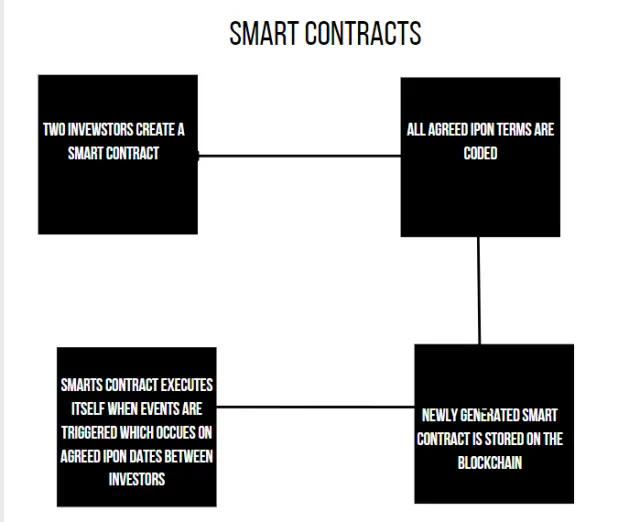
Cyber Perpetual Contracts are a type of Smart Contract. For those of you that are not familiar with the term "Smart Contract" I will explain.
Smart contract is a term that represents a blockchain based form of agreement or contract that is programmed via coding to follow through with an agreement automatically.
Compare a Smart Contract to a timer, when the timer goes off the terms of the contract are executed automatically.
Futures Contract Explained:
Derivatives known as "Futures" rely on the value of a cryptocurrency at a predetermined future date. The purchaser of the future is predicting/hoping that the asset in question will either rise above or fall below a previously agreed upon amount by the time the agreement expires. Upon expiration of the contract both parties must uphold their end of the contract: meaning the seller must deliver and sell the asset and the buyer must purchase the asset. Futures Contracts allow traders to take the long or short position (long=price of asset will increase in the future & short=price of asset will decrease in the future) to try and maximize their odds of profiting from the trade.
Perpetual Futures Explained:
Perpetual Contracts (commonly referred to as “Perps”) are a trading mechanism where the only value is that of the value that is tied to the underlying asset in question. For example, if Bitcoin where the asset involved in the contract the value would be tied to Bitcoin although no actual transaction has occurred yet.
Perpetual Future contracts are much like their predecessor, the traditional Crypto Futures Contracts, yet there is one big difference. While perps allow traders to surmise as to the future price of the asset in question (just as traditional Crypto Futures do) perpetual contracts are signed to perpetuity, differing greatly from traditional futures as traditional Crypto Future Contracts come with an expiry date.
Perpetuity and Expiry Explained:
In the financial world, perpetuity refers to a continual flow of uniform capital that is infinite. In cryptocurrency, perpetual contracts, specifically, perpetuity refers to the infinite state of the contract. (Hence the name "perpetual" contract).
Expiry dates are, as the name implies, simply the date that the terms of a futures contract expire.
The fact that Perps do not expire gives traders the control to hold onto the asset for as long as they want, or sell the asset when the time is right/ the most profitable for them.
Spot Strategy Explained
The lack of expiry gives traders the opportunity to utilize the “Spot” strategy to try and maximize their earnings. The Spot strategy is a simple tactic that involves the trader buying low and selling high. Just as it sounds the trader would buy assets at a lower price and sell them at a time when the price is higher to earn from the difference.
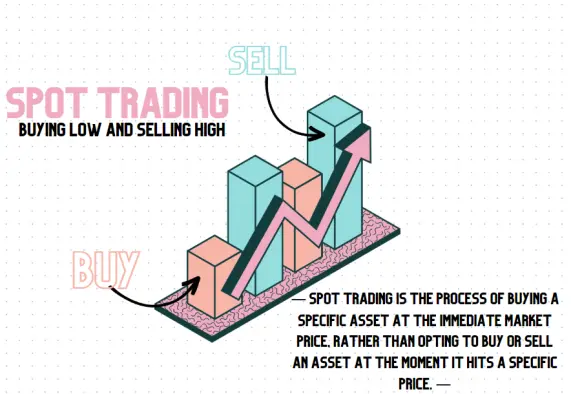

Cyber Perpetual Contracts in a nutshell, are derivatives that which are a form of a futures contract that derive their value from the asset in question and have no expiry date. The lack of expiry date gives the investor the flexibility to sell or trade their Cryptocurrency asset following the "Spot Trading" structure in hopes of maximizing their earning potential.
I hope this article summed it up for you and now you understand exactly what a perpetual contract is and how it functions! Look out for my next post on whether or not Cyber Perpetual Contracts are a smart financial investment or not!
Thanks for reading!





