
Introduction
It is agreed that the price for cryptocurrencies, such as Bitcoin (BTC), Ethereum (ETH), Ripple (XRP), and Litecoin (LTC), follow each other. But how good is the correlation?
A Pearson_correlation_coefficient (PCC) measures the relationship between two variables. A value of +1 shows a perfect positive relationship. Generally, the relationship between two variables is considered strong when their PCC is larger than 0.7.
Results
One site that has a list for the PCC between cryptocurrencies is Cryptowatch. Here are the results for the correlation between BTC, ETH, XRP, and LTC for a time period of 24-hours, 7-days, 30-days, and 1-year.
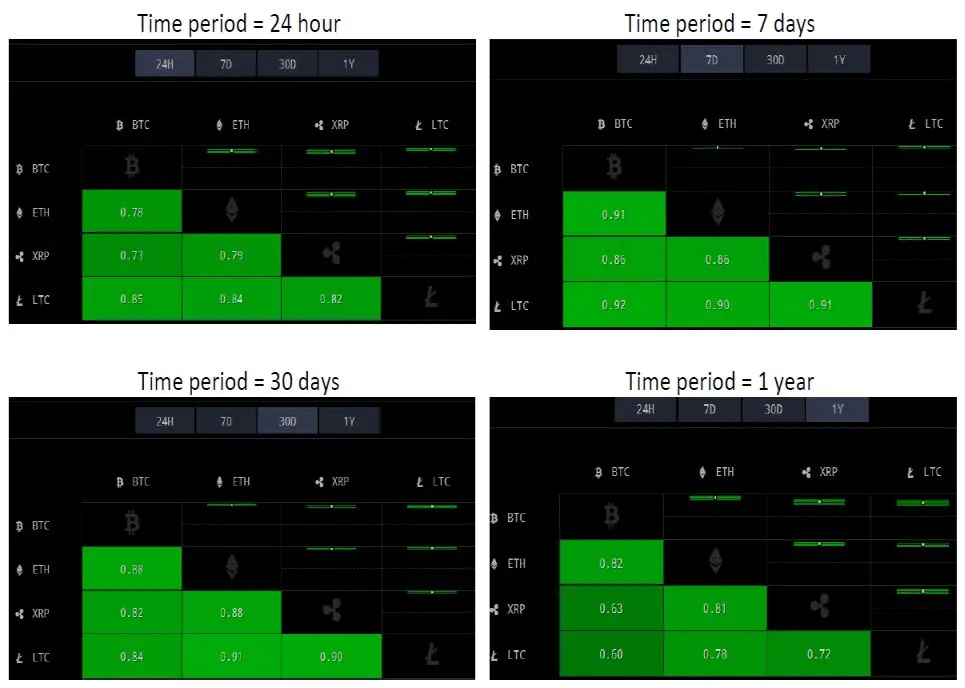
As the time period increases, the correlations between the cryptocurrencies decreases. But, only for the BTC/XRP and BCT/LTC relationship at a 1-year time period is the PCC between the cryptocurrencies less than 0.7.
A second site that has a list for the correlation between cryptocurrencies is Blockchaincenter.net. Here are the results for the correlation between BTC, ETH, XRP, and LTC for a time period of 90-days, 180-days, 1-year, and 2-year.
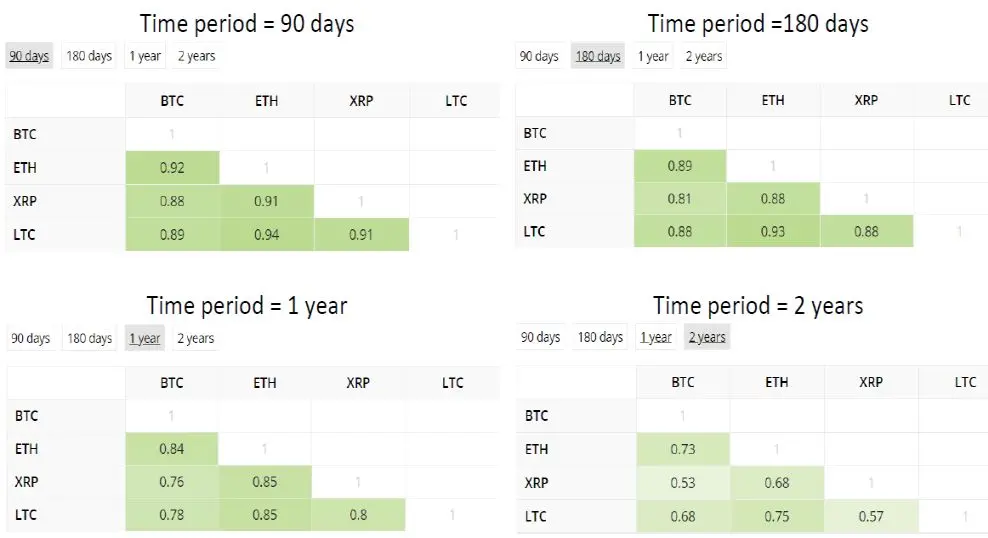
Again, as the time period increases, the correlations between the cryptocurrencies decreases. But, only for BTC/XRP, BCT/LTC, ETH/XRP, and LTC/XRP relationship at the 2-year time period is the PCC between the cryptocurrencies less than 0.7.
Conclusions
For a time period of 24-hours, 7-days, 30-days, 90-days, and 180-days the change in price between BTC, ETH, XRP, and LTC is considered strong as measured by a PCC. As the time period increases, the correlations between the cryptocurrencies decreases. For BTC/XRP and BCT/LTC at a 1-year and 2-year time period and for ETH/XRP and LTC/XRP at a 2-year time period is the PCC between the cryptocurrencies less than 0.7.






