
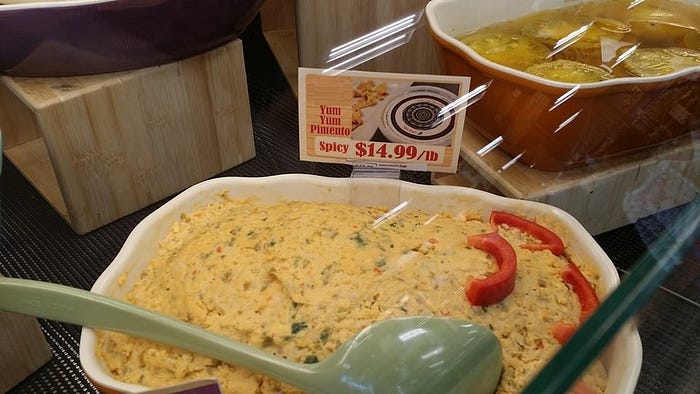
 Should have maybe gone public with a deli salad index fund
Though already having proven himself something of a manic madman, deli merchandiser Pat DiStazio is at least an entertaining one. The question of how long it is before he completely negates all progress made in this department has become a celebrity death watch type event, with bets ranging anywhere from a month to a year and a half. If Edgar had to guess, he would predict that Pat battles his way through this upcoming holiday season — survives but doesn’t exactly crush it — and then somewhere around spring to late summer next year, either by his own hand or given a forceful shove by those of management, quietly disappears.
So yeah, he’s going a bit long. The guy seems knowledgeable enough, though a total bundle of chaos and with plenty of wacky ideas to boot. Possibly nothing but wacky ideas, in fact. The prices of in-house made concoctions are one of the few things Edgar does not decide, as these have always fallen under the deli merchandiser’s purview. And while Edgar booted out Christie’s log-in credentials for the Hobart scales the instant she was gone — and Pat has never asked for such, not that Edgar would ever be deranged enough to agree to such a thing — DiStazio nonetheless hasn’t stopped tinkering with these prices from the day he was hired here.
Well, that’s not entirely accurate. The pattern has thus far gone like this: stores take their monthly inventories, the deli margins come back soft; Pat raises a ton of prices on their in-house made concoctions; the next inventory arrives, margins come back even softer, Pat raises these prices higher still.
So far this has happened through three inventory cycles. Of course, what saying that Pat raises prices really means is that he is submitting these to Edgar, who is the one actually punching these into the ScaleMonster program and sending them down to the scales. And Pat submits these via hilarious charts drawn up on notebook paper, the writing all caps, grids slashed across the page in pencil. The items listed down the lefthand side, with boxes beside them indicating the new retails he wishes to have applied to Palmrya and Southside respectively, as, in another twist, these aren’t always the same.
By now most of their salads for example are $3 higher per pound than they were before Pat took over, which has caught even Duane’s eye. One of Duane’s pets is the chicken salad, for a couple of compelling reasons. First off, it’s a unique recipe, and one that Duane himself brought to the table way back when he first joined this company. Most of all, though, it’s also consistently the deli’s strongest seller, day in, day out, and remains so despite these outrageous price hikes. It’s caught his attention enough that he pokes his head into Edgar’s office, which almost never happens, and asks what is going on with this price.
“Pat keeps jacking up the retails on all the salads,” Edgar shrugs, “basically every time the inventory numbers come back, he’s having me raise the prices.”
Duane’s eyebrows shoot up and he declares, “well, he needs to put a stop to that, now!” but as he then strolls off without any actual directives issued, Edgar isn’t quite sure what to make of this comment.
Pat’s emails are already becoming quite legendary, too, for both the content and the stylistic choices. Many of these are so skeletal they resemble haiku, or some other form of minimalist poetry, retaining an air of mystery than can be perceived any number of ways. For example, when Edgar sends out this email to Chef Mike, copying Pat as always:
Mike: I just had a couple of things to point out to you concerning last week’s invoices. Of course this is stuff you probably already know but just in case you don’t & want to save a few bucks — the Hartman’s mayo ($68.69) is cheaper through Atlanta Distributing ($64.41) and obviously as I know you’re aware much cheaper through Restaurant Junction ($47.60). The albacore tuna though ($110.21) is cheaper through Universal ($96.24) which you may not have known. That is all this week sir. Thanks.
To which Pat replies:
Edgar,
F Y I
southern is gone
also no movement reports
A response so baffling that Edgar doesn’t even bother touching it, apart from pulling up the thing and laughing over it endlessly. Even though, yes, this is a fairly representative effort from their deli merchandiser. Kathy Ames says that Pat is far and away the most notorious figure she’s yet worked with as far as missing tons of invoices every week. She hears about it from the vendors expecting payment, of course, but Edgar would have no knowledge of that aspect. Every invoice is supposed to go in the hopper down by the respective customer service desk, at each store, so he can go over them — yet if one is missing, he has no way of knowing this.
One thing’s for certain, though, Pat has already attempted what he may have considered a sneaky end run when forgetting to email people, then doing so anywhere from 7–11pm, then arriving on the scene the first thing in the morning and complaining to Duane or Harry or Corey, “I emailed everyone!” as though stumped as to why something hasn’t yet been handled. The only problem with this approach, obviously, is that the emails are time stamped and it’s readily apparent what really happened here. The first time he tries this with Edgar — and, well, yes, on subsequent occasions as well — he doesn’t directly bust Pat out, but rather replies in dry fashion as though there were nothing unusual at all about this request, copying Duane, Harry (having backed away from Redcrow’s maniacal and briefly complied with request that Edgar send every email to everyone with a HSM address…but definitely, absolutely including Harry on every single message from here to the end of time), and whatever store and/or department manager this might involve:
Pat: Alrighty sir, very nice. Sorry but I must have already left for the day before you sent this. No problem, though, I will get on it right away. Thanks!
On this occasion, it involves adding a new line of product to the Palmyra deli. Edgar happens to be sitting in their cafe area with his laptop this morning, and as a result maybe ten minutes later, Corey strolls past with his coffee, chuckling as he declares, “I already emailed Edgar about these! I don’t know why they’re not in the system! Yeah, Pat. You emailed him at 7:30 last night.”
Given these various points, when Pat also says something to him about the mileage he’s turning in, Edgar tends to take this with a grain of the proverbial Himalayan pink salt. They’re both hanging out behind the customer service counter. Edgar has drifted down here to make copies of the latest invoice cluster in the hopper, but Pat’s using the machine. He also has his mileage sheet with him, however, attached to his clipboard, and is filling in some details from his last trip to Liberty, while he waits.
“You’re figuring that up wrong,” Pat tells him, glancing at the sheet Edgar’s toiling over. When Edgar laughs, Pat’s eyebrows raise above his thick, shiny gold metal spectacles and he insists, “I’m serious.”
“That’s the same thing Harry said, actually. Where are you guys getting this?”
Coincidentally enough, though, Edgar’s in Walnut just a few days later. It’s the last of the month and he’s figuring up the final numbers for this month’s mileage. Karen has a manila envelope stuffed with invoices and her own mileage sheet, bound for Bellwether, and Edgar figures he’ll just add his to the collection. He hands it to Karen, who is seated at the cramped office’s lone computer, and can’t resist giving his sheet the inevitable once over.
“This isn’t right, you know. You’re shorting yourself on the mileage,” she says.
“Yeah, that’s what Harry said. And Pat too, actually. But I’ve looked it up in the handbook. And this is how it was explained to me.”
“I get paid more for one trip to Southside than you’re claiming for the entire month!” she smugly declares. But then again, she is trying to help him here, so he’s inclined to overlook this weird taunt.
“How’s everyone coming up with this, though? I actually live between here and Palmyra.”
“That doesn’t matter. Yeah, see, Duane and I live between here and Southside. But even if I drive straight from home to Southside, I get paid mileage from this store to Southside and back again. That’s how it’s supposed to work. Any time you’re at a store that’s not your home store, they should be paying you for it. Your home store is South, so even if you drive straight from your house to Palmyra, you should get paid from your office to there and back again. Or from your office to here and back again.”
As he’s here for the entire day, his mind will return to this a couple of times. Aside from the standard bursts of weirdness, that is, which, even weirder still, almost always seem to be store-specific, too — so it isn’t that you’re encountering a disorienting derangement of the senses at these stores, but that these same things crop up repeatedly, and yet only at that particular store.
Like this business with the average ring. Yes as someone who has been in the industry for nearly a couple decades now, he has heard this phrase bandied about here and there across the years. Yet it’s almost always just some casual notation made at a weekly or monthly meeting, a curiosity, leading to some idle speculation as to how they might bring this up a little.
Not so at the Walnut Healthy Shopper Market. Considering that they’re pulling in maybe a third of Liberty’s business, if that, which is itself not even half of that the other two are doing, you’d think they might pay a smidgen more attention to getting dollars into the cash register in any way, shape, or form. Yet, as Edgar today decides to purchase an apple, and attempts some light banter with the grouchy, middle aged mountain dude, Leonard, they’ve recently hired to work here, banter which includes the phrase, “just trying to help out the sales a little bit here, heh heh,” Leonard is not the least bit moved by either the gesture or the comment.
His nearly neutral grimace collapsing violently downward into a full-blown frown, Leonard grouses, “yeah, but you’re bringing down our average ring.”
Which is surely some doctrine he picked up from the in-house smug contrarian. As Leonard lifts the cash register to stick this Training Mode receipt partially underneath it, so they can re-ring the whopping four or five of these lesser transactions together at the end of the night. In turn, Edgar has a pair of consecutively arriving thoughts. The first is to wonder whether they talk to the customers this way, too. The other is to consider that he will likely pick up his future snacks from elsewhere in this neighborhood, possibly at that delightful coffee shop around the corner.
Then there is the matter of this mysterious scale, up by the cash register. As it turns out, this is a much newer model than any of those Hobarts they’re using at the other stores. However, it is also some peculiar off-brand that is no longer in business, and nobody seems to know where it came from. Corey said he thinks, if memory serves, somebody ordered it for Palmyra a few years ago, but couldn’t figure out how to get the thing to work, and they buried it on a shelf in the back hallway.
This theory does make the most sense, if still not explaining how Corey thought that it would magically receive updates while unplugged and gathering dust on a dark shelf. Now that this company no longer exists, manuals have proven impossible to come by online, though, and nothing about its functionality is the least bit intuitive. By some miracle, exactly one user has posted a few how-to videos on YouTube, and even though these are in Spanish, the miracle of show and tell has at least unearthed for them the mystery of how to load fresh labels roll into the machine. Also, for Edgar, revealing that the secret code for adding new items is *68 — unless possessing an eternity of free time to brute force one’s way through every possible combination, there’s just no way anybody could possibly know this. He draws the line at mashing in the ingredients letter by letter on this device’s clunky, non-responsive keyboard, however, but certainly isn’t insane enough to mention such, either. Should anybody else ever bring this up or, heaven forbid, should this store get popped, then he’ll just deal with the consequences.
But it’s not all senses-deranging weirdness. There’s some new girl here, it’s her second day and she’s walking the door with the UPC scanner, on the prowl for any missing tags. So she has a couple of questions for him, a task he finds pleasant in its normalcy. Otherwise, he remains focused mostly on the task at hand, going through all of Walnut’s invoices.
One of the tradeoffs of working in such a stifling environment is that he thinks it might be a little easier to concentrate, actually, provided intrusions are kept to a minimum. He doesn’t even have to worry about his email inbox while at this store, since it is limited to those twin windows of time over in that coffee shop. Because space is at a premium, it almost becomes a physical tunnel narrowing one’s focus, as there is no other choice. For months now, whether here or at Palmyra or Liberty, he has entertained himself trying to determine what the best method is for sorting invoices, given such limited elbow room.
Here’s what he’s come up with: take the top invoice on the stack, set this temporarily on his laptop keyboard. Since he has just enough room on this table, beyond the laptop’s raised lid, to set two stacks of papers — and it’s the same at the cafe tables at Palmyra, only slightly more room to work with in Liberty’s breakroom — anything that comes before this vendor, alphabetically, he stacks on the left. Anything that comes after, on the right, and if any additional invoices from the current vendor crop up, he adds these to the pile on his keyboard.
After working through that vendor’s invoices, he initials and files them in his laptop bag. Now he grabs the stack on the left. The top invoice goes onto his keyboard, as do any others from that vendor. Any before that one alphabetically get sorted to the left pile, obviously, but any that come after go upside-down on the right. And so on, repeat endlessly, alternating only which way the ones on the righthand stack are facing, whether up or down. By the time you’ve worked your way fully through the lefthand stack, you’ve got a fairly well sorted pile on the right already, and can now repeat this entire process all over again.
It’s possible, of course, that simply alphabetizing them all at the outset might be faster. And probably is, though positively dreadful to contemplate when you’re talking about dozens if not over a hundred invoices. This at least gets the ball rolling at the outset, is less likely to leave him right in the middle of a step if interrupted, and is somewhat fun to execute anyway.
Yet as engaging as this might be, not to mention the work itself, on this outing he can’t stop thinking about the mileage issue. It’s not just screwing himself by potentially getting paid half of what he should, but if everyone else is correct, then this would also mean he should be turning in mileage on roughly 40% of his days — on average, about two a week — instead of just a few. Therefore at the end of this day, over in the coffee shop again before he remotely clocks out, he dashes off a quick email to Duane, asking for clarification on this mileage policy. Duane was after all the one who explained to him in the beginning how this worked, even though it now sounds like his own wife is doing something completely different.
Duane responds by saying he’s going to kick this up to their controller, Carmen. Who then passes this request farther up the food chain, forwarding it for some weird reason to Janis Drake, who then volleys it over to Rob. By the time Edgar arrives the following morning, Rob has already replied, in straightforward fashion, leaving not much wiggle room for doubt: he’s only supposed to turn in mileage if driving to a second store in the same day, or a third, and only the distance from one store to the next. In other words, exactly as Edgar has been doing this all along.
Well, he’s read the employee handbook section a couple of times, too, and it’s a little bit more ambiguous, but basically supports this point of view as well. Which means this has become a situation where you almost hate having asked for clarification on the correct way to do things. He’s not going to rat out the legions of employees doing something else, but at the same time, doesn’t feel right willfully contradicting what their head honcho has just told him. So it looks like he’s eating a self-imposed pay cut on this one.





