
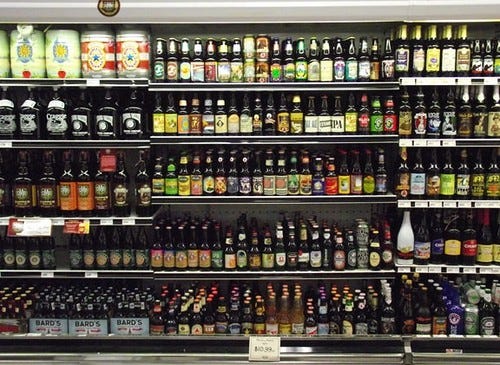
 Partial view of the growler and singles beer section at Palmyra
This move back to the store is like everything happening in reverse. It’s possible Edgar even gives Duane the exact same response, verbatim, in shrugging and saying, “wherever you want me, I’m okay with.” Unlike the frantic switcheroo that brought him up here to the accounting department, however, they at least have plenty of time on their hands to make this transition the right way.
Melissa isn’t leaving, but is rather reassigned to a post they’ve long talked about around these corridors: a dedicated IT person for Healthy Shopper Market. She will have no involvement with Bellwether Snacks whatsoever, apart from answering to Felix as her boss. And some of the existing department managers, merchandisers, and other existing employees, seemingly excited or if nothing else relieved by this turn of events, immediately begin emailing Edgar the new items files as soon as this news breaks. A deli employee he’s never even met introduces herself, for example, in the course of emailing such, and asking if this is okay. He can’t quite jump fully into the role, but this is a start.
In the meantime, they begin searching online for someone to take over this Accounts Payable position. This is a quest that absorbs very little time, though, as they immediately interview and latch onto Glenda Jackson, this hilariously sassy, middle aged black woman with considerable experience. She already knows the Great Plains software, so it’s just down to training her on company-specific procedures — which, after no more than an hour, it’s pretty obvious she already gets. His process is really just about unchanged from the one Kathy Ames taught him. The only notable exception, unless you count his preference for sending email versus her chit-chat inclinations on the telephone, were that he eliminated writing on every single invoice whether it was getting paid this week or if they were on terms, then separating them all out into two different piles after you had all the invoices from every store. This seemed like a serious redundancy, when you could just separate them into two distinct hoppers to begin with, and he figures this surely must save them at least a few hours a week. And Glenda agrees, which is a nice confirmation, but also another example in how they hit it off from the beginning and seem to be on the same page.
Though the process getting here was bumpy, you could argue that this year and a half long saga has ultimately benefited the company. They now have a dedicated IT person, a highly capable AP person, and Edgar’s back in his old post — with another hefty raise, to boot. It’s possible Duane felt he had no choice, considering that this is what he forced to pay Melissa, when she came back to take on that data coordinator role, but yes, Edgar is getting another flat $5 an hour bump to return. Maybe he’s reading too much into this, but as Duane pushes the offer across the desk to him, he detects an implied apology in the gesture, the expression on his boss’s face. As if to say, alright, we screwed up. Please help us get back on track.
The database is a mess, but this time around he has some really strong, experienced backed ideas about the likely trouble points to attack first. It’s akin to coming here as a brand-new employee all over again, but in a parallel dimension. He knows half to three quarters of the noteworthy employees, while the remaining key figures — and just about all of those lower in rank — are unfamiliar to him. Some absences, like Russian Robert simply not being here any longer, catch him off guard, as do some of the role changes, finding people in different positions, possibly having swapped locations as well. Three of the stores are known commodities, but the newest he barely had a chance to work with at all.
“Thank god you’re back,” Dale sighs, upon Edgar’s return behind the big old L shaped desk, “we just about had to shut this place down without you.”
Edgar laughs and says, “yeah, that’s what I heard.”
Which is an exaggeration and said mostly in jest, sure, but on balance, people do appear relieved that he has returned. The first time he’s over at Liberty, the newly hired grocery manager, Laurie, strolls up to him in an aisle, says, “you’re Edgar, right?” and when he affirms this, relaxes her body with an almost heaving sigh, as she then begins to unload on him everything that needs fixed around this place.
One person who will not budge whatsoever on his grumbling stance is Corey. It’s true that your occasional Vince Brancatto seems about as nonplussed as ever, but this is to be expected. With Corey, however, it’s as though something crawled up his ass a couple of years ago and has yet to leave. Edgar feels there’s no debating whatsoever now the significant points here, these being that Corey refuses to ever admit he’s wrong, but also that it bugs him to no end when people are praising someone else’s work. He also detests someone pinning him down with any specifics whatsoever, which is another huge beef he holds against those who are a little more organized. The only difference this time around is that Edgar is no longer intimidated by him, higher up or not.
He knows what he’s dealing with, here, and can’t resist poking the bear on occasion. Of course, situations like these all have legitimate business applications, and are beneficial to the company. It’s just that he knows certain strutting peacocks are going to get their feathers ruffled, and would be lying to himself if not admitting a certain satisfaction in this.
The newest chapter in this series concerns a late afternoon in Palmyra, as Edgar’s retracing his years old footsteps, and going through this twice downsized wine set to see what doesn’t scan. In the course of so doing, he’s also getting back on the horse of entering a location code for every section of fresh shelf tags. Still later, with some time to kill before 4pm and nothing else tremendously pressing, he gets on this kick of examining the sales figures for the little wine island in the middle of the floor.
This is a two-sided shelving unit, twelve feet long on both sides. One four foot section and some change, depending upon the day, is typically eaten up by alcohol related doodads, such as wine stoppers, corkscrews, and beer glasses. The remainder is all wine, anywhere from eighteen to twenty feet of it lengthwise, which is far more than it sounds when you consider all the shelves. Not to mention that this isn’t even the most substantial set, not with the hundreds if not thousands of bottles wrapping along both walls of the nearest corner.
Yet what makes him wish to examine this island most of all is not just the weathered condition and faded date on many of the shelf tags, but also the dust levels on the bottles themselves. Scientists have their carbon dating, retailers accomplish the same by examining dust. Say one thing about Pierre, when he was up here, that dude certainly did at least enjoy bebopping around with a feather duster, keeping this department in tiptop shape. Nobody on hand now must get into it to the same degree, although this does make a lack of sales activity all the more apparent.
By creating a spreadsheet of the location codes, the date each UPC was added to their system — to eliminate any new items brought aboard during this time frame — and dropping in the sales history for the past year, Edgar comes up with 93 different varieties, on the Palmyra wine island alone, that have sat there for at least a year, but haven’t sold a single bottle. Ninety-three! In a year! Giggling to himself, he can’t resist emailing Corey with his findings, though sure to keep his tone a strictly academic one. And also to copy store manager Karen as well as the Executive Beer Hipster for good measure.
As luck would have it, though not yet seeing the email, Corey calls him anyway some ten or fifteen minutes later, about a completely unrelated matter. Edgar answers his questions on that front, then throws in as an aside, “oh yeah, by the way, I just sent you an email. I was going through the wine set up here and found…almost a hundred different varieties that haven’t sold in the past year, just on the island alone.”
“Well…someone needs to systematically go through that section, see what we might get rid of,” Corey suggests.
“Yeah, I just did that. That’s what the list is. Those have all been sitting there for over a year, and haven’t sold once.”
“Mmm, well, someone still needs to go through it. We can’t just delete everything,” he says, and hangs up.
Which is of course the last that’s ever said on this subject. Unless you count happy hour, a short while later, when Edgar’s meeting some of his coworkers from the country club. He has held onto this part time, nights and weekends gig throughout, for over a year and a half now — and indeed, as part of the condition of his return to the data coordinator role, it was agreed that this would be a Monday through Friday, eight to four assignment for him. No one would ever make mention of his working a Saturday again, and certainly not demand it, out of the blue, late on a Friday afternoon.
So later this same day, Edgar’s meeting a few of these characters, at some trendy wine bar he’s never been to before. Over drinks and some tapas type offerings, one such coworker, Chris, mentions that he’s heard there’s a pretty good beer and wine selection at the Palmyra store.
“We do have an awesome selection, but it’s just a black hole taking up space. A lot of it doesn’t sell.”
“You need to just blow that out at a 30 and get rid of it,” Shannon suggests.
He doesn’t feel like mentioning that they’re already only at a 28 percent margin on wine, 25 on craft beer and 15 on domestics. This doesn’t seem like the time or the place. Nor does getting on some long-winded speech about how there’s ample proof that having too many options is proven to be counterproductive, and detrimental to sales. He also never said as much to anyone at work, because this might be construed as another example of acting like a “know it all” and that he should “stay in his lane.” After all one of his rallying cries is that there are just a few areas where he has some specialized knowledge, but he feels like he’s really good in those few areas. He’s definitely not trying to tell anyone how to manage a store or sell vitamins or make deli recipes. Whereas a guy like Corey actually believes he excels in all of those things, in everything. But yes, reams of research on this subject has established a couple of key points. One is that having too many options leads to shopper paralysis, diminishing sales. The other is that the human eye is instinctively drawn to larger swaths of the same product. This is why a double facing of 500 items will almost always outperform single facings of 1000 items.
“I heard the guy running it keeps Hop Supernova in the office, but you have to ask for it,” Ryan says.
Edgar smirks and shakes his head in disbelief, says, “the guy who used to run the store would do that. Now he’s the vice president. He’s really into beer and wine, so yeah, now we’ve got mountains upon mountains of the stuff, and it doesn’t sell.”
Edgar can’t help but to mention his recent conversation with Corey. There’s no real harm in this, considering none of these people cross-pollinate. Outside of his brother’s girlfriend, Melanie, the wine rep who got him this job, he’s not aware of anybody else familiar with both camps. Surely some of the other alcohol reps, but that’s about it — certainly nobody present here.
“I just emailed him earlier today about this, actually. I found almost a hundred different bottles of wine, just on this this one little island, that haven’t sold in over a year. He was like, well, someone needs to systematically go through these and take a look at them, we can’t just get rid of everything. I’m like, someone already did systematically go through these — that was me. I just did that. I just told you we’ve had these over a year, and haven’t sold a single bottle!”
Everyone starts howling with laughter as Chris concludes, “anytime someone uses the word systematically, you know they’re just blowing you off.”





