
Hey folks, I’ve written about Liquity in the past, and as innovative and lucrative of a platform it has already proven to be, the team has continued to introduce even more changes this past month that are revolutionizing the way that protocols can raise massive amounts of liquidity.
If you’re unfamiliar with Liquity, essentially it’s a decentralized lending protocol that allows people to borrow and mint $LUSD off of their collateralized $ETH for a relatively low fee. Profits are generated for the platform’s $LUSD stability pool providers when borrowers get liquidated, or in other words, revenue from the liquidations are “kicked back” to $LUSD depositors in their stability pool. Personally whenever I’m expecting that there’ll be a big market downturn, I find myself visiting Liquity quite often because its quite easy to see how close people are to getting liquidated in real time.
Introducing Chicken Bonds
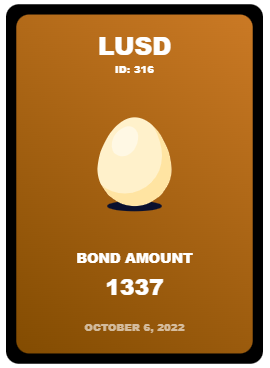
In a nutshell, Chicken Bonds are dynamic NFTs that are representative of the owner’s claim to the amount of their bonded $LUSD. Probably the closest comparison one could draw to Chicken Bonds are Uniswap’s LP NFTs, but as I’ll get into further, Chicken Bonds are so much more.
Once one creates a Chicken Bond, the owner starts accruing $bLUSD (Boosted $LUSD) represented by an egg NFT (picture above), until essentially the egg is ready to hatch and turn into a full-grown chicken (a process called “Chicken In”):
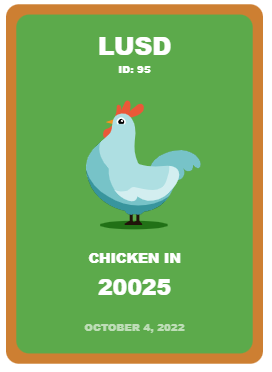
The NFT’s accrual rate of $bLUSD yield can vary but is ultimately stopped by its cap which you can calculate here:
As you can tell from the graphic above, the yield is relatively much higher at first but will decrease significantly as it reaches the $bLUSD cap. What significantly reduces the risk of these NFTs is that at any time, a user can decide to redeem the full underlying $LUSD assets of the bond, from which the NFT will turn into a a little chick running away (a process called “Chicken Out”):
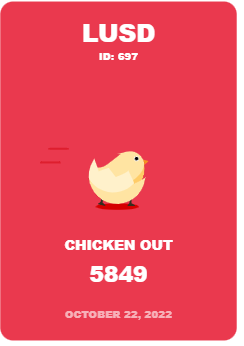
The Chicken Bonds team has essentially created a secondary market for raising liquidity and by taking a look at the metrics since its inception on October 4th, the project has been wildly successful:
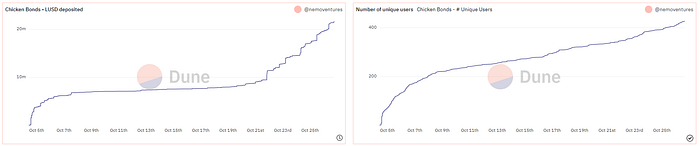
In just over 3 weeks the Chicken Bonds have been able to raise close $20 million dollars worth of $LUSD, and I imagine this number will only continue to grow.
How much can you earn with Chicken Bonds?
As I mentioned before, as an owner of a Chicken Bond you can start earning $bLUSD, a $LUSD derivative. To date, $bLUSD can produce an APR of 54.52% and the $bLUSD/$LUSD LP on Curve has an APR of 66.46%:
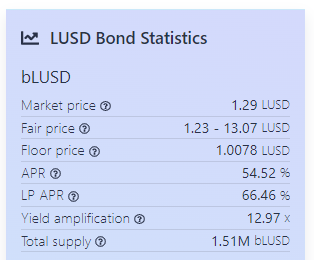
Like many recently bootstrapped LPs I imagine that as Chicken Bonds gain more popularity (as I’m sure it will), I fully expect the rates to decrease, however these rates are truly exceptional if you consider the minimal amount of risk there are on the underlying assets.
Speaking of risks…
Potential Risk Factors
No DeFi platform comes without risks, and Liquity is no different, as there are a few to be considered.
Some of the yield comes from other users: Reminiscent of ponzi-nomics, the earliest Chicken bonders are gaining boosted yields from the bonders that are doing so after, or in other words, yields are coming from people who deposit after you do. This might sound a bit scary however in the case of Chicken Bonds, as I mentioned before users can always “Chicken Out” and retain their initial deposit minus their forfeited yield during the time that they held the Chicken Bond. In addition, the Chicken Bonds team clearly states that:
The yield amplification is not solely dependent on ever more bonders joining. Over time, the POL of the Permanent Bucket will grow and provide additional yield for the amplification even if there are no new bonds created.
In Chicken Bonds, a bank run situation is mitigated as everybody can redeem its bLUSD pro rata for the LUSD in the Reserve. Thus, no one is left holding the bag.
Although it may be true that Chicken Bond holders are protected from bank runs, I’m sure most economists would agree that no platform is truly bank-run resistant. In other words, if there’s a run on $LUSD itself, then it doesn’t matter if you’re redeeming your original bonded amount because your $LUSD may not be worth as much.
$LUSD-peg: $LUSD is fully collateralized by $ETH as new $LUSD can only be minted if someone opens up a trove, issuing more $LUSD. Therefore, if the value of $ETH crashes significantly it may impact its collateralization, but theoretically this should not happen because this means that Liquity is retaining capital through massive liquidations. All this being said, Liquity does tend to have a fluctuating peg, normally to the upside:
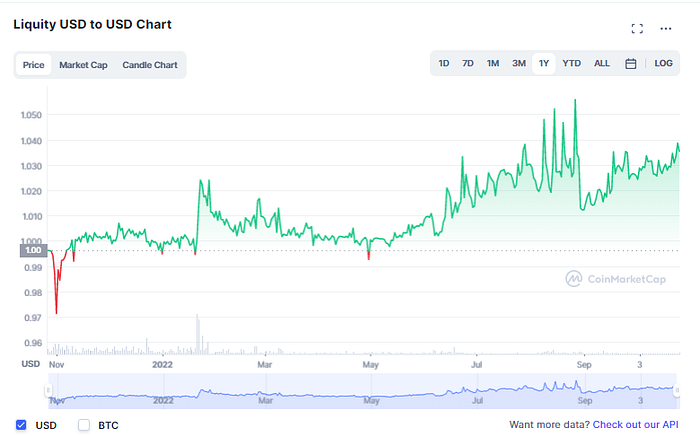
Therefore it’s important to take notice of your enter/exit prices for your $LUSD positions as a $1.00 to $1.05 difference could make a signficiant difference on your returns.
$bLUSD-peg: As a relatively new product, it’s hard to say exactly how correlated $bLUSD will be to $LUSD. According to the team’s FAQ:
bLUSD is expected to trade at a market premium above its redemption price.
This is because bLUSD earns an amplified yield compared to the underlying LUSD that it redeems for.
As a bLUSD holder, your bLUSD is redeemable for a certain amount of LUSD now — let’s say x LUSD. But in the future, the same amount of bLUSD will be redeemable for more than what x LUSD could have grown to by being staked in the best yield source
In other words, although $bLUSD is a derivative of $LUSD, the different use-cases and applications for $bLUSD yield accrual will have a possible unpredictable effect on $bLUSD’s price action.
Conclusion
I truly believe that the Liquity team has brought their collateralized stablecoin to the next evolutionary step of what it means to be truly decentralized, and with the introduction of Chicken Bonds, I can only assume that more platforms will start forking their ideas, just as DeFi Franc did with Liquity’s stability pool/trove mechanisms.
If you’re wanting to read further about Liquity, I highly recommend that you check out my previous articles on Liquity borrowing/liquidation mechanisms (1, 2) or if you’re interested in learning more about the Chicken Bonds, I only skimmed the surface here so I highly recommend you checkout their website https://www.chickenbonds.org, especially their deep-dive article about the NFTs themselves and all their different attributes.
Thanks for taking the time to read this and be sure to follow me on twitter (https://twitter.com/CryptosWith) to get all of those latest updates.
Disclaimer: And as a final reminder, this is not financial advice and this is for educational and entertainment purposes only. Please as always, do your own research and find what investments are best for you. Cheers everyone!





