
One of the first steps of onboarding anyone in crypto is usually through an exchange like Coinbase and having people buy their first $BTC (or some other bluechip cryptocurrency). The second step is usually setting up a Metamask wallet and sending your crypto to that wallet. In less than a 3-year span, Metamask has had “a 38-times increase from 2020,” now encompassing more than 21 million active users monthly.
With how quickly the crypto-space has exploded, it’s also no wonder how quickly the space has evolved since then — liquid staking, layer 2’s, the metaverse— and perhaps most importantly over the past few years, the rise of web3.
For all its strengths, one of the true things that Metamask lacks, is true ownership. As I’ll get into more detail later, Metamask has a tiered proprietary license which limits how its code can be used, and on top of that just like any web2 company, its profits and governance is centralized to the owners, not to the users itself. This is where Tally Ho comes in — the first “web3 wallet that belongs to everyone.”
The Next Evolutionary Step in the Wallet Game
Tally Ho has combined the similar functionality of Metamask with the benefits of a true DAO and underlying principles of web3. In fact, because Metamask essentially went private, this inspired the folks at Tally Ho to build something that wasn’t :
Wanting to create something web3-aligned, the Tally Ho team essentially made the decision to build something integral from the ground up — and they’ve been doing so for only less than a year. If you take a look at their timeline in relation to Metamask’s, it’s easy to see essentially why the push for Tally Ho came into being:
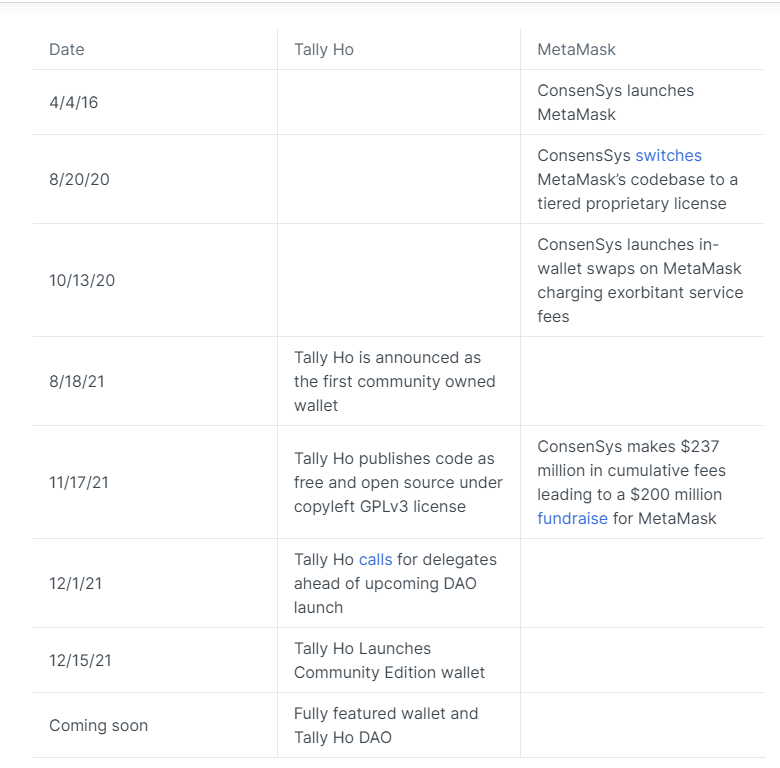
Unlike Metamask, the source code for Tally Ho is completely open-sourced with a GPLv3 license which is available to everyone, and all of its fees (such as from swapping) all go directly back to the Tally Ho DAO — hence which is why they state that this is a wallet “community owned and operated.” To put things into perspective, ConsenSys (the parent company of Metamask) has reported that Metamask had made a revenue of $200+ million dollars in 2021 alone — none of which went back to its users, and now is on track for even higher numbers for 2022:
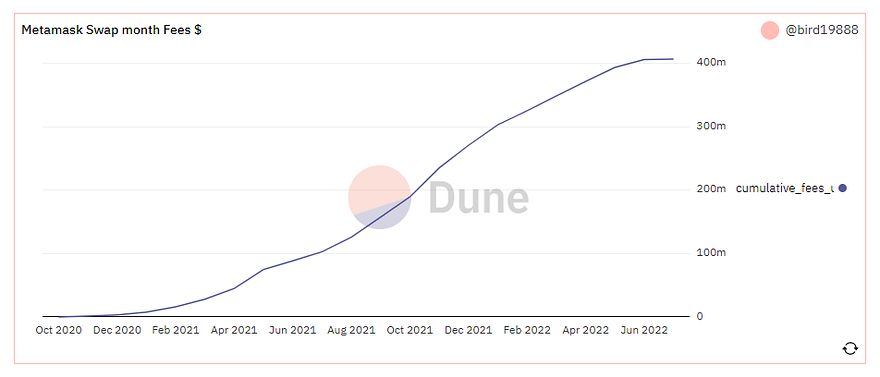
Now this is a type of revenue model that screams Facebook or Google — both “free” services that are based in web2, which takes profits off of its users. What Tally Ho wishes to do instead is to have the users/DAO to be the ones who profit and also help govern the direction of the company. And just to clarify, while Tally Ho eludes to the fact that profits go back to the community, the profits in fact go to the DAO, not individual user’s wallets.
How does the DAO work?
Like many other DAOs, Tally Ho operates on a Governor Bravo framework, with elected delegate positions (positions any one can apply for) that act as representatives for governance proposal decision-making. If you’re curious, you can find all their governance-related discussions here.
As you can see from the DAO’s structural proposal, the DAO has multiple governing responsibilities including those with the DAO’s treasury, swap fees, and operational plans tied the budget. If you’re curious to find information about swap fees, or the treasury itself, they’re all made publicly available on Dune Analytics:
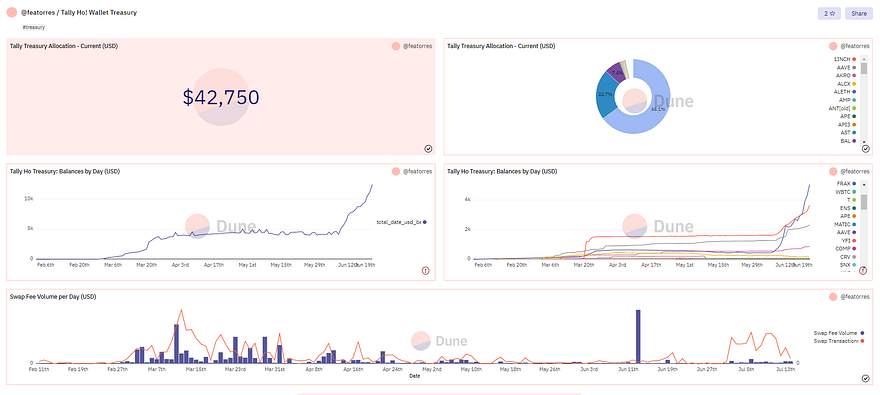
As you can tell from the graphic above, compared to Metamask, Tally has a long way to go. (The Community Edition Wallet itself is barely half a year old!) However, given their youth, it certainly appears that they have gotten off to the right start. If you look through their governance forums it’s clear that they have a strong focus on listening to its users, and since their birth they’ve already had 3 audits completed by Open Zeppelin, Least Authority, and Code Arena. If this integration towards web3 is successful, I find no reason why it can’t gradually take over Metamask’s marketshare, and become the wallet of choice for everyone that embraces web3 ideology. And speaking of Tally Ho’s growth, this leads me to my next section:
Tally Ho’s Road Map
Perhaps the biggest criticism that I’ve heard from users on discord are the bugs. In order to try to meet a December deadline, the Tally Ho team came out with their product by December despite thorough-enough bug testing in order to meet the demands by the community. That being said, it’s clear that the team is continuing to work hard — not only to perfect the wallet, but to work on integrations of new features, such as integration with Polygon, NFT support, and further down the line, connection to layer 2’s. In true DAO/web3 fashion, you can upvote for any upcoming proposals on their roadmap here. (And speaking of future events, they have also stated that at some point there will be an airdrop of their $DOGGO token, with and anticipated more than 10,000,000,000 tokens being distributed community-wide.)
Conclusion
Is Tally Ho a finished product? Absolutely not. But I would argue however that Tally Ho can’t be finished as long as it doesn’t have direction from a full-bearing compass from its users like you and me. In other words, web3 can’t reach it’s fullest or finest form without user-intervention, otherwise we will always remain stuck in web2. With that in mind, Tally Ho is one of those products that has the ambition to allow users to retain control of not only their cryptocurrencies, but ownership of the wallet and the wallet’s platform itself.
Interested in learning more about Tally Ho? I’d recommend joining their discord as their mods are very open to answering questions and receiving feedback about what to integrate in the future — it’s truly an opportunity to get in on a web3 project still in its early phases. At the very least, I’d say spend at least few minutes reading their blog, for there’s contagion in the excitement for what they’re building, and fundamentally why web3 is worth investing in.
Thanks again for taking the time to read this, and if you haven’t already, be sure to follow me on twitter to get all my latest updates: https://twitter.com/CryptosWith
Disclaimer: None of the content within this article is meant to be financial advice. Please do your own research and/or contact a financial advisor to find what investments might be best for you.





