
Hey folks, so If you’ve followed my other articles, you’ll know that in the past I’ve done a lot of deep dives into FUD surrounding different stablecoins, exchanges, and most recently Yield Nodes. I’ve been hesitant up until now to do a deep dive into Tether because there was so much information to cover, and simply because I haven’t had the time. And for that same reason, I’m not going to sort out the multiple-years’ worth of FUD that’s built up against Tether, but instead today I’m going to be honing in on the most recent news that came out this past week, more specifically the announcement they made on October 13th that stated that they have now “eliminated commercial paper” from their reserves:
In this article, I’m going to show how although this may be a step in the right direction, I still remain a bit skeptical of Tether and what it could mean for the crypto community as a whole. And full disclaimer here, I am not an accountant or financial advisor so everything is based on my personal takes and observations of what I found/thought to be interesting and/or concerning.
The Backstory:
First to set some context, in the Spring of 2021 Tether for the first time disclosed the breakdown of its reserves, or in other words they gave the most comprehensive breakdown of how they were backing $USDT:
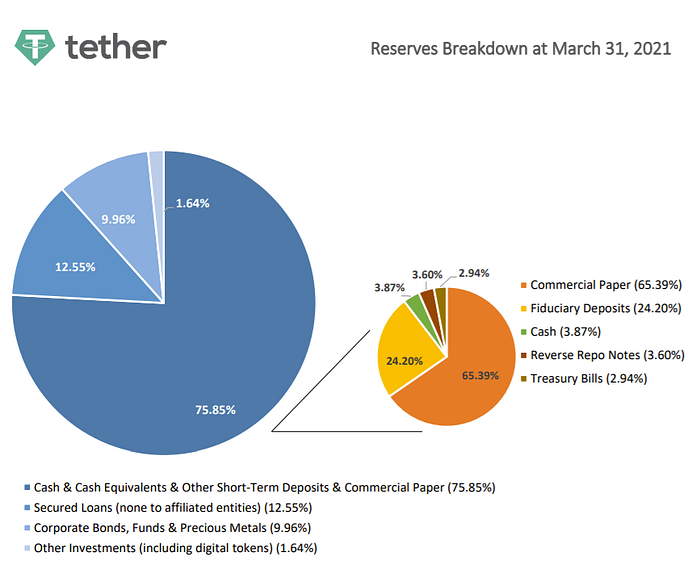
The biggest alarm that came from this breakdown was that a significant amount of their reserves were held in commercial paper — approximately 49.59% (if you reference the graphic above, this is calculated by taking 65.39% of 75.85%, which equates to 49.59% of the total reserves). This means that nearly half of the total reserves up until March 31st, 2021 was held in commercial paper.
What is Commercial Paper?
This is where a great deal of the FUD came in — the definition of commercial paper according to investopedia is as follows:
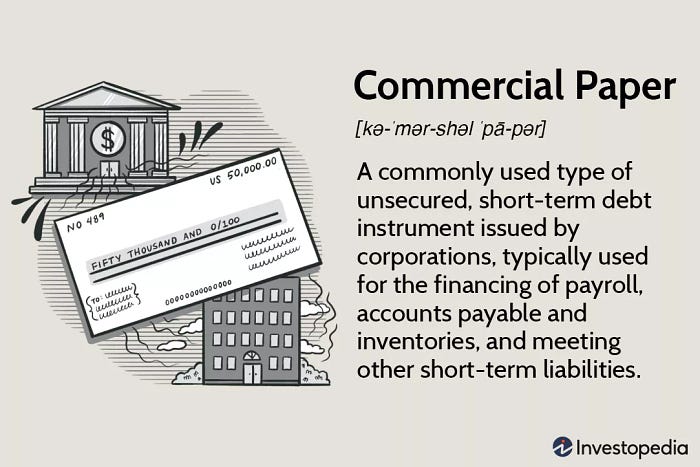
In other words, Tether had essentially loaned out $20 billion dollars worth of uncollateralized debt. Now in “normal” times this may not have been that big of a bombshell, but given that there has been so many different platforms that went under because of uncollateralized debt issued to bad-actors such as 3AC, it’s quite understandable why there was a great deal of FUD surrounding Tether once this information became public. And as more details and research came out about who all these unsecured loans were issued to, the FUD has just continued to grow…
Who did Tether loan money out to?
Speaking of bad actors with bad debt, an article came out by Bloomberg in October 2021, that identified Tether’s loans were given out to the likes of Alex Mashinsky, former CEO of Celsius, and also:
billions of dollars of short-term loans to large Chinese companies — something money-market funds avoid…Tether’s Chinese investments and crypto-backed loans are potentially significant. If Devasini [Tether’s founder] is taking enough risk to earn even a 1% return on Tether’s entire reserves, that would give him and his partners a $690 million annual profit. But if those loans fail, even a small percentage of them, one Tether would become worth less than $1.
If Tether truly loaned out “billions of dollars” to large Chinese companies, then considering that Tether had a marketcap of around $40 billion dollars in late March (stated in the above reserve breakdown), this would equate to at least around 5% of $USDT reserves. What makes this compelling (or perhaps frightening) is that with all the Evergrande protestors from 2021, and an exposed housing market ponzi-scheme in 2022, I don’t think it would be too far of a leap to think that one (or several) of these loans could fail. This leads us to the greatest fear of all: If Tether depegs and causes a big enough bank run, this could lead to catastrophic consequences on the cryptoeconomy as a whole.
Going to Zero
On October 13th with most of the Tether community breathing a big sigh of relief, Tether made an announcement that they had “eliminated commercial reserves, replacing these investments with U.S. Treasury Bills:
The graphic above was semi-corroborated by a report issued August 10th, 2022 by auditing firm BDO, which confirmed that on Tether’s June 30th Consolidated Reserves Report (essentially Tether’s balance sheet), that at that time, Tether had $8,402,426,505 in Commercial Paper and Certificates of Deposit out of a total of $66,409,619,424 in reserves, which equates to roughly 12.6% of total assets. The move to U.S. Treasury bills is a move similar to Circle and $USDC’s, as back in July they moved to 100% cash and short-term treasuries as well. I know there’s lots of $BTC maxi’s out there that would still say that tying one’s fate to the U.S. government might still be a bit risky, but perhaps we can all agree that it’s far less risky than tying your fate to the Chinese housing market.
Questions that remain
Once again referring to the August 10th BDO report, you’ll notice that although BDO is indeed a world-wide credible auditing firm, they still only issued an audit that was limited in scope instead of a full audit that many people have been asking for. In the auditing world (at least in the U.S.), to my understanding there are key significant differences between a full audit and one that is limited in scope, namely:
- In a full audit, everything is subject to testing; in a limited-scope audit, the auditor can examine bank and financial statements, but these can be certified by the trustee and thus, not be tested
- In a full audit, a formal opinion can be issued about whether or not the company is in compliance with regulated and standard accounting principles; in a limited scope-audit, it’s more of a verification that what they saw was accurate.
Why is this significant to Tether? As I’ve detailed in my article, the FUD surrounding Tether has been going on for literally years. The BDO report as well as the recent changes that have been made to commercial paper have only occurred in the last couple of months. One would think that if you’re under that much speculation with the New York’s Attorney General’s office as well as with countless numbers of people fudding them online, that not only would they have requested a legitimate audit earlier, but they would have completed a full one at that.
Conclusion
Are we not giving Tether enough credit for what they’ve done so far? Perhaps. But as the premier leading marketcap stablcoin in the crypto-economy, if a full audit isn’t done soon, then it’s that much later that the public will be too scared to adopt cryptocurrency in general.
Personally I think that Tether has gotten to a point that if it fails, everything in the crypto-economy might fail, and I sure as hell hope that doesn’t happen. If you have any additional takes on Tether or if you believe that there’s something I missed, I would greatly appreciate hearing about it in the comments below. In the meantime, I will be voraciously reading whatever reports and findings that Tether comes out with in the future.
Thanks for reading, and as always, please be sure to follow me on twitter to read all about my latest findings and updates: https://twitter.com/CryptosWith
Disclaimer: None of this information is financial advice, and is just speculation from me, a random guy on the internet. Please consider this for purely educational and entertainment purposes. As always, please do your own research or contact a financial advisor to find what investments might be best for you.





