
Hey everyone, as always I am not a financial advisor, and none of this is not financial advice and is for educational and entertainment purposes only. Please do your own research and find what investments might be best for you.
Cryptocurrency-related credit/debit cards in general
If you've followed some of my other posts on Cryptocurrency cards, you'll know that I often try to work out the math to see whether or not it's worth it especially when you consider the opportunity costs involved. In other words, if you are committing any tokens or money to any card for cashback or rewards for any purchases you're making, it's important to consider whether or not there's a better product place out there where you can put your money to work.
For the purposes of this article, although there are some European options like the Nexo card, I'm really only focusing on US based cards for US citizens/residents, as the United States usually has the best credit card options out there with the biggest/best cash back rewards as well as the largest signup bonuses. Also, I'm not going to go into depth on debit cards, because they either require a significant stake (like Crypto.com) or are associated with custodial platforms such as (SoFi or Robinhood) which don't allow you to trade, yield, or farm your cryptocurrencies. And lastly, there are some other great debit cards out there like the one from Outlet Finance or the one coming out soon from Voyager. Yet even though these might help you accrue some decent APY's on the funds that you hold with them, they don't necessarily have the best cashback rates for purchases. So in other words, it might make sense to open Outlet Finance or Voyager accounts just to accrue the APY on your stables, but there wouldn't be as much benefit to actually do any real world spending on them. In addition, I personally wouldn't knowing that I could get almost twice the APY on other platforms such as Midas.
BlockFi's Visa Signature Credit Card
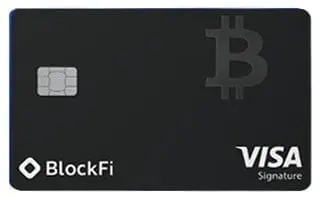
BlockFi just came out with some updates with their card, the biggest news being that they have now eliminated their annual fee of $200 dollars. This hefty annual fee has always been the immediate reason why I didn't give this card the light of day, but now that the fee has been waived, and in conjunction to the country's crazy inflation rates, I thought that now it might be worth it to do the math and take a look. Let's first break down the current aspects of the BlockFi card:
1) No Annual Fee
A very stellar change, especially considering it used to be $200 dollars
2) No Foreign Transaction Fees
Obviously, this isn't that big of a deal for those who spend the majority of the time in the US, but it could be a game changer for those who are expats or who are international jetsetters. There are many cards out there with no foreign transaction fees, but out of the ones that offer consistent cashback and have no annual fees, this is pretty uncommon. That being said, I feel like this is a big plus for the BlockFi card.
3) "Earn 3.5% back in crypto during your first 3 months": The terms and conditions actually state "Earn 3.5% back in bitcoin on all purchases in the first 90 days of card ownership after activation, up to $100 in bitcoin. To reach the full $100 cap would require at least $5,000 in USD card spend."
This is a bit confusing because if you do the math, 3.5% of $5000 dollars actually comes out to $175 dollars, so I don't understand why in order to reach the full $100 cap you would have to spend $5000, when in fact it should be approximately $2,857.15.
4) "Earn 2% back in crypto on every purchase over $50,000 dollars of annual spend"
This basically means that everything you spend between $2,857.15 and $50,000 you will be earning 1.5% and then if you spend more than that, you'll start earning 2%. This total spend bonus essentially resets once your hit your anniversary date, meaning that in order to qualify for the bonus, you'd have to start spend another $50,000 dollars in order to be eligible for another 2% back in crypto again.
5) Trading Bonus of "0.25% back in bitcoin on all eligible trades, up to a maximum of $500 in bitcoin each month"
So honestly, I see this as a pretty insignificant benefit for 2 reasons:
- First, in order to utilize the full benefit of $500 I'd need to be trading around $200,000 worth of crypto a month, something I doubt that the average retail investor/consumer will be able to take full advantage of
- Second, this is a bit misleading because although BlockFi advertises that they don't have trading fees per se, they do have a buy and sell wall for their trades which is one of the ways that they make money. So basically this benefit means that you won't be price gouged as much as you normally would on your trades...but only if you're doing less than $200,000 dollars worth.
6) Stablecoin Bonus: "Cardholders with stablecoin assets...can earn up to an extra 2% APY on top of the prevailing stablecoin APY.
Just like the previous point, I think this too, is a nothingburger, especially considering that the highest rates BlockFi offers on stablecoins is 7% APY. This means that with the BlockFi card, at most you would then be able to earn 9% APY, and this is only on your first 20,000 worth of stables. I'm not bashing the rates here especially if you have a lot of trust in BlockFi, but like most custodial platforms, your assets held on BlockFi aren't insured, and if you're OK with that, then there are other platforms like Voyager who offers 9% APY on USDC (or 10% with the interest booster) or my favorite, Midas Investments, who offers 14.5% APY in native stablecoin (or 17.6% APY with their Midas Boost) with no minimum or maximum amounts deposits required. Therefore, it wouldn't make a whole lot of sense for me to be putting a lot of stablecoins onto BlockFi, especially if I can make better returns without opening a credit card.
How does the BlockFi Visa Signature stack up against the competition?
Now my no BS, benchmark card that I'll always compare all credit cards to is the Fidelity Unlimited 2% cash back card:
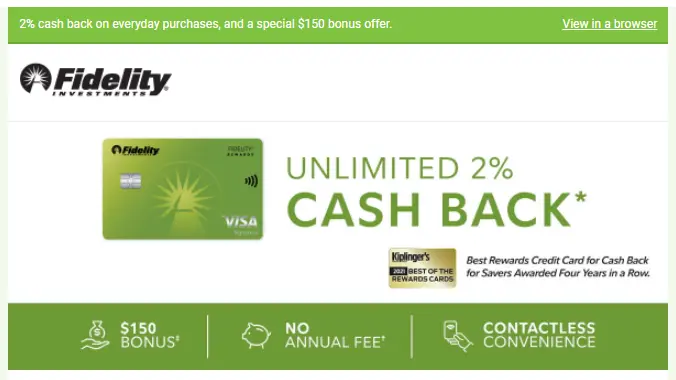
No schilling here, but any one from the points and miles community can tell you that it's pretty much the standard for all-around-decent-return card. Here's the current specs on this card:
1) No annual fee
2) "Foreign Transaction Fee: 1% of each foreign purchase transaction"
Like I mentioned before, as far as no annual fee cards are concerned, most do have foreign transaction fees to offset the credit companies costs. But I do have to note that 1% is still relatively low compared to other no annual fee cards, as many can go all the way up to 3.5%.
3) "Receive 15,000 Bonus Points--which equals $150 cash back, when deposited into an eligible Fidelity account--after you make at least $1,500 in eligible net purchases within the first 90 days of account opening. Limited time offer.
It's true that this offer is limited, because it normally doesn't come with any signup bonus at all. Although to note, there has been targeted snail mail offers for $300 dollar signup bonuses, and previous bonuses for either $100 dollars for $1000 or even $500 dollars in spend. To the best of my knowledge, the $150 offer is currently the best public offer available.
4) "Unlimited 2% cash back on everyday purchases."
This is the card's bread and butter because this essentially is 2% back on any amount of purchases that you make, whether it's $100 or $1,000,000 dollars or more. Now please note that the cash back is in points, which are redeemable 1:1 for cash, but you do have to open an account with Fidelity (which is free) in order to redeem.
A Case for Each Card
I get that spending rates are going to be drastically different for different people, so the following is a case basis for 2 different types of spenders, which will probably encompass most of retail consumers. By breaking down the math for each case, hopefully we'll see what the true value of the card is, or at least see how much we may be losing out on opportunity cost.
Case 1) Only for the spending bonuses
BlockFi: If one were to spend $2,857.15 on their BlockFi card, they would qualify and earn the full $100 dollars worth of BTC, both overseas and domestic.
Fidelity: If one were to spend $2,857.15 on their Fidelity card, they would earn $57.14 dollars from the actual spend, plus $150 for their signup bonus, totaling $207.14. This amount would be for domestic, but for international folks charging the 1% foreign transaction fee, the total would come down to $178.57.
Comparing just the spending bonuses, it's pretty clear that Fidelity, regardless of the foreign transaction fees is worth it more for the short term bonus.
Case 2) Spending on Average $58,488: Why $58,488? According to the visualcapitalist.com, the average consumer spends around $4, 874 a month, or at least they did October/November last year, and for a yearly average this comes out to $58,488. Personally, I thought this was awfully high because I don't usually spend near this much, but it's in the ballpark for other studies I've found. So anyways moving forward...
BlockFi: If one were to spend $58,488 on their BlockFi Card, they would earn: $100 (for their first $2,857.15 in spend) + $707 (for spend between $2,857.15 to $50,000) + $169.76 (for spend on the remaining $8,488 dollars) = $976.76. And once again because there's no annual fees, this $976.76 figure would be the same for both overseas and/or domestic.
Fidelity: If one were to spend $58,488 on their Fidelity Card, they would earn $1,169.76 (for all $58,488 of their spend) + $150 Signup bonus = $1,319.76. This total would be for domestic purchases, but if you charge the 1% foreign transaction fee ($584.88) this would come out to $734.88 assuming that all of your spend was done overseas.
The results are a bit more mixed here, but it appears that domestically the Fidelity card still has a better return for its customers, offering almost $350 more for its customers after the course of the year. Regardless, for expats, the Fidelity is only worth it if 41.3% or more of your purchases are done in USD. If it's any less than that, it appears that the BlockFI card would be a better option. I would also argue that regardless of the foreign transaction fees, it would still be the option even for ex-pats, because having been an ex-pat myself for more than 10 years, I would still spend at least a third to half of all my purchases online mostly in USD, meaning that I wouldn't have to worry about foreign transaction fees for a significant portion of my spending.
In Conclusion
I know I didn't really paint a good picture for BlockFi here, but regardless of the return rates, if you're interested in DCA-ing BTC, the BlockFi card might be a good option to force yourself to do so. In addition, as I've mentioned before I don't use BlockFi as much as I did when I first started out with Crypto, but I think the card itself is good for the crypto economy as it will help more people onboard into cryptocurrencies in general.
Am I going to be opening a BlockFi card up? Not any time in the near future, and probably not until they start offering 2% cashback on all purchases, not just over $50,000. In addition, I have my eyes on other cards in the TradFi-world such as a new 2% cashback card coming out from Bread Financial that is supposedly going to offer 2% cashback with no foreign transaction fees or annual fees! If this card really does get released, in the long-run it may be both a better option than BlockFi and Fidelity.
Have you heard or used any cards that I haven't mentioned? Or have you signed up for the BlockFi card already? I'd love to hear about your experiences using it if you have. Regardless, thanks for reading and please remember to follow me on twitter: https://twitter.com/CryptosWith





