The concept of blockchain to modernize the supply chain industry has been welcomed by many analysts, even those who don’t really believe in the future of cryptocurrencies. VeChain, IBM Blockchain, and many other projects have been trying to “revolutionize” and fix all the ongoing issues in the supply chain ecosystem.
Waltonchain is one of those public blockchain networks that try to target the same use-cases. While Waltonchain looks similar to VeChain and other similar solutions, but Waltonchain primarily focuses on utilizing RFID technologies, and Waltonchain also has a slightly different algorithm compared to its competitors.
So, how does Waltonchain actually work, and is it worth your money to invest in Waltonchain’s native cryptocurrency (WTC) in the long term? Let’s find out together!
Waltonchain - Summary
The name Waltonchain was directly inspired by the name of Charlie Walton. For you who don’t know who he was, Charlie Walton was the inventor of RFID technology. In Waltonchain, the word WALTON itself is actually short for Wisdom Alters Label, Trade, Organization, and Network.
To be honest, it feels like the words were “forced” into “WALTON”
Just because the founders wanted to pay tribute to Charlie Walton.
But, you know what, either way, Waltonchain has been doing decent compared to many of its public blockchain competitors.
Waltonchain team believes that the current supply chain industry needs full integration of blockchain technology. And to achieve the goal, they utilize RFID chips along with their own unique consensus algorithm.
For you who don’t know, RFID stands for Radio-frequency Identification, which uses electromagnetic fields to auto-identify and tracks tags that are being attached to certain objects. The tags themselves have pieces of information that are being stored electronically.
Passive tags, then, obtain the energy from a close RFID reader through the technology of radio waves. The tags do not need to be on the sight of the RFID reader; that’s why they can be easily hidden inside the tracked object.
The concept of Internet of Things (IoT) itself in the Waltonchain ecosystem has been improved. Here, they use what they call Value Internet of Things (VIoT).
The term VIoT is not that much different, to be fair.
VIoT is just the combination and “marriage” between blockchain technology and the utilization of RFID chips. Many Waltonchain critics claimed that Waltonchain was just trying to reinvent the wheel. There’s no need to use a new fancy term when they could simply use both “RFID” and “blockchain”.
Anyway, RFID chips react to a specific type of electromagnet frequency while it sends back the data. RFID chips are usually used in several different environments, which include library systems, inventory tracking, and product kiosks. For your information, RFID chips do not require any battery usage.
And for its own blockchain, Waltonchain uses what they call as parent-chain and sub-chains. So, basically, there’s one parent chain that acts above everything else. The purpose of this parent chain is to execute smart contracts, manage Waltoncoin (WTC) movements, and to manage the sub-chains.
Meanwhile, the sub-chains’ purpose is to be used by the clients and partners who simply want to adopt the Waltonchain blockchain platform for their own benefits. The sub-chains can have their own crypto tokens.
The good thing here is that the sub-chains won’t bother nor clog the network of the parent-chain. The Waltonchain team believes that it’s better when everything is independently managed. They have learned their lesson from the past experience of Ethereum.
For you who don’t know what happened with Ethereum, in 2017, there was a popular dApp called CryptoKitties. When CryptoKitties became very popular, it “clogged” the entire Ethereum network, because of how popular it was. Other Ethereum users who did not even play the game were still affected. They found it very hard and expensive just to send ERC20 tokens from one Ethereum wallet to another.
This is why the Waltonchain team “separates” the traffic management in the parent-chain and in the sub-chains. They don’t want “CryptoKitties incident” to happen in Waltonchain when the blockchain becomes much more popular than today.
Besides the separation of sub-chains and parent-chain, Waltonchain also uses a different consensus algorithm that they call “Waltonchain Proof of Contribution” (WPoC). This consensus was the improvement of the previous consensus that they call “Proof of Stake and Trust” (POST).
WPoC mixes three traditional algorithms into one new consensus. They are Proof of Work (PoW), Proof of Stake (PoS), and Proof of Labor (PoL). The parent-chain in the Waltonchain ecosystem uses both Proof of Work and Proof of Stake, while the sub-chains have to use Proof of Labor for the data exchange across different sub-chains.
The utilization of RFID technology, a unique consensus mechanism, and the separation of sub-chains and parent-chain traffic management has been the unique selling points of this project.
Analyzing Waltonchain Team
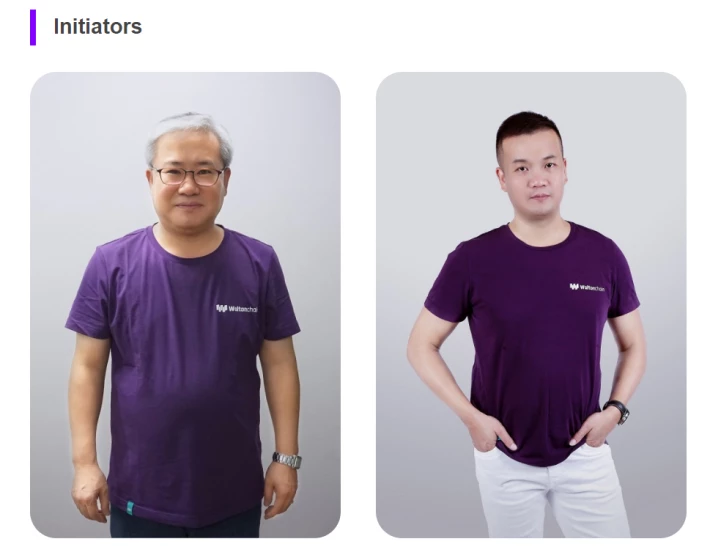
Do Sang Hyuk (left) and Xu Fangcheng (right) - image source
Prior to 2018, there was not much information about the Waltonchain core team’s background. At the beginning of the project, the Waltonchain core team was simply trying to get attention from the Chinese blockchain community. However, things started to change last year (2018) slowly.
The team broadens their shift to the international community, and they finally attempted to market Waltonchain presence to the global community. The main persons behind the project are Xu Fangcheng and Do Sanghyuk, who both co-founded Waltonchain in 2015. The project itself was only officially launched in 2017.
For your information, Do Sanghyuk used to be the Director of the Korean Standard Products while Xu FangCheng was the Supply Chain Management Director for the Septwolves Group Ltd.
One another big name is the senior advisor Kim Suk Ki, who is the ex-Vice President of Samsung. He graduated from the University of Minnesota as Doctor of Engineering. At Waltonchain, Kim Suk Ki acts as the Chief Scientist Advisor.
Another senior advisor besides Kim Suk Ki is Zhu Yanping, a Taiwanese who has won multiple awards in his home country. He won the Taiwan Ministry of Education Youth Invention Award and Taiwan Top Ten Information Talent Award. He’s also the Chairman of Cloud Computing & IoT Association in Taiwan.
Then, we have two chief experts in the project. They are Wei Songjie and Mo Bing. Wei graduated from the University of Delaware. He used to work in high profile companies such as Google, Qualcomm, Bloomberg, and other companies.
Meanwhile, Mo Bing is the Research Professor at Korea University. He’s also the senior member of the Chinese Society of Micro-Nano Technology and IEEE member. Since 2015, he’s been mainly focused on integrated circuits and blockchain technology.
Overall, all of the key players have a strong background. At Waltonchain, their huge experience will play an important rule in the project’s future.
The Importance Of Waltoncoin (WTC) In The Waltonchain Ecosystem
Of course, when it comes to cryptocurrency investment, we need to think about the exact use-cases of the said cryptocurrency itself. Many investors only know about the project fundamentals without knowing the crypto’s purpose in the same project.
So, how about the importance of Waltoncoin (WTC), which is the native cryptocurrency of Waltonchain? Well, WTC has several different use-cases. First of all, it is being used to pay dividend interests. Secondly, it is needed to issue sub-chains. And then, WTC must be used to distribute asset exchange as well as to function as a governance token.
Waltonchain And Past Controversy
There’s one controversy about Waltonchain that happened in 2018. It’s not related to a hacking incident or anything like that. The controversy was about the competition winner. So, basically, Waltonchain held a competition for Valentine’s giveaway. They promised that the winner would be randomly selected with the usage of a script.
However, the “randomly-selected winner” was apparently their own employee. The employee of Waltonchain was caught off-guard because he forgot to logout from the Waltonchain official twitter account. He said “thank you” by using the Waltonchain twitter account. Just look at this below image if you don’t know what I mean:
Of course, the Waltonchain team felt embarrassed by this incident. They revoked the employee’s winning and tried to apologize to the community. Nevertheless, the reputation was already damaged, and most people claimed that the Waltonchain should have never had any competition in the first place.
Waltonchain Future And Potential Roadblocks
If only Waltonchain was running alone in its attempt to introduce blockchain for the supply chain, the future would be very bright. I say bright because blockchain has been proven as one of the most innovative technologies to help identify and verify the supply chain management processes.
However, there are a lot of competitors in this space, both from the public and the permissioned blockchain spaces. IBM Blockchain, VeChain, Food Chain, Tael, and even non-blockchain DLT technology like IOTA are all trying to tap into the same market.
Whether Waltonchain can beat its competitions, only time will tell. However, it looks like VeChain and IBM Blockchain are ahead of Waltonchain in terms of adoption rate.
External Factor And WTC Price
So, you have read about the fundamentals regarding this project. You also have read about its past controversy. But, is it enough to make your decision whether to invest in WTC or not? Unfortunately not. Just like all the other altcoins, you need to pay attention to Bitcoin price.
Most altcoin prices will go down when Bitcoin price goes down. Most altcoin prices will also go up when Bitcoin price goes up. It’s quite important to pay attention to Bitcoin price action in 2020 and in the next few years because it will certainly affect WTC price.
And talking about Bitcoin, there are dividing opinions. Some analysts predict Bitcoin price will go up in 2020 following the next mining halving reward event. Just like in 2016, they believe Bitcoin price will go up significantly this time as well. And of course, if Bitcoin pumps, WTC should pump as well.
However, other analysts predict that Bitcoin pump has already happened in early to mid 2019. They believe everything was already “priced in,” and there’s no new demand for pumping Bitcoin price.
Either way, WTC price will be hugely affected by Bitcoin price action. You need to pay attention to BTC if you decide to invest in WTC.
Conclusion
Waltonchain is a decent project with a decent core team. However, having a “decent” project is not enough to stand out in the sea of altcoins. You also need to be unique and have strong partnerships or adoption rate.
While investing in WTC is still a good idea, but there are also other cryptocurrencies you might want to look at if you want to invest in a blockchain-for-supply-chain solution.






