
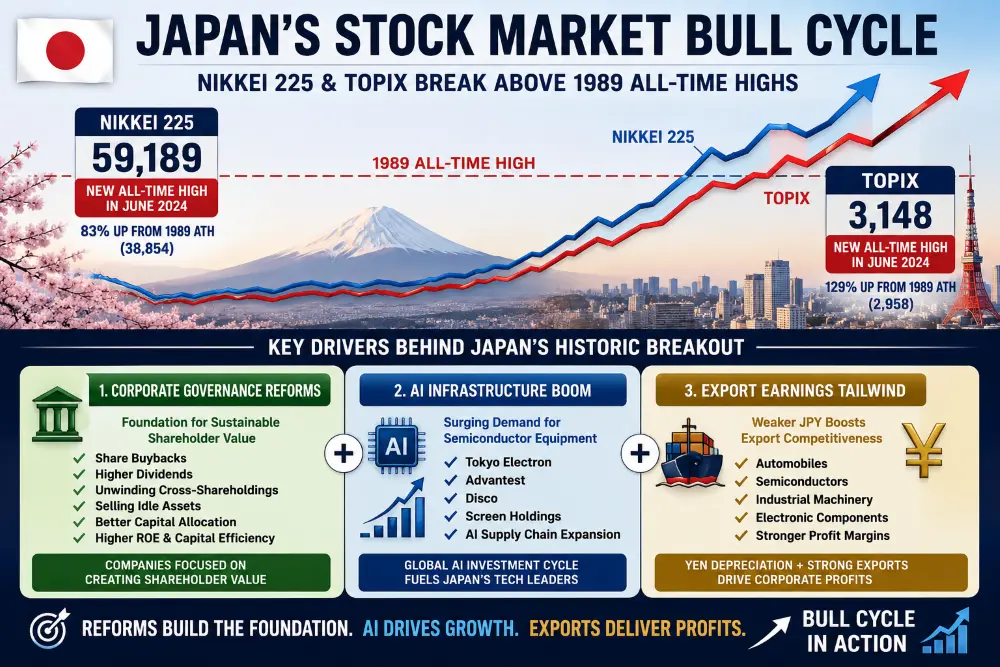
ChatGPT generated image. Entrance of Bull Cycle in Japanese Equity Markets after 35 years!
## Japanese Stock Market enters a Bull Cycle after more than 30 years!
Japanese Benchmark Indices have looked impressive lately as
- Nikkie 225 hit an ATH of 59,189 in June this year, 83% up from its historic ATH of 38,854
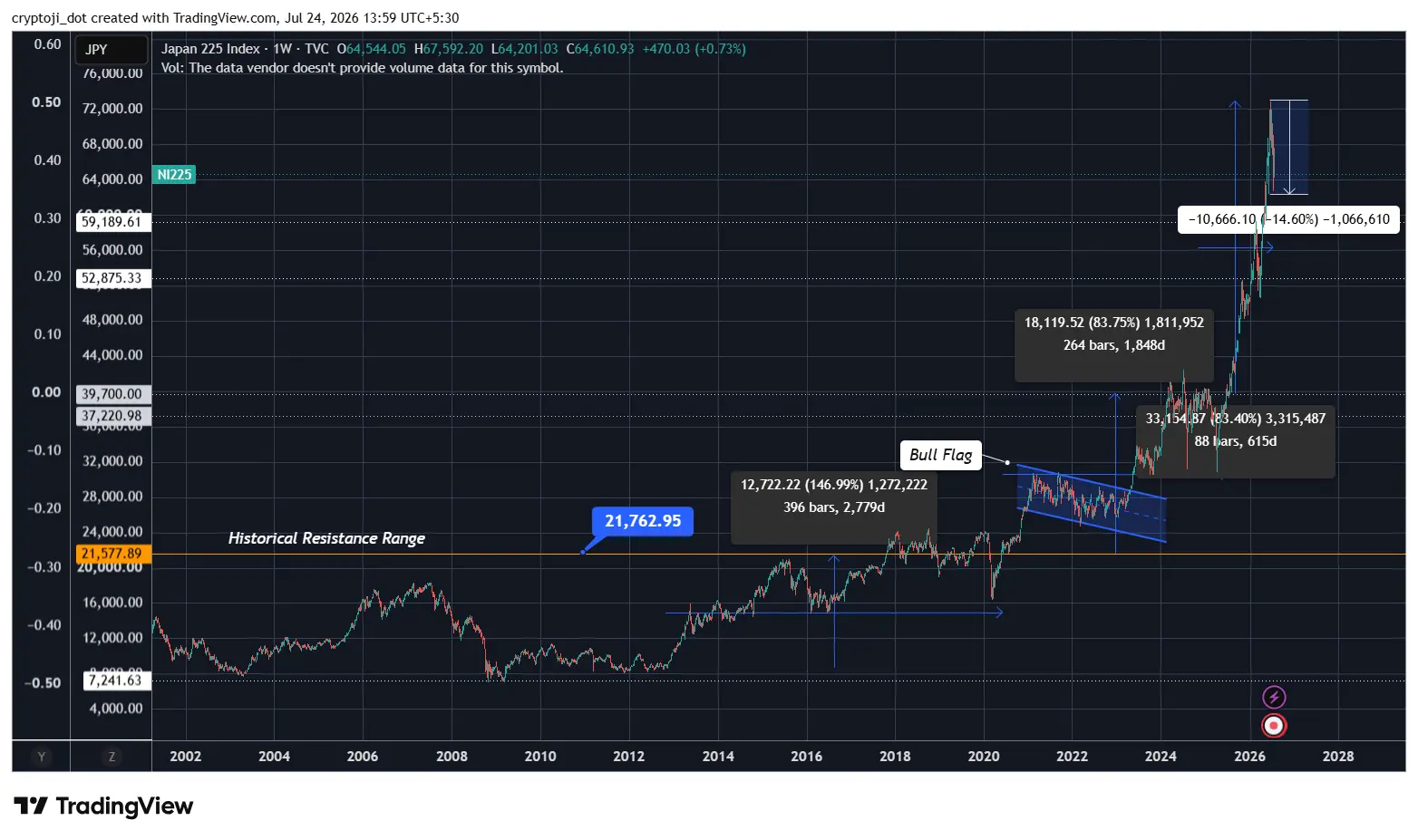
Tradingview chart. Nikkie225 Bull Cycle movements.
Topix hit an ATH of 3,148 in June this year, 129% up from its historic ATH of 2958.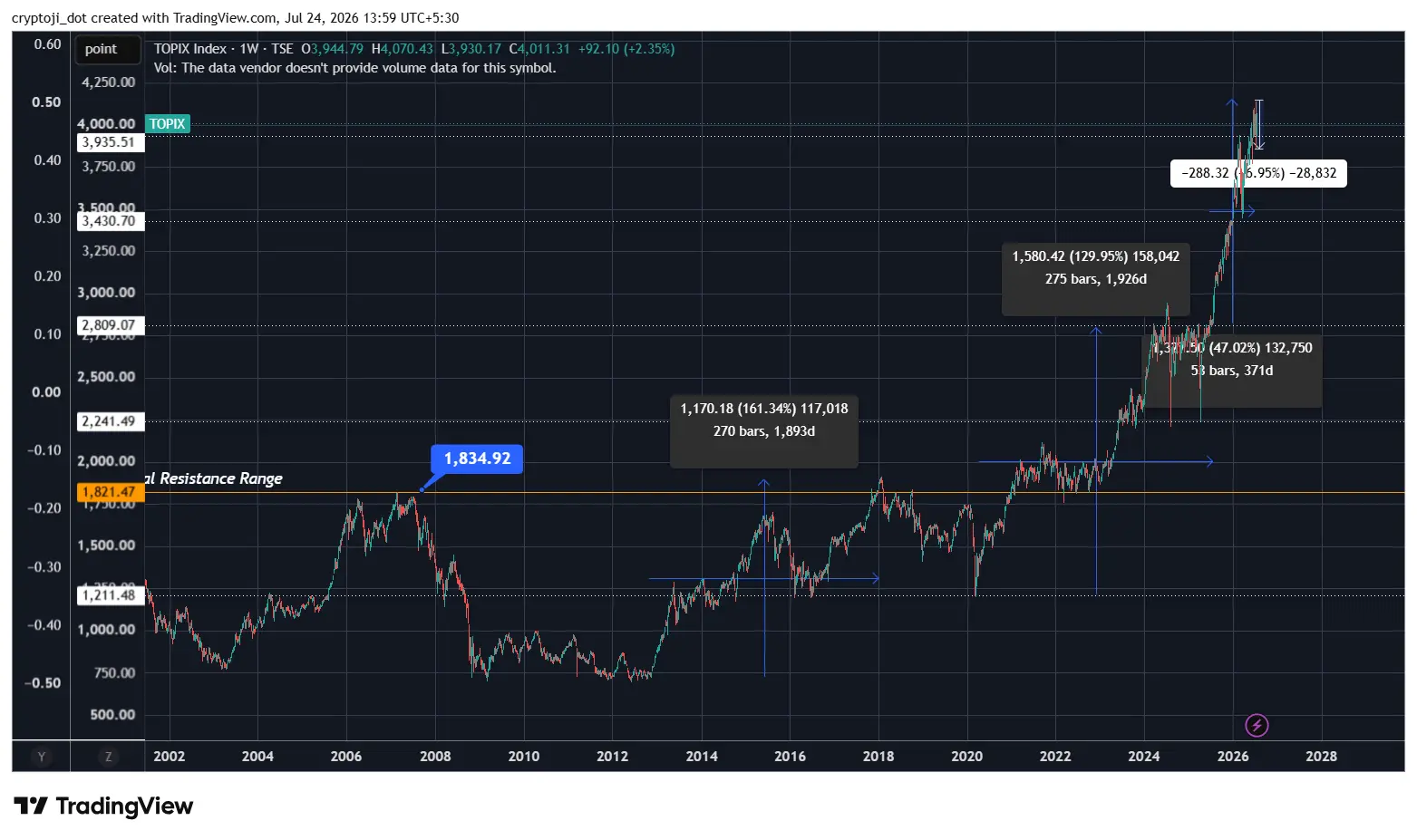
Tradingview chart. Topix strong upside to heights beyond earlier ATH milestone.
What intrigued me here was that the earlier historic ATH peaks of these indices go back to historical timeframe of Dec 1989, more than 35 years ago.
As can be noticed in the price charts – both Nikkie 225 and Topix spent years declining from 1989 Top, consolidating and then acquiring momentum for the Bull Cycle they entered after crossing their earlier ATH range.
Technically the Japanese BenchMark Indices entered into the current Bull Cycle only post 2023 and 2024, as Nikkie and Topix broke their earlier ATH peak and rose into new bull territory.
The backstory behind the recent Japanese Stock Market Bull Run is a fascinating story to understand – it has lessons explaining why Japan’s Stock Market was dull from an investor's perspective and what was done to make the same Stock Market attractive to investors that Japanese Stock Market experienced a Bull Cycle boom.
Low Valuation growth in stocks even through Japanese companies earned profits
As can be noticed in the chart, Japanese Benchmark Indices experienced exciting upside movements from 2023. The question that comes up front is weather there were any specific factors at play during that period that escalated the Bull movement in Japanese Stock Markets?
Another question arises – why did Japan’s Stock Market take decades to enter into a Bull cycle when it has Worldclass companies known for manufacture of Globally renowned products in the segments of electronic equipment, gaming devices, semiconductor components and automobiles.
Japan Brands like Sony, Canon, Hitachi, Nintendo, Toyota, Honda have been earning billions in export revenues as their products were Globally in demand. Japan had always a thriving export market.
Yet – even though many of Japan’s companies had earned revenue surplus from profitable operations, their valuations did not increase proportionately to their profits.
Why Profitable earnings of companies did not get captured in Japanese Stocks?
Japan’s companies earned most of their revenues through exports as Japan was inside a deflationary economic landscape.
Here companies could not raise prices of products for Japanese customers as their demand did not increase as their wage growth was low.
This was Japan’s deflationary landscape, yet companies made profitable revenues through exports.
One of the limiting factors that kept valuations of profitable companies low – was their custom of keeping their profit earnings in form of large cash reserves. These cash reserves piled up without creating shareholder value.
This was why activist shareholders and policy makers were long demanding Corporate reforms that would necessitate companies to take measures to increase Shareholder value.
Reforms inculcating Corporate practices that increase valuation of company stock
The issue that was identified by Regulatory Bodies was – market value of company stocks were lower than company’s book value. This meant most Japanese companies were more valuable than their market valuation reflected in their share price, as they held valuable assets in form of cash, factories, equipment.
Therefore, many Japanese company share prices was undervalued as were priced lower than their book value; a company’s actual valuation taking into account the cumulative value of their assets.
To sort out this discrepancy between company’s share price and their book valuation, the Tokyo Stock Exchange(TSE) introduced Corporate Governance Reforms in 2023 instructing companies to take measures that would improve their stock valuation.
Emphasis was laid on -:
i) Creating Shareholder Value by increasing Return On Equity
ii) Efficient allocation of capital and available resources into productive operations for maximise profits
Companies adopting practices to increase stock Valuation with their profits
Companies began to adopt practices geared to increase their stock valuation, optimise their operations with improved their capital efficiency.
These were -:
- Engage in Stock Buy backs
- Make Dividend Payouts
- Unwind cross-shareholdings
- Sell off idle assets and non-core factory outlets
- Allocate capital strategically to profitable business divisions
Improved Shareholder Value and Attractive Valuations Revive Foreign Investor Interest
As companies implemented these measures – their stocks were fundamentally aligned for valuation growth capturing their performance in earnings.
Global investors were convinced about the potential of Japanese shares to rise in value as companies began implementing practices to create Shareholder value.
As Japanese company stocks were undervalued to their earnings, they were smart bargain buys for investors. This amounted to buying shares that were low priced but valuable with their earnings performance.
Foreign investments flowed as they saw Japanese Stock Market having good valuation growth potential with US Stock Markets perceived to be overvalued.
AI factor increasing stock prices of AI linked Japanese companies
These Corporate Reforms came at a time when AI Boom phenomenon played out with Hyperscalers making massive investments to build AI Data Centres.
Since Japan has Globally leading companies manufacturing equipments, components that are a crucial part of AI supply chain, stocks of such companies belonging to semi-conductor or AI segment surged taking valuation of Nikkie 225 and Topix to higher valuation terrains.
Foremost company stocks that shot up due to their linkage with AI segment were –:
Tokyo Electron (8035) :
Tokyo Electron supplies the equipment used to produce semiconductors, which is important part of AI infrastructure. As demand for semiconductor memory chips increased so did the demand for Tokyo Electron semiconductor manufacturing equipment, taking stock price of Tokyo Electron to highs.
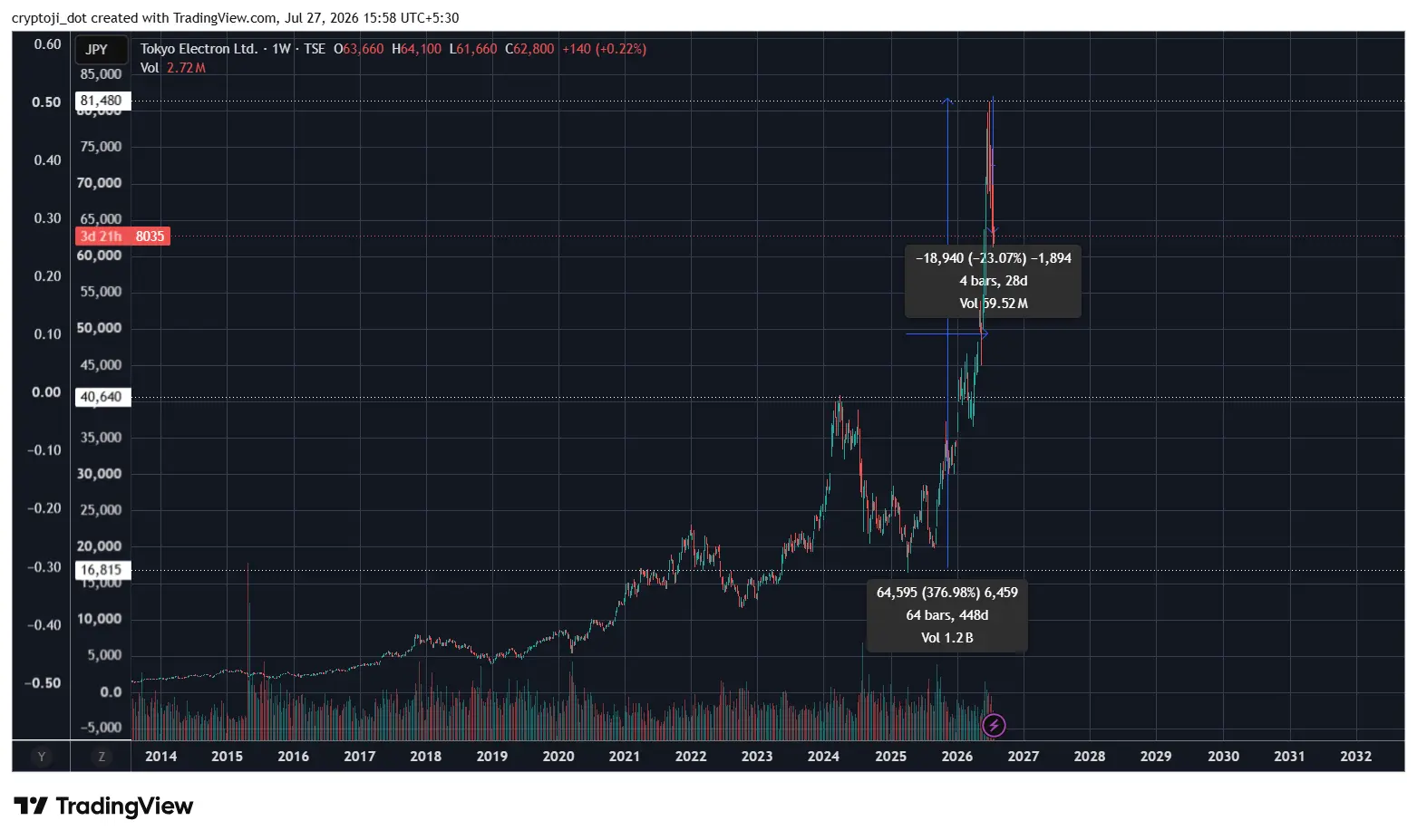
Tokyo Electron surged to an ATH of 81,500 JPY in June this year from a price of 16,500 JPY on April 2025, a 375% surge. Now, the stock has corrected by more than 20% to 63,150 JPY at the time of writing.
Advantest (6857) :
Advantest stock price climbed with the semiconductor boom, as Advantest provides semiconductor testing equipment.
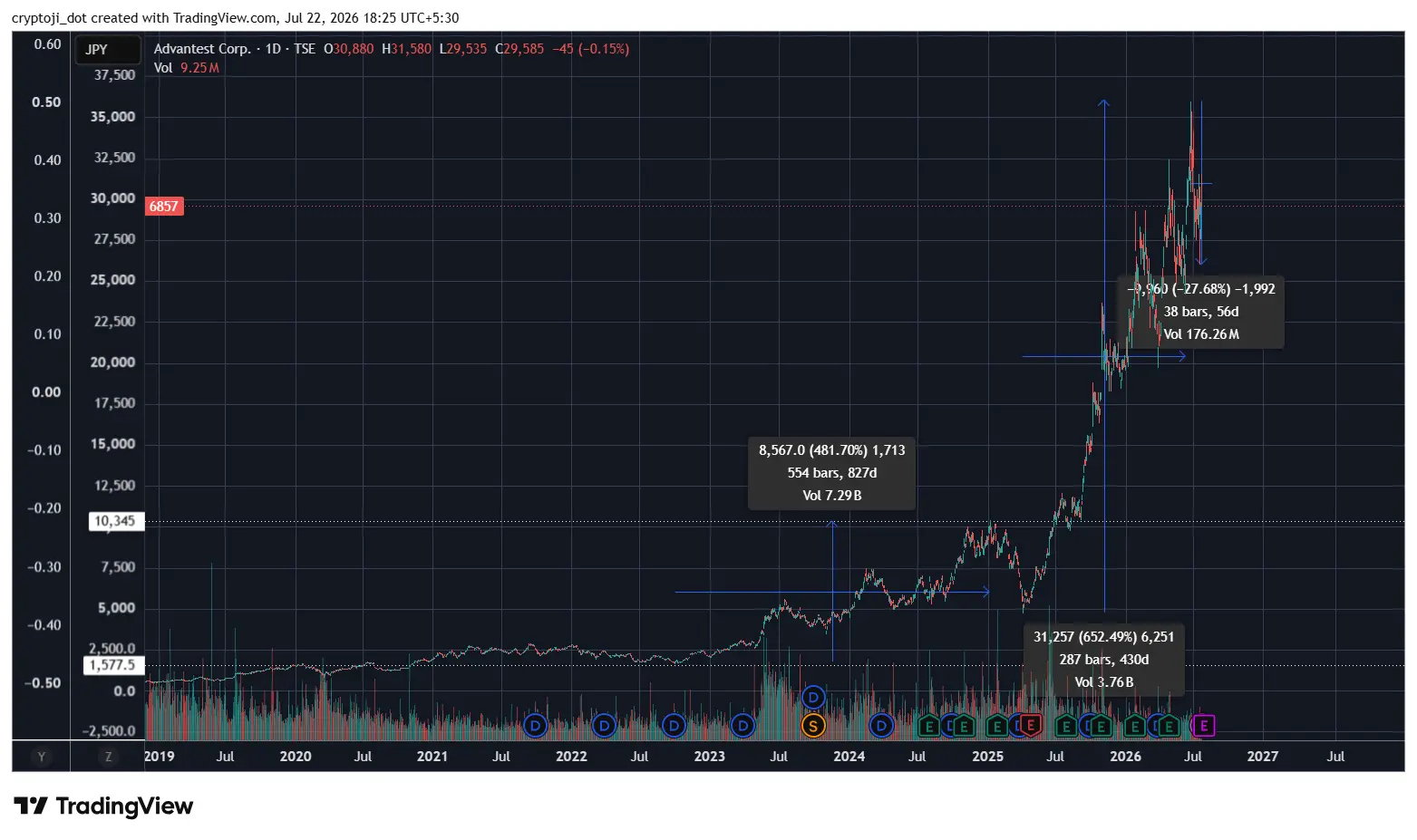
Advantest rose by 650% from 4,921 JPY on Apr 2025 to ATH of 36,050 JPY on June 2026. Stock has corrected 27% from ATH to 26,000 JPY at the time of writing.
Kioxia (285A) :
Kioxia produces memory storage components required by computer processors for performing AI functions smoothly, bearing load.
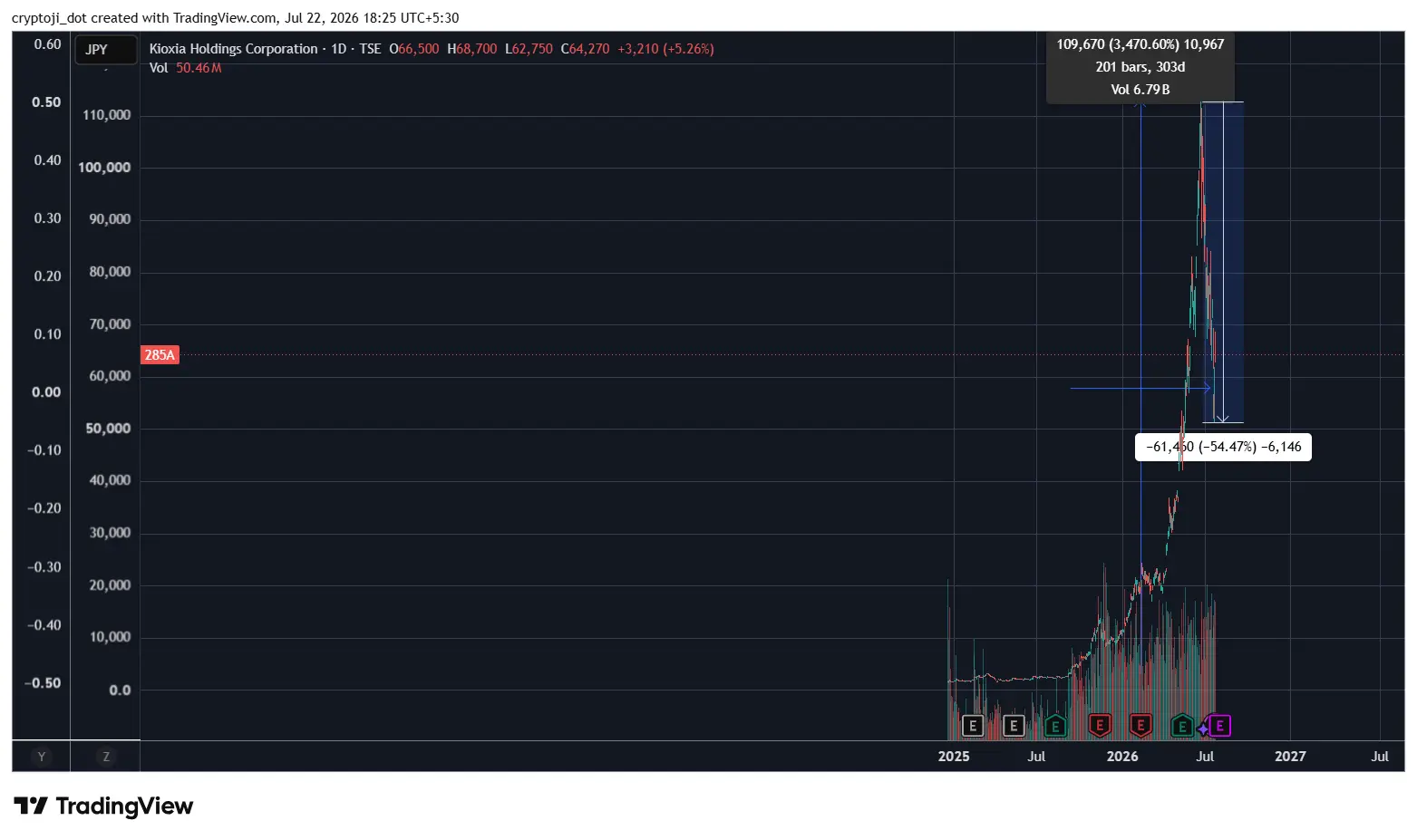
Kioxia stock price skyrocketed to over 3400% from its price of 3,377 JPY on Sept 2025 to ATH of 111,550 JPY in June this year. At the time of writing the stock has corrected by more than 50% to 50,590 JPY.
A majority of stocks that drove the performance of Nikkei 225 were of companies linked with AI, such as semiconductor segment stocks mentioned above.
The earnings of these companies also compounded due to export earnings with companies globally importing these equipments.
## Surplus earnings for exporting Japanese companies with depreciation of JPY
Japanese companies like Toyota, Honda in the automobile segment earn surplus revenues through exports. Japanese companies that earned revenues in USD through exports or through operations of their Global franchise outlets benefited due to depreciation of JPY against USD. This meant profits in USD translate to more Yen per USD earned. Depreciation of currency rewards exporters.
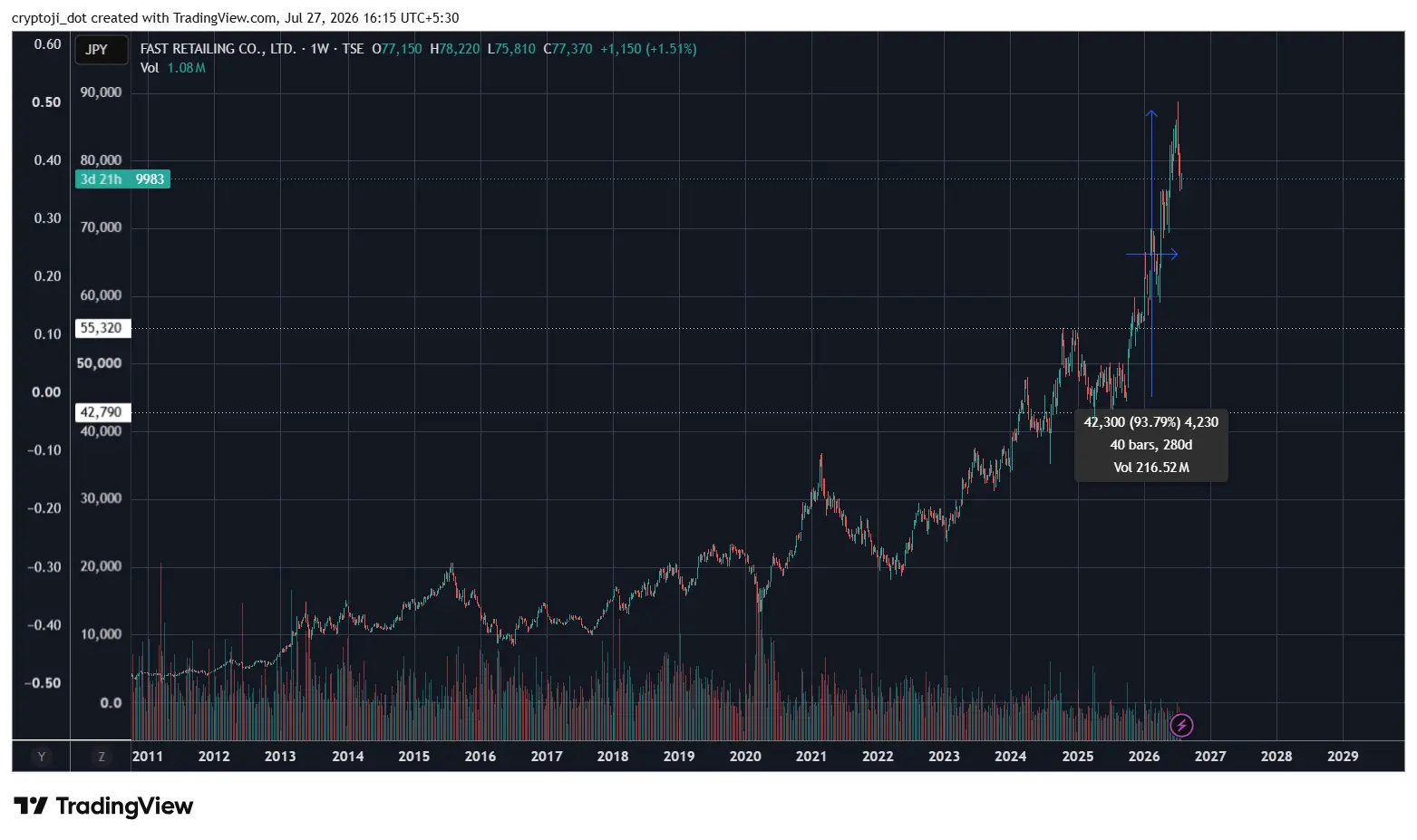
Fast Retailing (9983) surge of 90% since April 2025 was also due to the profit margins their UNIQLO International outlets earned through their global operations in Europe and North America. Fast Retailing deals in apparel business.
Factors that fuelled the surge in valuations of Japanese Benchmark Equity Indices
A significant portion of stocks that drove the valuation increase of Japanese Benchmark Equity Indices Nikkie 225 and Topix had were linked with AI, the AI Data Centre investment sphere was one of the factors leading to the Bull Run visible in these indices.
However, the foundation layer that prepared these Japanese Company stocks for valuation increases were the Corporate Governance reforms introduced by TSE.
Nikkie 225 is a price weighted index, its movements are influenced by stocks that have high value due to their share price. So, Nikkie valuation surge is dominated by few company stocks that have high value in terms of their stock price. It does not reflect the performance of company stocks belonging to broader markers.
Topix valuation is influenced by stocks based on their Market Capitalisation weight. Topix therefore better reflects performance of the broader Japanese Market.
More undervalued Japanese Stocks plays yet to rise with reform effects
The positive effects of Japanese Corporate Reforms may yet to be play out on company stocks belonging to industry categories beyond AI connected company stocks.
Investors may rotate their investments from AI play stocks to stock categories belonging to other business verticals.
There is scope for increase in stock prices of Japanese companies belonging to other industry sectors – banking, insurance, exporters, trading houses and other undervalued companies.
Japan’s change in Economic policy shifting to a positive interest rate regime
Japanese Financial Landscape underwent a major transformation when Japan shifted its policy from maintaining negative interest rate to keeping positive interest rates. Currently lending rates for Japanese Banks is at 1%. This improves Japanese Bank businesses on the lending front.
Is Japan’s Stock Market Bull Cycle to continue with new Stock plays?
Japanese Stock Market finally experienced a Bull Cycle after 35 years – post the Corporate Governance Reforms at a time when AI industry linked company stocks experienced exponential price surges.
So, a majority of stocks that lead this Bull Cycle in the early phase were stocks linked to semi-conductor segment, or computer peripheral segment who were part of AI industry supply chain
However, Japanese BenchMark Equity Indices have still got global investor attention, as Japanese Stock Markets are seen as lucrative space for investment, with their valuation still modest when compared to US BenchMark Equity Indices.
There is scope for other Japanese stocks from the broader Japanese Market listed in the Japanese BenchMark Equity Indices increase in value reaping the positive effects of the implemented Corporate Reforms.
The shares of AI linked companies have already surged high and may be near to entering a correction phase.
Such a correction phase in stocks of AI segment linked companies would significantly decline the valuation of Nikkie 225 and to a smaller extent Topix.
It would be interesting to track Nikkie 225 and Topix, monitor the momentum of these Stock Market Indices.
A question that would later be unravelled in time – will there be a second Bull Phase playing out in Japanese BenchMark Equity Indices driven by new stock plays?
My article can also be found in these platforms I post my content on-:
Hive — https://ecency.com/hive-150329/@mintymilecan
Publish0x — https://www.publish0x.com/@greenchic
Medium — https://medium.com/@kikctikcy
t2World — https://app.t2.world





