
After Neutron, other protocols are near to distribute and price their governance tokens in the Cosmos ecosystem. Mechanisms for identifying eligible wallets for airdrops are becoming increasingly sophisticated and require active involvement by beneficiaries. In this article I propose three new projects at different stages of development, two of which have adopted truly original airdrop modes. In the first case, distribution has already done, and the token is about to be listed. In the second, you can check whether you are eligible for the first batch of tokens. For the third project, the eligibility criteria have not announced.
Nolus
Nolus is a protocol that offers innovative leasing solutions for decentralized finance. Its users will be able to earn returns on deposited stablecoins or borrow them with up to 150% leverage on the value of the deposited collateral.
The network uses the Tendermint Core consensus and Cosmos SDK framework. Rust language and the CosmWasm module ensure its security and multi-chain compatibility. In addition, Nolus has adopted the Interchain Account (ICA) protocol by leveraging Osmosis, the main DEX AMM on Cosmos, as the host network. Through this implementation, every transaction on Nolus regarding swaps, liquidations, and liquidity pools will go through Osmosis protocol.
For the distribution of part of this layer-1 native token supply, the team conducted a Leasedrop in which selected Cosmos community members were able to participate. To take part in the Rila Testnet users had to hold an equivalent of at least $100 in staking for at least one of the following tokens: $ATOM, $OSMO, $JUNO, $STRD, $KUJI, $UMEE, $MARS, $CRE, $LUNA (snapshot as of March 15, 2023), or have the Nolus OG role on the Discord server.
By participating in the testnet and completing related quests on Nolus’ Zealy community, users thus selected were able to experience the full potential of the platform and help the team identify and fix bugs. After the leasedrop and the mainnet launch on May 23, testnet participants received $NLS in airdrop on the mainnet. Needless to say how useful this method of distribution can be for projects to get their product out there and test its acceptance before airdropping.
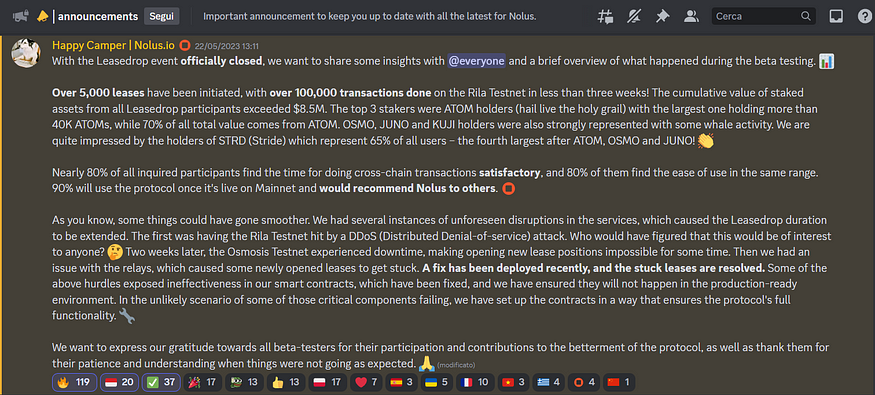
When the token will be listed and exchangeable on DEX, we will find out whether or not the beneficiaries of this slice of $NLS have enjoyed the platform. On June 13 on StreamSwap, Osmosis’ launchpad, the community-driven token launch event will start. The event consists of three phases:
- Bootstrapping phase, in witch participants will be able to deposit USDCs they wish to allocate for the NLS purchasing. Withdrawal is available at any time during this phase;
- Streaming phase, during which the deposited USDCs are spent linearly throughout the phase to purchase NLS. Withdrawal of only unspent USDC will be possible;
- Price, final phase in which the price is determinated based on the total USDC received at the end of the previous phase.
The entire event will last two days and anyone in possession of a compatible wallet and any amount of USDC (on Osmosis network or any other EVM or IBC network) can attend and try to grab the $NLS at the best possible price. If you missed the airdrop, this is another opportunity to enter the world of DeFi leasing from Nolus.
Nois
Let’s turn to a new project that proposes a truly unique way of distributing its token in airdrop. It’s Nois network, a PoS blockchain belonging to the Cosmos ecosystem allowing developers to use secure, unbiased, and cost-effective “randomness” via IBC. It is possible for any decentralized network and application, via special proxy, to adopt the randomness provided by Nois.
And it’s precisely randomness the protagonist of the network’s native token distribution method, $NOIS. Randdrop, as it has been called, introduces the “chance” factor into the distribution, allocating a larger amount of tokens to a subset of potentially eligible users. Thanks to the underlying technology, selection is mathematically unpredictable, unbiased and provable.
In this mechanism, addresses have a 1/3 probability of winning the randdrop and, thus, getting 3 times the amount for which they were eligible. By doing so, more hype is created around the distribution driven by the element of surprise. The amount earmarked for the first randdrop is 8M of $NOIS, or 4% of the total supply. To be eligible, users had to have in staking an equivalent of at least $4 in tokens on the networks:
- Injective: 4.1M of $NOIS allocated to $INJ stakers (snapshot May 23, 2023);
- Juno: 2.6M to stakers of $JUNO (snapshot May 22, 2023);
- Stargaze: 1.2M to $STARS stakers (snapshot May 20, 2023);
- Aura: 100K to $AURA stakers (snapshot May 24, 2023).
A cap on staking positions has been set at $40K, which means that a wallet holding 40K in staking will get the same amount as one holding, say, 150K. In the dedicated article, you can check if you are eligible but be careful: you will only get the airdrop if you win the Randdrop! If you are not drawn, you will not receive any amount of $NOIS, even if you are eligible.
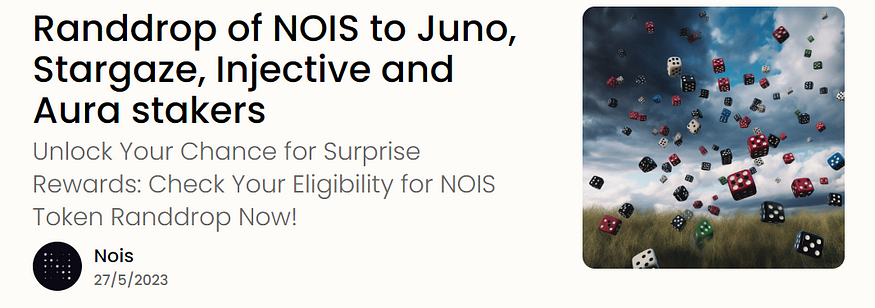
You may or may not like this distribution mechanism, but it certainly fulfills the goals identified by the team: instead of having a broad spectrum of beneficiaries receiving paltry amounts, a third of the eligible addresses will receive a substantial amount in airdrops, with the “chance” factor generating more anticipation and attention around the randdrop (and thus the project).
Lastly, it is useful to specify that this is only the first batch of randdrops scheduled for Nois, the next ones will reward stakers from other networks such as, could be, Kujira, Osmosis, Desmos or others that the community would like to propose. So even if you do not have active staking positions in the first four networks identified, all is not lost.
NEXX GEN AI
Nexx GEN AI has the ambitious goal of implementing a decentralized exchange aggregator, decentralized finance hub and NFT marketplace on the Juno blockchain. The platform will offer users artificial intelligence-driven trading algorithms, as well as farming tools and other features to maximize profits in crypto trading while minimizing risk.
NEXX, the platform’s native token, will have a maximum supply of 888M, which will be reduced by burning 5% of each transactions. An additional 5% of each transactions will be distributed to token holders to incentivize long-term loyalty to the platform. There is not much news yet about this new protocol, but a tweet on the Nexx Gen AI profile seems to indicate that there will be an airdrop.
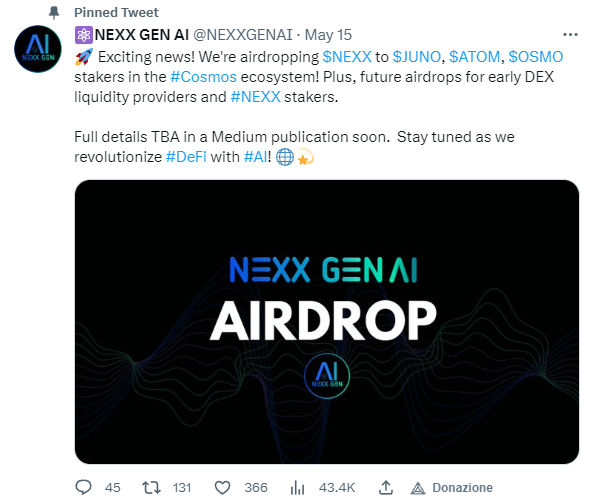
Although more details about the snapshot and criteria have yet to be announced, we know that to hope to be eligible we will have to have at least $JUNO, $ATOM, or $OSMO in staking. It will be interesting to see what distribution methods this project will adopt.
Conclusions
Airdrops continue to play a key role in the attractiveness of the Cosmos ecosystem, and protocols are developing increasingly articulate methods to get beneficiaries excited about the project. Staking, in addition to voting on governance proposals, is confirmed as a winning practice for falling within the eligibility criteria set by nascent protocols (as well as generating excellent APRs, even in a bear market).
Good luck, Cosmonauts!
This article was originally published here.
Sources:
https://docs.nois.network/what_is_nois.html
Follow me on Twitter: @ifiwasfrank
Buy me a coffee on ifiwasfrank.strk






