
When it comes to criticizing Bitcoin or the cryptocurrency industry, politicians, bankers, economists, and the media are the first to come running to the door. On the other hand, when it comes to informing you about money laundering scandals within the banking system, you will hear from far fewer people.
It is indeed more convenient for these powerful people of the current system to criticize Bitcoin than their system which they try to protect at all costs.
So I'll try to quickly bring to light what happened with Danske Bank. Danske Bank just pleaded guilty to fraud in the United States and agreed to pay more than $2 billion to turn the page on the massive money laundering scandal that had come to light in 2018.
According to a statement released Tuesday evening, December 13, 2022, by the U.S. Department of Justice (DoJ), the Danish banking institution “accepted responsibility for defrauding U.S. financial institutions and funneling billions of dollars in suspicious and criminal transactions through the United States. As part of its guilty plea, Danske Bank will forfeit over $2 billion and implement significant changes to its compliance program and AML controls. This coordinated resolution with the Securities and Exchange Commission (SEC) and Danish authorities sends a clear message that the Department of Justice stands ready to work with our partners around the world to investigate corporate wrongdoing and hold bad actors accountable for their criminal conduct.”
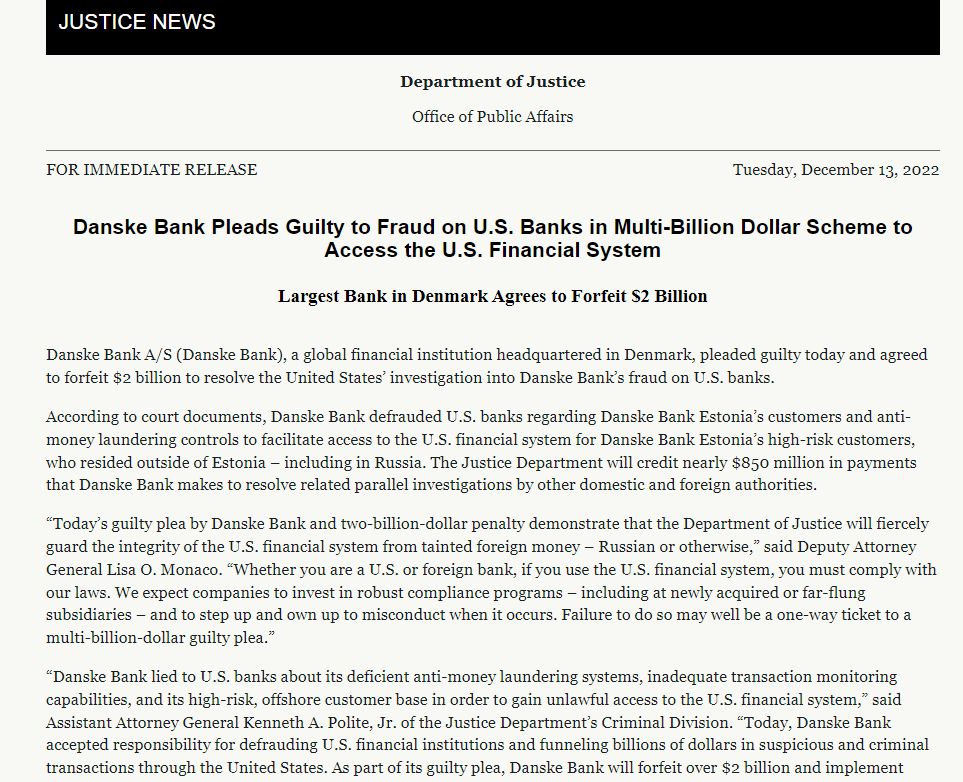
Of the $2.06 billion in monetary fines against the Danish bank, the DoJ will pay $850 million to other U.S. and Danish authorities that have brought cases against Danske Bank.
The role of the Estonian subsidiary was pointed out
Between 2008 and 2016, Danske Bank allowed its Estonian subsidiary to develop a lucrative business allowing clients residing in other countries, including Russia, to transfer large sums of money by guaranteeing them access to the financial system of the world's largest economy. In the name of an offshore clientele, the Estonian subsidiary of Danske Bank has transferred 160 billion dollars through American banks, according to the press release.
In this fraudulent scheme, the Estonian subsidiary of Danske Bank acted “with little or no oversight,” according to the DoJ, which refers to the proceedings.
Some employees of its Estonian subsidiary “conspired with offshore clients to disguise the true nature of their transactions, including using shell companies to hide the true ownership of funds.” When it emerged, the scandal had caused a shake-up of Danske Bank's staff. The Danish bank has since been working to improve its compliance with anti-money laundering laws and has closed its subsidiaries in the Baltic States and Russia.
In addition, the Securities and Exchange Commission (SEC) announced that it has reached an agreement with Danske Bank to terminate a parallel but separate proceeding. According to a statement from the U.S. Securities and Exchange Commission, Danske agreed to pay $413 million to close the case. According to the SEC's charges, when Danske Bank acquired its Estonian subsidiary in 2007, it knew or should have known that a significant portion of its customers was engaging in transactions that posed a “high risk of money laundering,” and that its internal control procedures were not adequate to prevent such conduct.
No surprise or disappointment if you're a Bitcoiner
When reading about the resolution of this money laundering scandal related to Danske Bank, you should not be surprised or disappointed if you are a Bitcoiner like me. You have already understood that the opacity of the current banking system was perfect to give free rein to the inherent penchant of humans for corruption. Their greed does the rest.
While politicians keep trying to convince the general public that Bitcoin is dangerous because it is decentralized, you can see that the opposite is true. If Bitcoin is a pseudonymous network, the movements of funds are not transparent: they are visible to everyone at all times. This makes Bitcoin a trap for criminals, which is why you won't see a scandal as big as the Danske Bank scandal happening on the Bitcoin blockchain.
Only low-level thugs will make that mistake, but they will be quickly exposed. The biggest money launderers and fraudsters rely on the current opaque and centralized banking system. That's why Bitcoin's decentralization is a solution rather than a problem, as the powerful people in the current system would have you believe.
The next time someone tells you that Bitcoin is used to launder money, remember the latest case: Danske Bank. The latest, but unfortunately not the last, because the opacity of the current banking system is such that more cases like this will come to light in the future.
Some reading
-
Banks Have Received Over $332B in Penalties Since 2000 — Bitcoin Is a Necessity for the People. The opacity of the banking system is dramatic for the people.
-
Bitcoin’s SHA-256 Algorithm Gives You More Guarantees Than Any Bank in the World. It abstracts you from the corruption to which humans always give in.
-
The Real Reason Why Governments, the World Bank, the IMF, the Fed, or the ECB Falsely Denigrate Bitcoin. Fight against terrorism? Arms or drug sales? Climate change? The reason is quite different!
-
German Bank Raiffeisen Bank Puts an End to Cash — One More Reason, If Needed, to Opt for Bitcoin. The dystopian world of mass surveillance is taking shape before our eyes every day.
-
To Fight Against a Corrupt and Flawed Banking System, Bitcoin Is Your Only Weapon. The example of Esther Freeman, whose bank is blocking her funds from her investment in Bitcoin, is the latest in a long line of abuses.





